
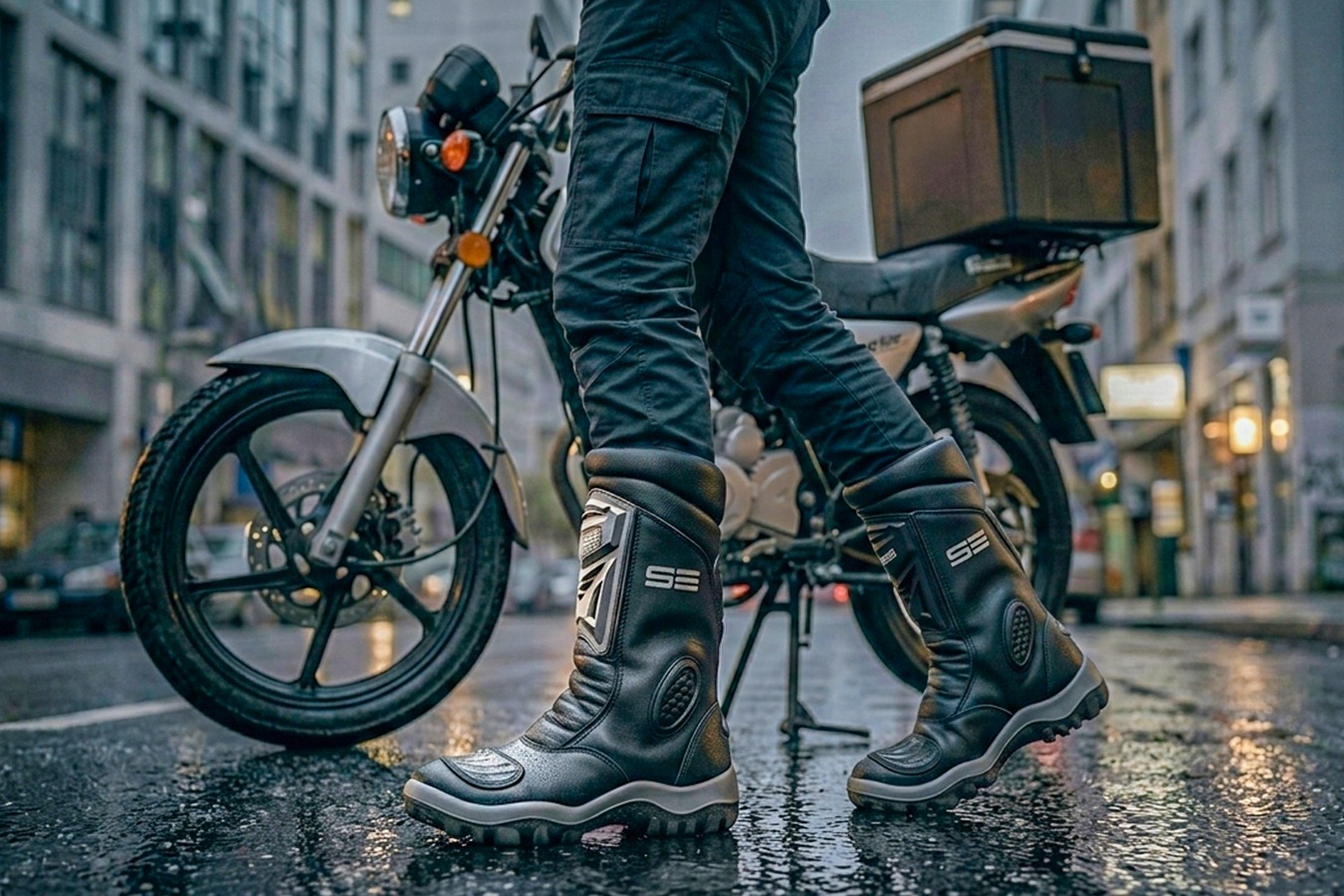
The motorcycle courier and the motorcycle rider in the service of the company are workers covered by Regulatory Standard No. 6. In this context, footwear ceases to be a style accessory and becomes part of the mandatory Personal Protective Equipment for lower limbs. NR6 conditions its validity on a current Certificate of Approval (CA), issued by the competent body, without which there is no recognized legal compliance.
A boot sold in a leisure motorcycling store, no matter how robust it seems, does not replace certified footwear when the route is a work shift.
Many fleet managers only realize the failure when it is too late: the PPE they purchased does not have a valid CA and, during an inspection, does not protect the company.
This article separates what the standard requires from what the motorcycle retail market offers, and shows how to choose the right boot by activity.
What NR6 requires from safety footwear for motorcyclists
NR6 is the regulatory standard that defines Personal Protective Equipment and obligates the employer to provide free of charge the PPE appropriate for the risk of each role.
For the motorcycle rider in the service of the company, footwear is included in this list as protection for lower limbs. It is not a suggestion, nor a courtesy: it is a legal duty, and the item must be certified.
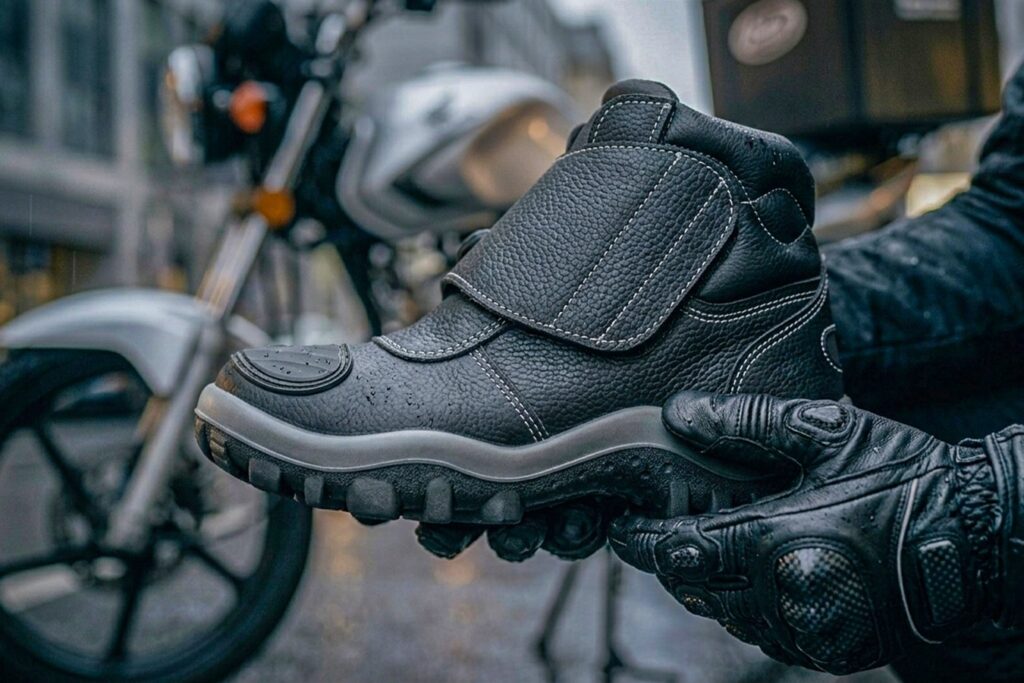
The definition of PPE and the role of the Certificate of Approval (CA)
NR6 defines PPE as any device of individual use intended to protect the physical integrity of the worker. For footwear to be recognized as PPE, it requires a Certificate of Approval (CA) issued by the competent body.
The CA is the number that proves that the model has undergone laboratory testing and meets technical requirements. Without the CA, the footwear may even protect in practice, but it has no legal value as PPE.
What does the standard treat as mandatory protection for the feet?
Foot protection covers the risk of impact, puncture, thermal agents, and slipping. In the context of those who ride all day, the motorcycle safety boot must respond to falls, contact with hot exhaust, and uneven ground.
The employer selects the model according to the risk analysis of the activity. The correct PPE is not defined by the supplier alone: it is the intersection between the job role assessment and the product certification.
Why does the professional motorcyclist fall under the logic of occupational risk?
Motorcycle couriers, delivery riders, and professionals who travel by motorcycle for work are exposed to risk throughout their entire shift. The exposure is continuous, not occasional.
This changes the manager's perspective. It is not about protecting someone who rides a motorcycle for leisure, but rather about equipping an employee whose work routine takes place on two wheels. The legal responsibility falls on the company that benefits from this travel.
Ignoring this point exposes the organization to fines and labor liabilities in the event of an accident.
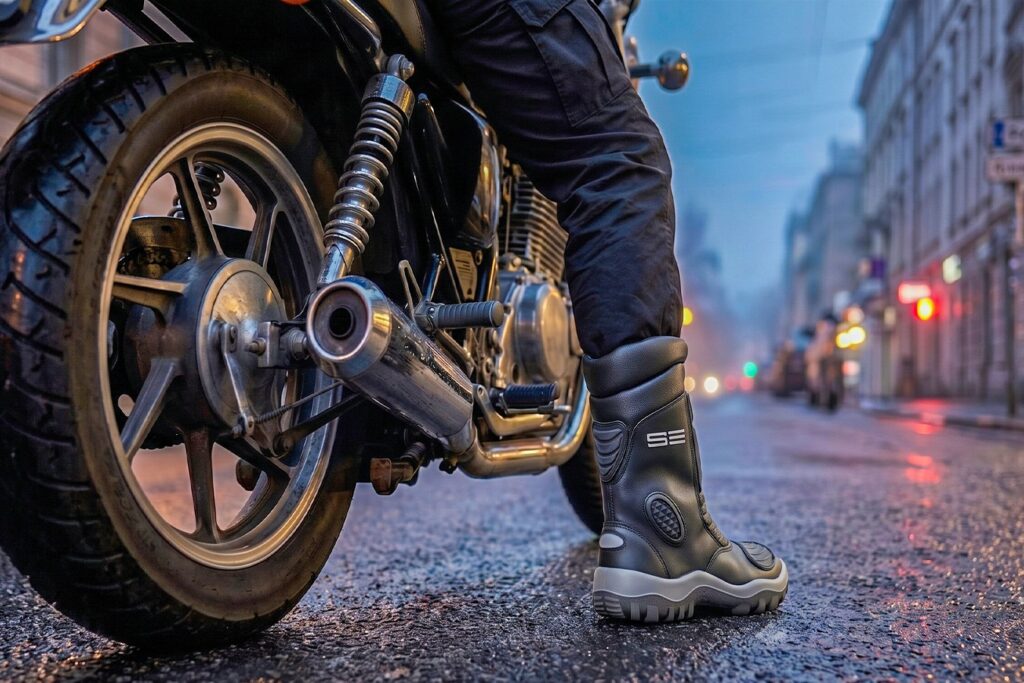
The boundary between a common motorcycle boot and certified safety footwear
This is where the most common confusion occurs. Boots sold in leisure motorcycling stores usually prioritize aesthetics and off-road performance, but rarely possess a valid CA for occupational use.
A model developed as PPE, on the other hand, undergoes compliance testing and carries the CA. It is this certification that transforms the item into one accepted by labor inspectors.
For the fleet manager, the difference is objective. A Safetline motorcycle boot designed for the professional segment delivers proven protection and documentary support, something a leisure boot does not offer.
The choice, therefore, begins before comfort or price: it begins with the question of whether that footwear is, in fact, a PPE recognized by the standard.
Real occupational risks of those who work on two wheels
Before defining a footwear model, the manager must map out what the rider faces during the shift. The choice of PPE stems from the risk, not from the catalog. And the risk for those who work on two wheels is very different from the risk for those who operate inside a factory.
Below are the four risk groups that most impact the motorcycle courier's lower limbs.
Impact and compression in falls and collisions
A fall is the most common and serious event. In a side fall, the weight of the motorcycle itself falls on the rider's foot and ankle. Without a resistant safety toe cap and reinforced structure, crushing is immediate. Collisions with curbs, barriers, and other vehicles worsen this scenario.
Exposure to heat, friction, and fuel
The exhaust pipe reaches high temperatures and is just a few inches from the leg. Brief contact can cause a second- or third-degree burn.
Combine this with the friction of the skin against the asphalt during sudden braking, known as abrasion, and potential contact with spilled fuel. These are three distinct agents requiring materials that resist each of them.
Ankle stability and high-top design
The motorcycle courier places their foot on and off the ground dozens of times per hour, during stops, maneuvers, and traffic lights. This repeated movement, combined with the weight of the motorcycle, takes a toll on the ankle.
A high or mid-cut shaft locks the joint and reduces the risk of sprains. Low-cut footwear leaves this region completely unprotected.
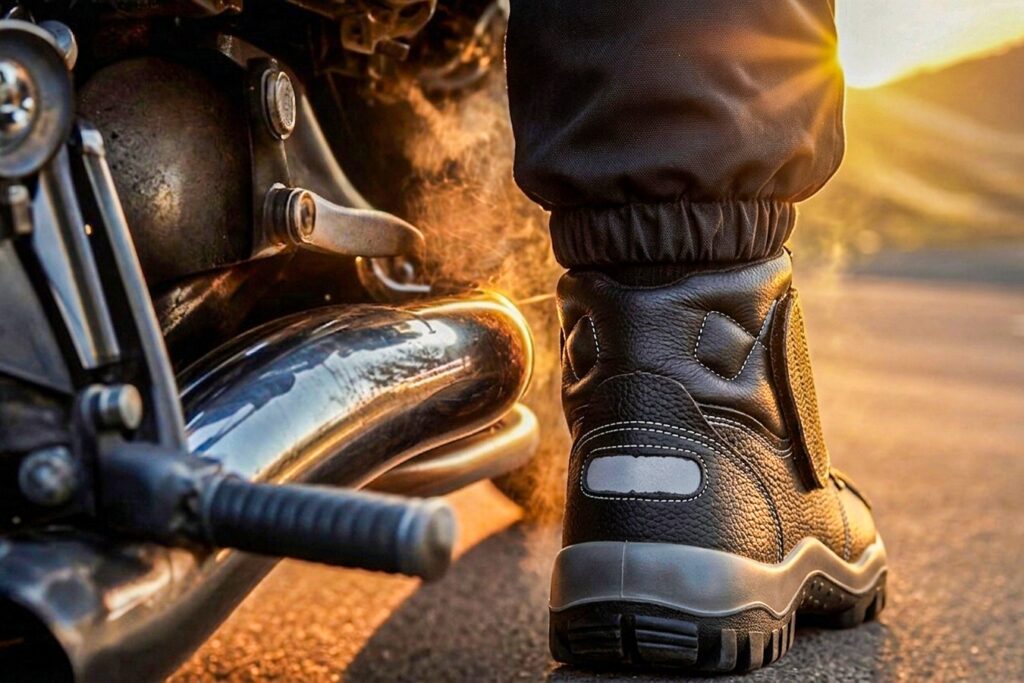
Uneven ground, moisture, and slippery surfaces
Potholes, manhole covers, oil on the road, and rain are part of the routine. The rider puts their foot down without seeing exactly where they are stepping. A slip-resistant outsole with good grip on wet surfaces prevents the slip that precedes many falls.
For each of these risks, there is a technical response: the safety toe cap withstands the impact, the right material tackles abrasion and heat, the shaft stabilizes the ankle, and the outsole ensures grip on the ground.
It is this analysis that separates the appropriate PPE from generic footwear, and it is what guides the criteria for the next stage.
Technical criteria for choosing the right boot by activity
Mapping the risk, the next step is to translate each threat into an objective technical requirement. Good footwear is not the most robust of all, but the one that balances protection, comfort, and durability for the rider's actual activities.
See how to compare models without being limited to aesthetics or showroom appeal.
Shaft height and ankle protection
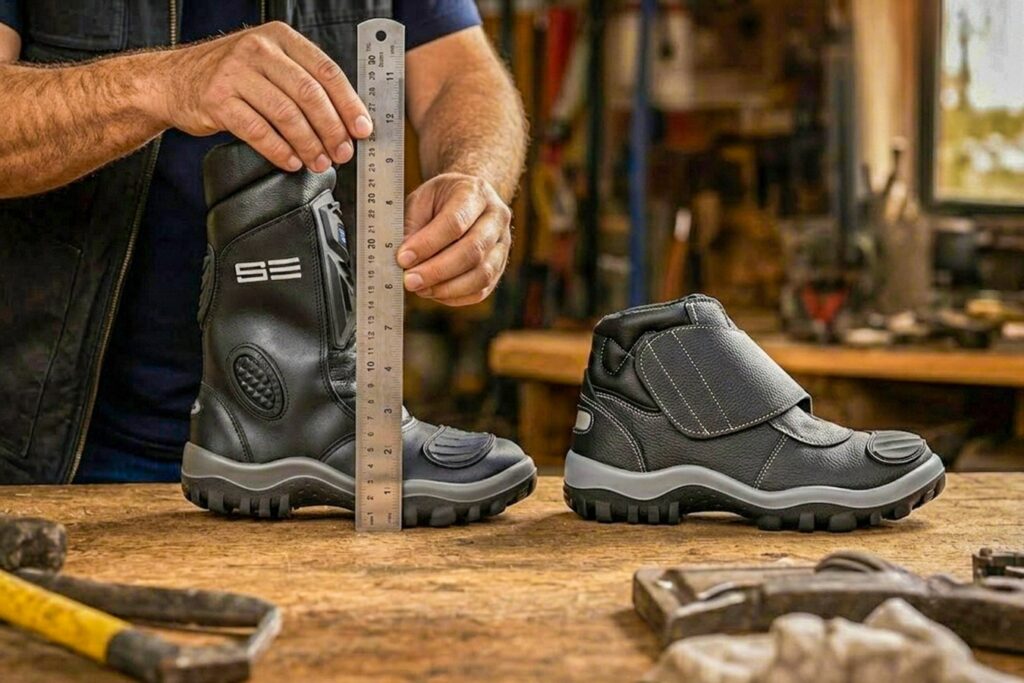
The ankle is the most exposed joint in a side fall. Therefore, a high or mid-cut shaft is not a minor detail: it is a barrier against sprains and direct contact with the asphalt and the hot exhaust pipe.
For intense urban routes, a mid-cut shaft usually delivers sufficient mobility without sacrificing coverage. On the other hand, long routes or irregular terrain require a higher shaft and reinforcement in the ankle area.
Slip-resistant outsole and friction resistance
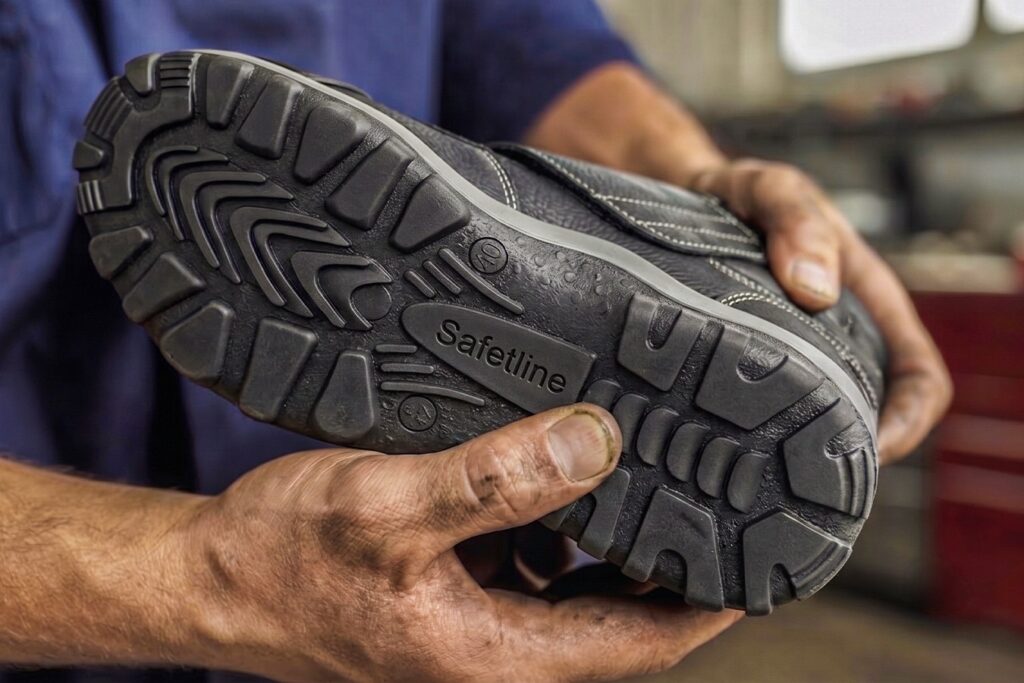
The rider places their foot on the ground at every stop, often on wet, oily, or uneven surfaces. The outsole must offer reliable grip under these conditions.
Verify the slip resistance and resistance to friction from abrasion. An outsole that wears out quickly loses traction and becomes a silent risk in the fleet.
Materials that combine durability and comfort during the shift
Treated leather and microfiber offer greater resistance to abrasion while maintaining a controlled weight. Outsoles with a longer lifespan reduce the frequency of replacement, and this superior durability results in a lower cost per pair over the contract period.
For companies, this represents fewer replacements, fewer operational interruptions, and greater budget predictability, reducing the total cost of safety footwear.
In addition to durability, comfort also exerts a direct influence on results. Footwear that causes discomfort during the work shift tends to be used improperly or even cast aside. And a PPE that is not used correctly does not fulfill its main function: to protect the worker.
How the CA guides purchasing and delivery to the team
The Certificate of Approval (CA) must be the first criterion when choosing safety footwear. It is what proves that the equipment has been tested and approved to protect against specific risks, ensuring compliance with current standards and avoiding the acquisition of models that, although they look good, do not meet legal requirements.
Before closing a purchase, consult the CA number in the public database of the competent body and verify if the certificate is active, in addition to confirming if the intended use corresponds to the risks present in your operation.
At Safetline, all footwear for professional use is developed following this principle: combining certified protection, legal compliance, and comfort to meet the needs of those who spend their entire shift on the move.
Manager's responsibility: delivery, registration, and inspection
Providing the right boot is half the job. The other half is documenting every step and ensuring that the rider uses the equipment as they should. Many managers stumble precisely at this stage because they treat PPE as a one-time purchase, rather than a continuous management process.
NR6 is clear about this: it is up to the employer to require use, guide the employee, record the delivery, and replace the damaged item. Failure at any stage transfers liability to the company in the event of an accident.
PPE record sheet and proof of delivery
Every delivery must be recorded. The PPE record sheet documents which footwear was provided, the date, the Certificate of Approval (CA) number, and the worker's signature. This document is proof that the company fulfilled its legal obligation.
Without this proof, the delivery simply does not exist from the perspective of labor inspectors. Keep records organized and update them whenever there is a change of model.
Training on use and maintenance
Delivering the boot is not enough. The rider needs to know why that footwear is mandatory, how to wear it correctly, and how to maintain it. Simple training reduces resistance to use and extends the product's lifespan.
Explain objectively: the slip-resistant outsole only protects if it is clean, and the high shaft only performs its function if the boot is securely fastened during the ride.
Replacement due to wear and footwear lifespan
All safety footwear has a lifespan. A worn outsole, open seams, structural deformations, or damage to the ankle protection are signs that the equipment no longer offers the expected level of protection. Therefore, it is essential for the company to establish periodic inspection criteria and replace the footwear before its protective capacity is compromised.
In addition to increasing worker safety, this practice contributes to more efficient cost management. Footwear manufactured with high-resistance materials and greater durability requires fewer replacements over time, reducing the total cost per employee without compromising protection.
The motorcycle models from Safetline are developed to withstand intense shifts and demanding work environments, providing longer lifespan, comfort, and performance throughout the entire period of use.
What do inspectors look for in practice?
During an audit, three fundamental aspects are typically verified: whether the PPE has a valid Certificate of Approval (CA), whether there is a signed delivery record, and whether the worker is using the equipment correctly during their activities. When these three requirements are met, the company achieves compliance with legal demands.
However, compliance goes beyond documentation. Adherence to PPE use depends directly on the comfort offered by the footwear. A model that causes discomfort, excess weight, or limits mobility tends to be used improperly or even cast aside. Investing in footwear that combines protection, ergonomics, and comfort is essential to ensure that the equipment is effectively used and fulfills its function of protecting the worker.
From the standard to the rider's foot: your next move
At this point, theory turns into a purchasing decision. You may have started this text treating the motorcycle courier boot as an accessory, and now you understand that it is mandatory PPE under NR6, with the same legal weight as any protection used inside the factory.
If there is anything to take away from this reading, it is three points. Certification is non-negotiable: without a valid Certificate of Approval (CA), there is no compliance, no matter how robust the boot looks in the window.
It is the risk that defines the model, and not the aesthetic appeal of leisure motorcycling: the shaft, slip-resistant outsole, and ankle protection respond to the rider's actual shift. And, finally, adherence depends on comfort, because uncomfortable footwear is footwear abandoned in the middle of the shift, and then protection ceases to exist in practice.
The next step is simple: find out today how many boots in your fleet have an active CA and cross-reference that number with the total of active riders. This spreadsheet will reveal your legal exposure in minutes.
The superior durability of Safetline footwear reduces replacement frequency, which lowers the cost per rider throughout the year and supports the standardization of the entire fleet.
A certified boot is not an expense. It is what keeps the fleet in compliance and prevents labor liabilities from accumulating without anyone noticing.
To equip your motorcycle couriers with protection that resists abrasion and complies with NR6, discover our line of certified industrial footwear and align compliance with real cost-benefit.
Frequently asked questions
Does a motorcycle boot need to have a CA to be used at work?
Yes. When the rider operates in the service of the company, the footwear is PPE and must possess a valid Certificate of Approval (CA), issued by the Ministry of Labor and Employment. Without a CA, the item has no legal compliance and does not cover the employer's liability. Leisure motorcycling boots, sold in motorcycle shops, generally do not have a CA and do not meet NR6.
Does NR6 obligate the company to provide boots for motorcycle couriers?
Yes. NR6 determines that the employer must provide free of charge the appropriate PPE for the risk of the role. For the motorcycle rider in the service of the company, protective footwear for lower limbs falls under this obligation. In addition to providing it, the company is responsible for training on its use, requiring its use during the shift, and replacing the equipment when damaged.
How to check if a boot's CA is valid?
The check is done on the official website of the Ministry of Labor and Employment, on the Consulta CA page. Simply enter the number printed on the footwear. The system shows the validity, the manufacturer, and the risks the equipment protects against. If the CA is expired or not listed, the item cannot be used as legalized PPE.
What is the difference between a leisure motorcycling boot and certified safety footwear?
Leisure motorcycling boots are developed with a focus on performance, comfort, and style for riding, but they are not certified as PPE. On the other hand, safety footwear is certified, has a valid CA, and offers specific protection for occupational risks, such as abrasion resistance, ankle protection, and a slip-resistant outsole. In professional activities covered by NR-6, only the certified model meets legal requirements.
What characteristics should a boot for a motorcycle courier have?
The model must combine a high or mid-cut shaft for ankle protection, abrasion resistance against sliding in falls, a slip-resistant outsole for ground support, and comfort for long shifts on the move. Protection against burns from contact with the exhaust pipe is also relevant. Each criterion must stem from the actual risk of the activity, not from the visual appeal of the product.
Is the employer responsible if the motorcycle courier does not wear the boot?
Yes, largely. NR6 establishes that the employer must require use, guide the employee, and inspect the use of PPE during the shift. Providing it without enforcing its use does not exempt the company. Therefore, the delivery record, documented training, and continuous inspection are mandatory steps in safety management, not optional formalities.
Is it worth investing in a more durable boot for the fleet?
For managers who buy in volume, durability directly impacts the cost per rider throughout the year. Footwear that resists abrasion and intense use longer reduces replacement frequency and the total cost of the fleet. In addition to the unit price, evaluate the actual lifespan of the product, as this defines the true cost-benefit ratio.