
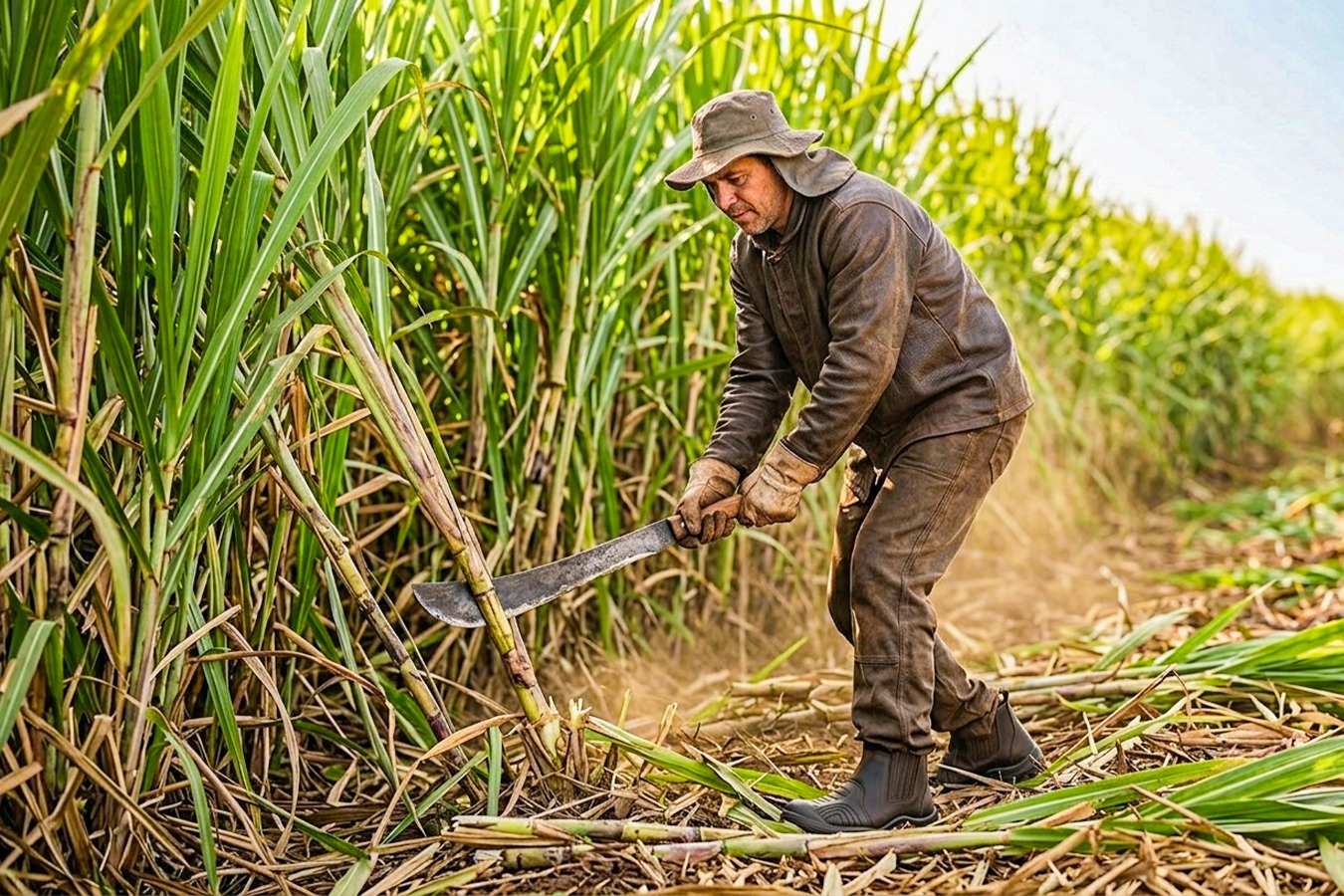
The sugar cane safety boot is the safety footwear designed for cutting and handling sugar cane in an environment that combines sharp straw, uneven terrain, exposure to soot and fertilizers, as well as long shifts under the heat.
\n\nIt is distinguished from standard models by reinforced features: metatarsal guard, resistant leather, mid or high shaft, slip-resistant dual-density outsole, anti-torsion bar, and steel safety toe cap. Its function is to neutralize specific risks of the sugar cane field and sustain productivity throughout the harvest.
\n\nIn the sugar and alcohol sector, inadequate safety boots compromise entire batches throughout the harvest. When the safety boot has a short lifespan, replacement becomes a recurring expense, and the actual cost rises without the buyer realizing it.
\n\nThis guide shows what technically differentiates a proper sugar cane safety boot and how to evaluate this choice with volume purchasing predictability.
\n\nWhat is the Sugar Cane Safety Boot and why does it exist?
\n\nThe sugar cane safety boot is safety footwear developed for cutting and handling sugar cane, bringing together requirements that go beyond simple foot protection. It combines resistance against blades and sharp straw, tolerance to contact with sucrose, an outsole with traction for uneven terrain, and comfort elements for long shifts.
\n\nUnlike a standard safety boot, it is born for a hostile environment that punishes the worker's materials and joints every day.
\n\n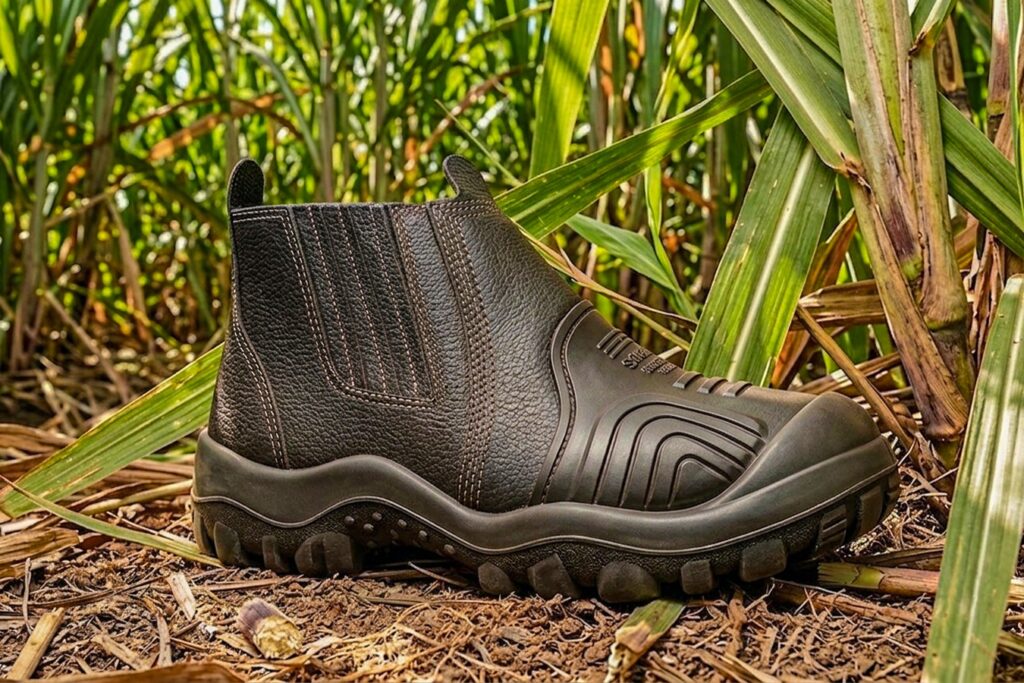
Technical definition of footwear for the sugar and alcohol sector
\n\nFrom a technical standpoint, the sugar cane safety boot is a Personal Protective Equipment (EPI) with a valid Certificate of Approval (CA), developed to protect feet against mechanical risks, such as cutting, puncture, and slipping, common to activities carried out in the sugar cane field.
\nIts structure combines a high or mid shaft, higher resistance leather, slip-resistant outsole, metatarsal protection, and protective systems such as a safety toe cap and anti-torsion bar.
\nEach element meets a specific field work condition. Unlike standard work footwear, the sugar cane safety boot combines features aimed at protection against the different risks present in the daily routine of the sugar and alcohol sector.
\nDifferences in requirements between sugar cane cutting and other rural activities
\n\nNot every rural activity imposes the same load on footwear. Manual sugar cane cutting with a billhook places the worker in direct contact with the risk of the blade, rigid leaves, stumps, and soil furrows, often under intense sun for hours on end.
\n\nThis combination requires more than a general-use safety boot. Uneven terrain increases the risk of ankle sprains. Dry, sharp straw, combined with sucrose, wears down the leather at an accelerated pace.
\n\nSoot from burning and fertilizers attack fragile materials. In other words, the sugar cane field concentrates several aggressive factors at the same time, and it is this concentration that justifies footwear designed for the sector.
\n\n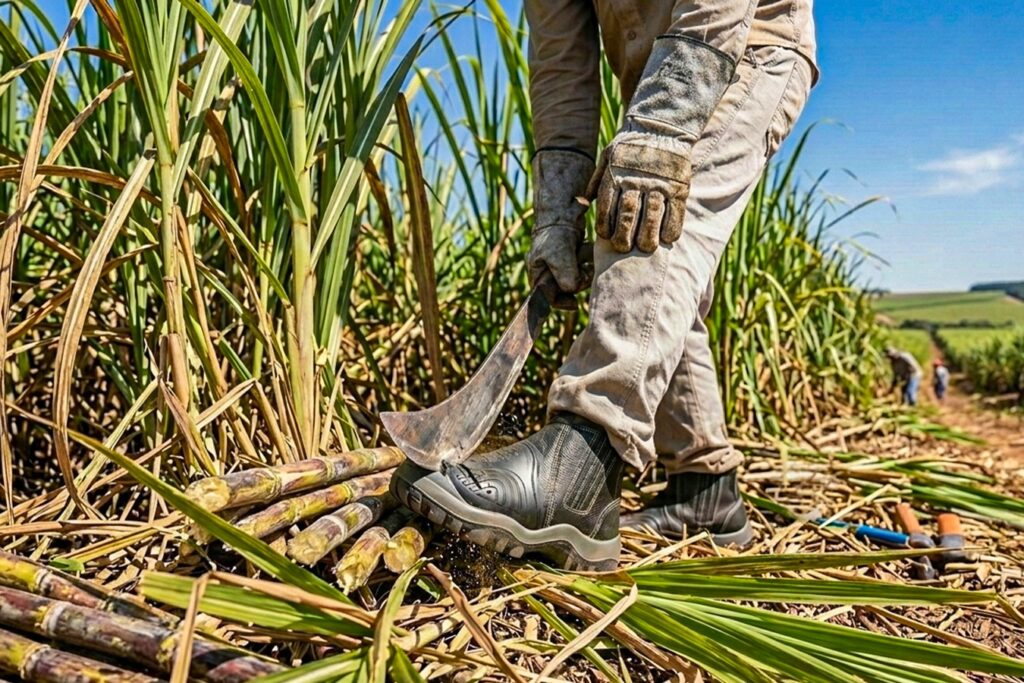
Typical occupational hazards of the sugar cane field that shape the product
\n\nSome risks appear frequently and help explain why this category exists:
\n\n- \n
- \n
- \n
- \n
- \n
- Cuts and punctures caused by the blade, rigid straw, stumps, and harvest residues. \n
\n
- \n
- \n
- \n
- Twists and sprains caused by uneven ground and furrows. \n
\n
- \n
- \n
- \n
- Slipping on wet ground, with mud or vegetation cover. \n
\n
- \n
- \n
- \n
- Fatigue in long shifts, when the outsole does not cushion the impact. \n
\n
- \n
- \n
- \n
- Premature degradation of the leather by sucrose, heat, soot, and chemical agents. \n
\n
In practice, these are the factors that determine which features the product must combine to last and protect. For a plant buyer and the Occupational Health and Safety (SESMT) team, understanding this functional origin changes the acquisition logic.
\nThe sugar cane safety boot stops being an off-the-shelf item chosen by the lowest price and becomes a technical decision, linked to team safety, the durability of high-quality brands, and replacement predictability. The next sections detail each risk and specification that support this choice.
\n\nSugar cane field risks that the footwear needs to neutralize
\n\nEach design requirement of a sugar cane safety boot is born from a concrete field risk. Before comparing specifications, the manager needs to map out what threatens the worker's foot during cutting and handling.
\n\nWith this map in hand, the purchase of EPI becomes based on technical criteria, and not just price. It is worth looking closely at the four most relevant risk groups and the protection requirement that each one imposes.
\n\nPuncture by sugar cane residues and irregular soil
\n\n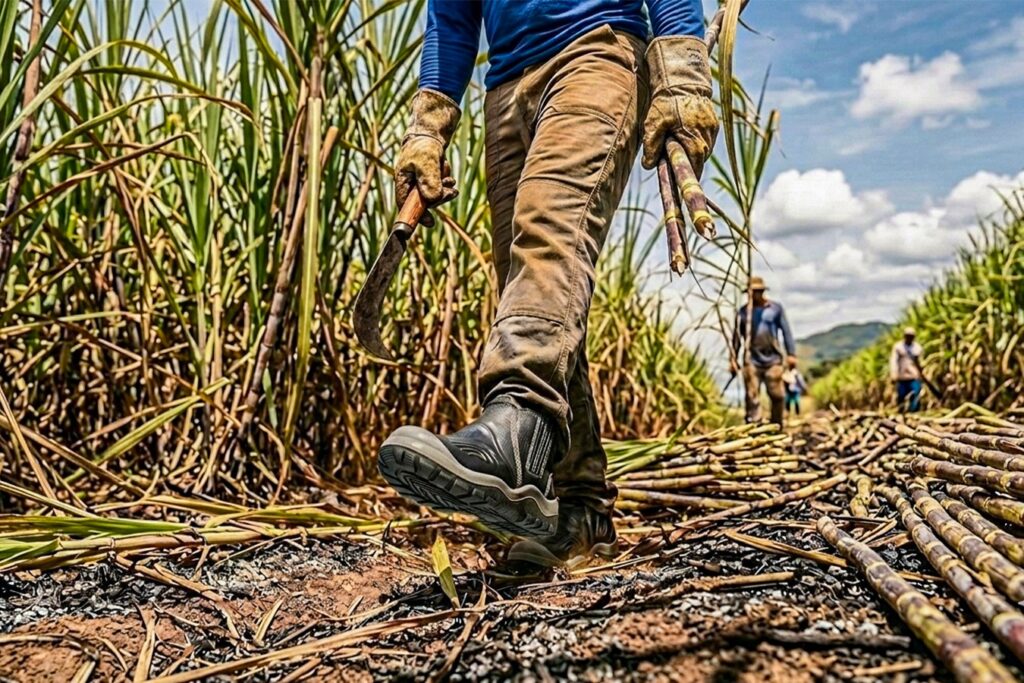
The sugar cane field leaves cut sugar cane stumps, exposed roots, and stones along the path. The worker steps firmly on unstable or uneven terrain, subject to different obstacles throughout the shift.
\nThis requires two responses from the footwear: an outsole with a puncture-resistant protective insole and an anti-torsion bar that stabilizes the ankle. Without this structure, a misstep can result in a sprain or puncture of the sole.
\nMoisture, mud, and dry-wet alternation
\n\nThe shift alternates between sun-dried soil and waterlogged stretches from irrigation or rain. This variation attacks the leather and compromises grip.
\n\nThe sugar cane safety boot needs to have moisture-resistant treated leather and a slip-resistant dual-density outsole to ensure durability and safety. The leather prevents water absorption, which accelerates wear and creates unhealthy conditions, while the outsole ensures traction on both dry and wet ground. The absence of these requirements hastens footwear replacement and can generate labor issues, making it essential to invest in high-performance materials.
\nCutting by machete and harvesting tools
\n\nThe use of a billhook and machete repeatedly brings the blade close to the feet in tiring movements, increasing the chance of an accident throughout the shift. This predictable risk makes the use of safety boots with reinforced cut protection indispensable, as fatigue and repetition inevitably increase the probability of occurrences.
\n\nThe protection of the sugar cane safety boot depends on the metatarsal guard, internal or external, the impact-resistant steel safety toe cap, depending on the risk, and the mid or high shaft, which protects the front and side of the foot against direct contact with a billhook or machete. These combined elements guarantee essential safety in high-risk activities.
\nProlonged exposure to heat and long shifts standing
\n\nWork occurs under direct sun, many hours standing, with the body in continuous effort. Inadequate footwear can increase the feeling of fatigue and compromise performance throughout the shift.
\nThe requirement involves cushioning in the outsole, dual-density construction, and leather breathability, a characteristic related to its ability to allow water vapor to pass through. This aspect contributes to removing sweat from inside the footwear, favoring thermal comfort during the shift. Comfort, here, sustains performance throughout the entire shift; it is not a dispensable add-on.
\n\nWith the risks identified, the next step is to convert them into measurable technical specifications.
\nTechnical characteristics of a proper sugar cane safety boot
\n\nAfter mapping the risks, it is time to translate each threat into a verifiable specification. The manager does not need to be a footwear designer, but needs to know what to require in the technical datasheet before closing the purchase.
\n\nIt is worth knowing the four systems that define whether a safety boot can withstand the sugar cane field or becomes a replacement in a few months.
\n\nSlip-resistant outsole and puncture resistance
\n\nThe outsole is the first item to analyze. For uneven terrain, wet straw, and soot-covered ground, look for a dual-density outsole with a slip-resistant design and grooves that expel accumulated material.
\n\nIn the construction of a dual-density outsole, an outer layer resists abrasion, while the inner layer absorbs impact. In long shifts, this reduces fatigue without compromising traction.
\n\nWhere there is a risk of puncture from stumps and cutting residues, evaluate the puncture-resistant protective insole. This is a requirement that must be listed on the model's CA.
\n\nUpper, seams, and abrasion resistance
\n\nThe upper is the part that sucrose and sharp straw attack every day. Leather with the appropriate thickness and moisture resistance, designed to resist abrasion and water, maintains the integrity of the safety boot for longer.
\n\nReinforced seams and the scuff cap in the front region extend the lifespan. A simple point: a fragile seam, coming undone in three months, is the type of discreet failure that starts the replacement cycle and erodes the budget.
\n\nClosure system and fit for field work
\n\nIn the field, fit matters as much as protection. In the cutting operation, the footwear used features an elastic closure system, which makes putting on and taking off easier and contributes to practicality during the work routine.
\nTherefore, when standardizing the team's purchase, it is important to consider not only the protection offered by the footwear, but also features that favor practicality and the proper fit to the workers' feet.
\nComfort, breathability, and durability in long shifts
\n\nUnder sun and heat, the breathability of the safety boot is essential to reduce thermal discomfort during the shift. Leather that allows heat exchange, an insole that dissipates moisture, and proper lining keep the foot drier and more comfortable. Meanwhile, the anti-torsion bar supports the foot on uneven surfaces, protecting the ankle in lateral movements. Combined with the dual-density outsole, this structure guarantees durability and stability, transforming the cost per pair into real savings over time.
\n\nThese four fronts form the technical standard that the manager must demand. It is what transforms specification into supply predictability.
\n\n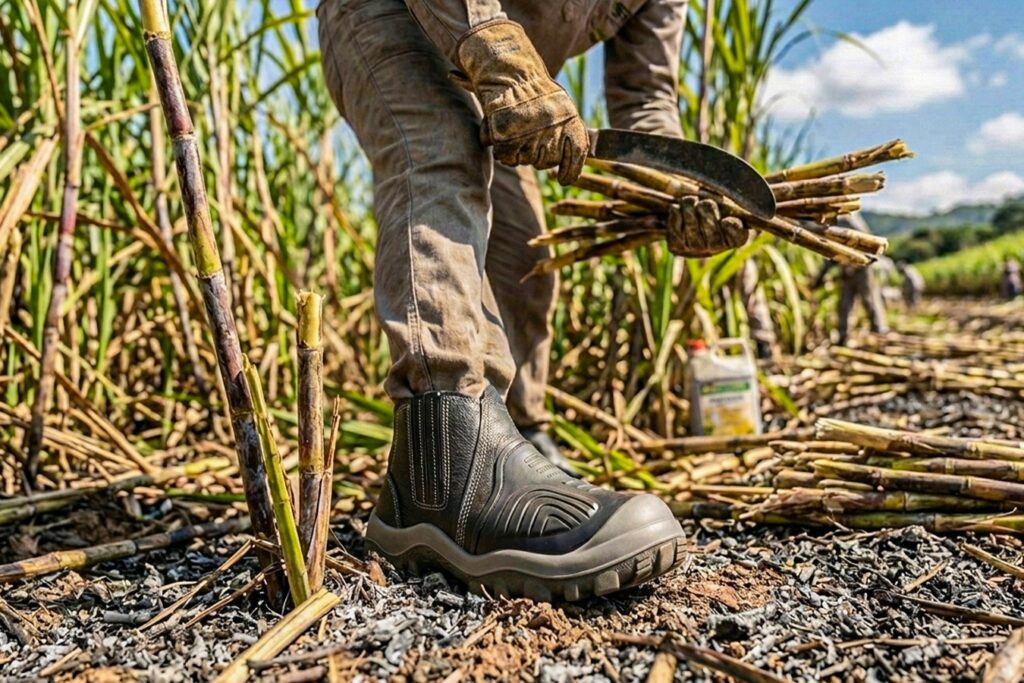
CA, NR 6, and the manager's responsibility when providing footwear
\n\nA good technical specification is worth nothing on paper if the footwear is not formally approved and the supply does not follow a clear rule. It is at this point that the technical decision meets the legal obligation.
\n\nFor the manager of the sugar and alcohol sector, understanding this framework avoids two risks: worker exposure and labor liabilities for the plant.
\n\nThe role of the Certificate of Approval in the sugar cane safety boot
\n\nEvery safety footwear item marketed in Brazil needs a Certificate of Approval (CA) issued by the competent body of the Ministry of Labor. Without a valid CA, the equipment has no legal value as EPI, even if the technical datasheet seems adequate.
\n\nThe CA certifies that the model has undergone tests for safety toe cap resistance, outsole resistance, and impact absorption. Before closing a volume purchase, check if the CA number is active and if it corresponds exactly to the quoted model.
\n\nAttention to a common point: an expired CA invalidates the delivery. Verifying validity is a mandatory step in the purchasing process, not a formality.
\n\nEmployer obligations when delivering the EPI
\n\nNR 6 defines EPI as the employer's responsibility, and provision is a legal duty, not a courtesy. In the sugar cane field, where exposure is continuous, this weighs even more.
\n\nIt is up to the manager to provide the footwear free of charge, in the correct size for each worker, in addition to requiring and recording its use throughout the shift.
\n\nIt is also their responsibility to provide guidance on maintenance, sanitization, and equipment limitations and to replace the safety boot whenever it is damaged or lost.
\n\nFailure to comply with any of these points opens the door to fines and liability in labor lawsuits.
\n\nRecording, replacement, and footwear lifecycle in the field
\n\nThe proof of EPI delivery is the plant's documentary defense. Record the date, model, CA, and worker's signature with each supply.
\n\nIn the field, the lifecycle is short when the safety boot cannot withstand sucrose, straw, heat, and uneven terrain. Document replacements and track the average replacement interval per batch.
\n\nThis control reveals the difference between footwear that lasts an entire harvest and one that gives out in weeks.
\n\nHow to choose and maintain the team's sugar cane safety boot
\n\nApproving the technical specification is half the job. The other half happens after the purchase: choosing the right model by role, sizing it well, and creating a maintenance routine that extends the footwear's lifespan.
\n\nIt is in this second half that it is decided whether the manager will face constant replacement or just live with it.
\n\nSelection criteria by role within the sugar cane field
\n\nNem todo trabalhador do canavial enfrenta o mesmo risco. Um roteiro simples ajuda a decidir:
\n\n- \n
- \n
- \n
- \n
- \n
- Cutter with billhook: prioritize the sugar cane safety boot with metatarsal guard of wide coverage and thicker, water-repellent leather, reinforced anti-torsion bar, and a shaft that protects the ankle. \n
\n
- \n
- \n
- \n
- Tractor and harvester operator: focus on an outsole with good traction for climbing on and off the machine and comfort during seated shifts. \n
\n
- \n
- \n
- \n
- Management and planting team: continuous exposure to fertilizers and soot calls for treated leather and protected seams. \n
\n
Buying a single model for all roles usually turns out to be more expensive in the long run, because the EPI wears out outside of its intended use.
\n\nSizing, numbering, and field testing
\n\nPoorly sized safety boots generate two effects: discomfort, which the worker tries to correct on their own, and accelerated wear due to internal friction.
\nTherefore, at the time of purchase, it is important to consider the appropriate sizing and correct fit to the workers' feet, avoiding choices that compromise the comfort and durability of the footwear. This care also contributes to reducing replacements due to improper sizing, one of the causes of replacement.
\nMaintenance routine to prolong durability
\n\nDesign durability only converts into savings with basic maintenance:
\n\n- \n
- \n
- \n
- \n
- \n
- Clean mud and residues at the end of each shift, without washing the leather under running water. \n
\n
- \n
- \n
- \n
- Dry in the shade, away from direct heat sources that dry out and crack the leather. \n
\n
- \n
- \n
- \n
- Moisturize the leather periodically with an appropriate product. \n
\n
- \n
- \n
- \n
- Rotate use, adopting the practice of offering two pairs to the user. \n
\n
Signs that the footwear needs to be replaced
\n\nAdie a troca só até onde a segurança permitir. Substitua quando aparecer:
\n\n- \n
- \n
- \n
- \n
- \n
- Excessive wear of the outsole, when it compromises its grip or protection; \n
- Exposed or compromised safety toe cap, reducing the protection offered; \n
- Loss of firmness in the shaft or anti-torsion bar, compromising stability; \n
- Compromised metatarsal guard, reducing its protective capacity; \n
- Cuts or damage to the upper that compromise use and safety conditions, such as those that allow water to enter. \n
\n
- \n
- \n
- \n
\n
A safety boot that resists longer, like a Safetline Sugar Cane Safety Boot designed for the sector, dilutes the cost per shift and reduces purchasing frequency. That is where durability translates into budget predictability.
\n\nKey takeaways from the sugar cane safety boot guide
\n\nIn the end, footwear that has a short lifespan is expensive. The frequent replacement cycle is not an inevitability of the sector: it almost always starts with a poorly made specification.
\n\nThose who treat the sugar cane safety boot as a disposable item pay twice: in constant replacement and in risk that does not disappear.
\n\nOf everything this guide has brought, three ideas deserve to stay. The first is that specification is born from risk, and not from price: the risk of the blade, sharp straw, uneven terrain, and long shifts are what define the leather, outsole, and anti-torsion bar, before any quote.
\n\nThe second is that a valid CA and formal supply transform a good specification into real protection and also shield the manager against labor liabilities.
\n\nAnd the third is that durability is not an expense, it is savings: the total cost of ownership drops when the footwear goes through the entire harvest without becoming a replacement.
\n\nSafetline has been producing safety footwear for over 50 years, with proprietary technologies and durability that sustain field work for longer, and this changes the math the manager does at the end of the year.
\n\nWith the right specification, the sugar cane safety boot stops being the cheapest option and becomes the most economical over time. Request a quote for Safetline safety boots and size the supply of the sugar cane fleet with predictability.
\n\nFrequently Asked Questions
\n\nWhat is a sugar cane safety boot?
\n\nA sugar cane safety boot is a functional category of safety footwear designed for cutting and handling sugar cane. It combines specific characteristics for the sugar cane field environment: protection against blade cuts, resistance to sharp straw, an outsole with traction on uneven terrain, heat tolerance, and comfort during long shifts. It is not a single model, but rather a set of technical requirements that a standard safety boot does not meet.
\n\nWhat is the difference between a sugar cane safety boot and a standard safety boot?
\n\nA standard safety boot protects against generic ground and impact risks. The sugar cane safety boot responds to specific field threats: metatarsal guard, cut- and moisture-resistant leather, slip-resistant dual-density outsole for uneven ground, anti-torsion bar to reduce ankle injuries, and a construction that withstands heat and prolonged use. It is the sum of these characteristics that defines the category.
\n\nWhich CA and standard apply to the sugar cane harvesting safety boot?
\n\nSafety footwear needs a valid Certificate of Approval (CA), issued by the Ministry of Labor, proving that testing was conducted in an accredited laboratory. NR 6 defines EPI as the employer's obligation: to provide free of charge, require use, train, and replace when damaged. Without an active CA, the footwear has no legal value as EPI, exposing the company to fines and labor liabilities.
\n\nWhy does a cheap sugar cane safety boot turn out to be more expensive in the long run?
\n\nBecause the low price usually comes from thin leather, an outsole that unglues, and the absence of an anti-torsion bar. The result is frequent replacement, more purchases per year, and a risk that does not disappear. The total cost of ownership considers durability, not just the unit value. Footwear that lasts longer reduces replacement frequency and lowers the cost per worker per year.
\n\nHow to buy sugar cane safety boots in volume with predictability?
\n\nSpecify the technical datasheet before quoting: metatarsal guard, safety toe cap type, dual-density outsole, anti-torsion bar, shaft height, and required CA. Standardize by risk role, not by price alone. Work with a manufacturer that guarantees batch consistency, sizing availability, and a history of proven durability. This transforms the purchase of EPI into a predictable process and reduces supply failures.
\n\nHow to maintain the safety boot to increase its lifespan in the field?
\n\nGuide the team to clean the leather after the shift, remove excess sucrose, soot, and soil, dry in the shade (never in direct sun or near a heat source), and alternate pairs when possible. Inspect the outsole, seams, and safety toe cap periodically. Replace at the first sign of ungluing or loss of protection. Disciplined maintenance extends the lifespan and reduces the replacement cycle.
\n\n\n\n\n