
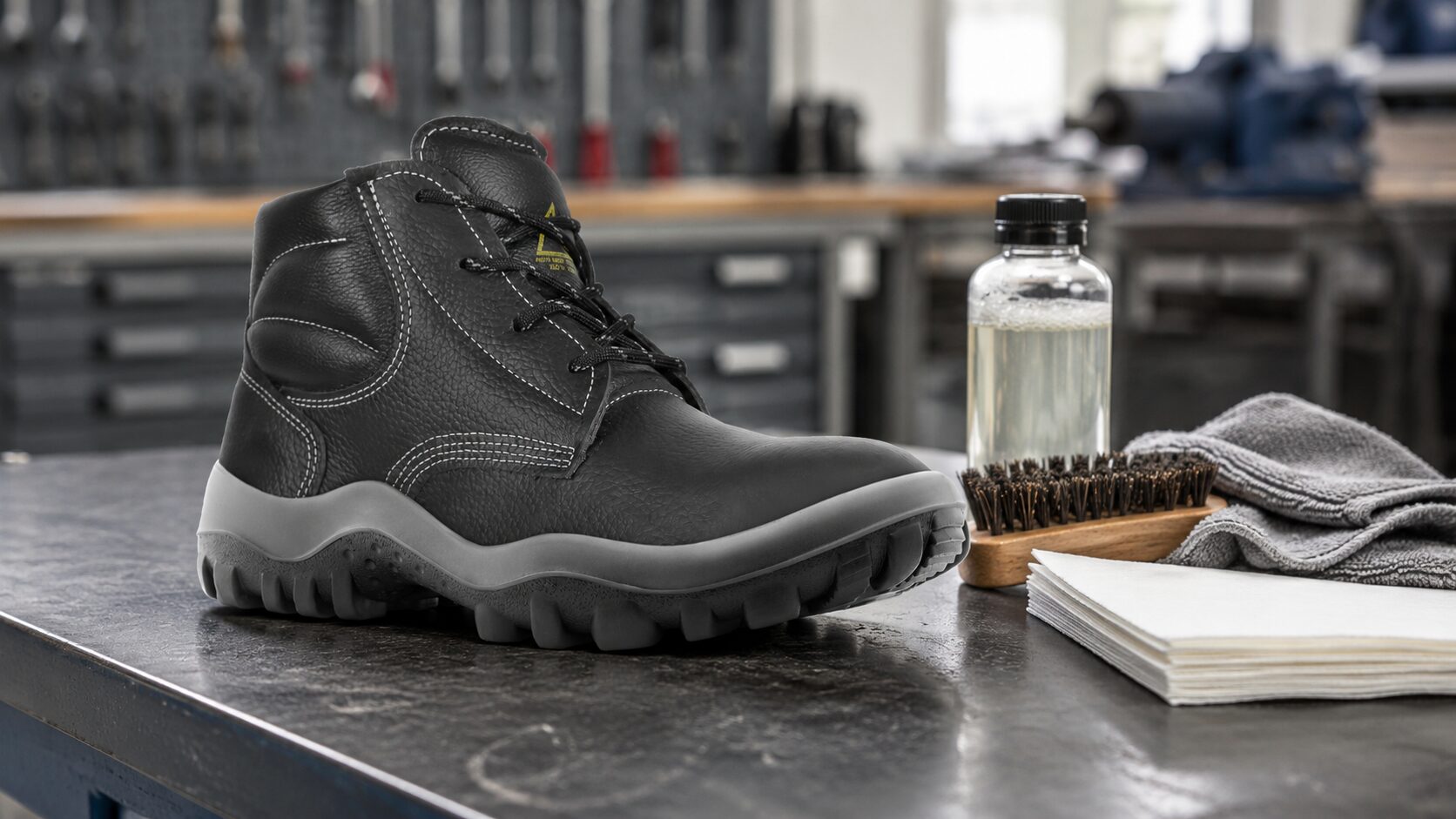
The maintenance of safety footwear consists of a set of cleaning, drying, storage, and periodic inspection practices that preserve the structural integrity, comfort, and protective properties of the equipment.
It includes the proper removal of residues, moisture control, storage in a ventilated environment, and the visual assessment of critical components such as the outsole, safety toe cap, upper, and seams. These routines extend the service life of the equipment and maintain the protection level required by the Certificado de Aprovação.
A single shift on a wet floor with oil splashes is enough to compromise the durability of new footwear. In less than 30 days, the upper can lose flexibility if drying is done incorrectly, whether directly in the sun or near intense heat sources. The result is premature drying, reduced elasticity, and a higher risk of cracking.
Most premature replacements of safety footwear in Brazilian industries do not happen due to product failure, but rather due to a non-existent or poorly executed care routine in locker rooms and warehouses.
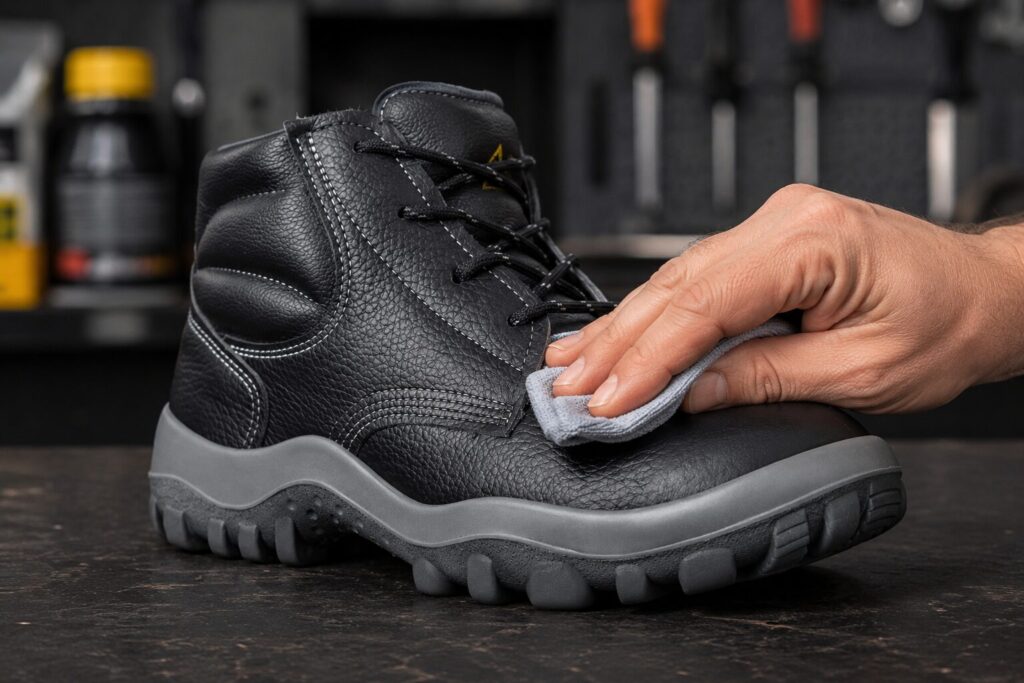
The good news: there is a simple protocol, replicable by any employee, that protects the company's investment in PPE and, most importantly, ensures that the worker continues to receive the certified level of protection throughout the entire cycle of use.
In the following sections, this content presents the impact of maintenance on operational safety, the practical step-by-step guide for cleaning, drying, and storage, as well as the technical criteria to identify when the footwear must, in fact, be replaced.
The Importance of Maintenance for the Longevity and Safety of Protective Footwear
Caring for safety footwear goes beyond aesthetics or durability. It is a direct practice of occupational risk management.
Poorly maintained footwear loses its protective properties, compromises worker integrity, and generates rework in the routine of the Occupational Safety department. Preventive maintenance, therefore, is an inseparable part of the company's PPE program, with technical, economic, and legal implications.
Direct impact on the service life of Personal Protective Equipment
The service life reported by the manufacturer assumes proper use and care. Without this, materials such as leather, polyurethane outsole, composite safety toe cap, and anatomical insoles degrade at an accelerated rate.
Moisture accumulation, prolonged contact with chemical agents, direct sun exposure, and improper drying reduce by months a product designed to last up to two years. Proper maintenance preserves the internal structure of the safety footwear and keeps the technical performance of the footwear stable throughout the entire cycle of use.
Intrinsic relationship between maintenance and effective worker protection
An outsole contaminated by oil loses grip. A dry upper cracks and allows liquids to pass through. A damp insole promotes dermatosis and alters the fit of the foot.
Every detail of wear reduces the protective barrier against impacts, punctures, electrical shocks, and slips. Maintaining the footwear is, in practice, keeping active the same attributes certified in the Certificado de Aprovação (CA).
Neglecting hygiene is equivalent to operating with a partially compromised PPE, even if it appears visually intact.
Economic benefits of preventive maintenance for PPE management
Premature footwear turnover represents one of the largest hidden costs in the Occupational Safety budget. When the manager implements cleaning, drying, and storage routines, the average service life of the PPE increases significantly.
This reduces purchasing frequency, optimizes inventory, decreases emergency replacement liabilities, and frees up resources for investment in training and other protective items. Maintenance is, in short, an operational efficiency tool.
Compliance with Norma Regulamentadora 6 (NR 6) and footwear durability
NR 6 establishes clear obligations: it is the employer's responsibility to provide the PPE in perfect condition for use and operation, as well as to guide and train the worker regarding its use, storage, and cleaning.
It is the worker's responsibility to maintain and care for the equipment. Documenting these practices in internal procedures protects the company in audits, Ministry of Labor inspections, and potential labor lawsuits. Maintaining the footwear is, therefore, complying with the standard and sustaining the chain of responsibility that supports the safety program.
Practical Guide: Proper Cleaning, Drying, and Storage of Safetline Footwear
The maintenance routine requires specific procedures for each component of the footwear. Applying the wrong method to a certain material can accelerate degradation and compromise the PPE. See below the technical guidelines for each step.
Cleaning techniques by material type
The leather upper must be cleaned with a cloth slightly dampened with water and mild soap. Avoid full immersion, as excess water dries out natural fibers and causes cracking. After cleaning, apply a specific leather moisturizer every 30 days to maintain flexibility and mechanical resistance.
For microfiber or synthetic fabric uppers, use a soft brush with a solution of water and mild detergent. These materials tolerate moisture better, but they should not be subjected to abrasive products or solvents, which attack the inner layers.
The polyurethane (PU) or rubber outsole requires brushing to remove residues of cement, oils, or chemicals accumulated in the grooves. The presence of these agents compromises slip-resistant grip and alters the outsole's response on wet surfaces.
Drying methods that preserve the structure
Never expose the footwear to direct sunlight, electric dryers, or heat sources such as ovens and radiators. Excessive heat deforms the outsole, unsticks the inner layers, and hardens the leather.
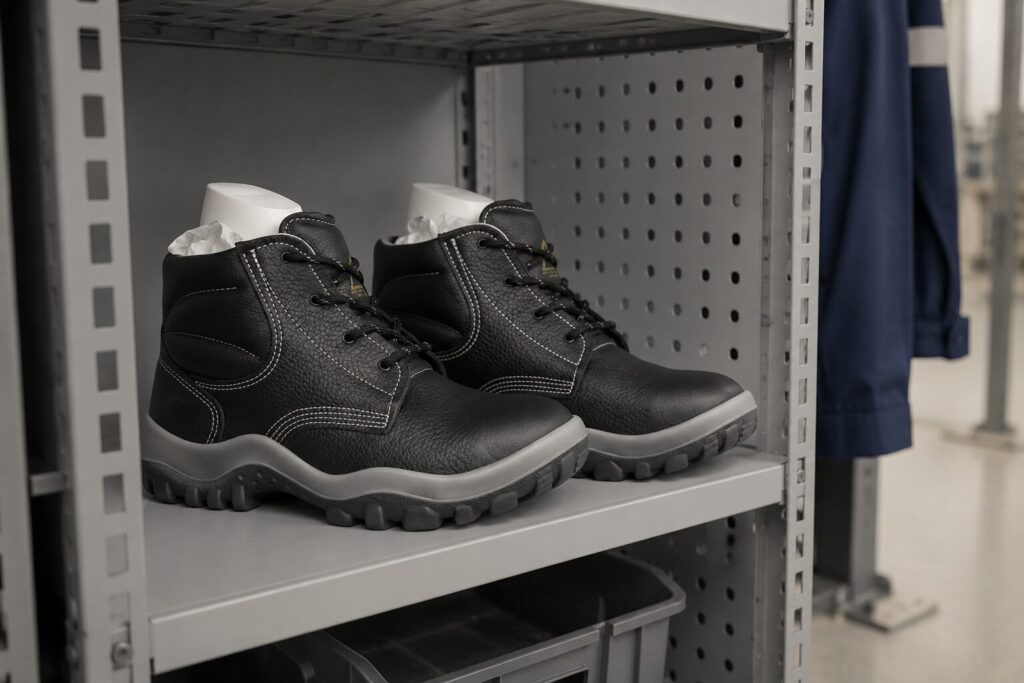
The correct method is natural drying, in a ventilated environment and in the shade, with absorbent paper inside the footwear to remove internal moisture. Change the paper every 4 hours until completely dry.
Ideal storage
Store the pairs in a dry, airy place protected from direct sunlight. Use plastic shoe trees or crumpled paper inside the footwear to maintain its original shape. Avoid stacking pairs, as the weight deforms the uppers.
Care for internal and external components
Laces must be washed separately and replaced when they show fraying. Insoles need to be removed at the end of the shift to air out and dry, a practice that reduces the proliferation of fungi and odors. The safety toe cap, whether made of steel or composite, must be visually inspected for deformations after impacts, as guided by NR 6.
Identifying Signs of Wear and the Right Time for Replacement
Even with a proper cleaning and storage routine, all safety footwear has a finite service life. The challenge for the Occupational Safety manager lies in recognizing the exact point at which the PPE stops fulfilling its protective function.
Relying solely on usage time is insufficient: wear depends on the intensity of the shift, the environment, and the risk agents involved.
Assessing outsole integrity
The outsole is the first component to show signs of fatigue. Periodically check the depth of the slip-resistant grooves. When the grooves are visibly worn smooth, grip on wet or oily floors drops significantly.
Another indicator is the loss of elasticity of the compound: hardened or cracked outsoles lose impact absorption capacity, exposing the worker's spine and joints to repetitive microtraumas.
Checking the upper and seams
The upper protects the worker against potential light risks. Cracks in the leather, tears in synthetic materials, or separation between the upper and the outsole indicate that the protective barrier has been broken.
Pay special attention to the seams in the areas of greatest flexion, near the instep and the heel. Loose threads or open seams compromise the structure and can quickly worsen in the field.
If the safety toe cap is exposed or deformed after an impact, replacement is mandatory, even if the footwear appears intact externally.
Aggressive environments and chemicals
Operations with hydrocarbons, solvents, alkaline agents, or high temperatures accelerate degradation. Outsole swelling, deep stains, severe drying, or changes in the original color are signs that the material has reacted chemically and lost its certified properties.
For these routines, consider specific models such as high-temperature footwear, designed to withstand controlled thermal exposures.
Criteria for immediate replacement
Footwear replacement must be immediate whenever there is any sign of structural compromise, such as a safety toe cap deformed after impact, detached outsole, puncture in the upper, tear or puncture in the outsole by a sharp object, or any visible change in the geometry of the footwear, as these conditions reduce protection and jeopardize user safety.
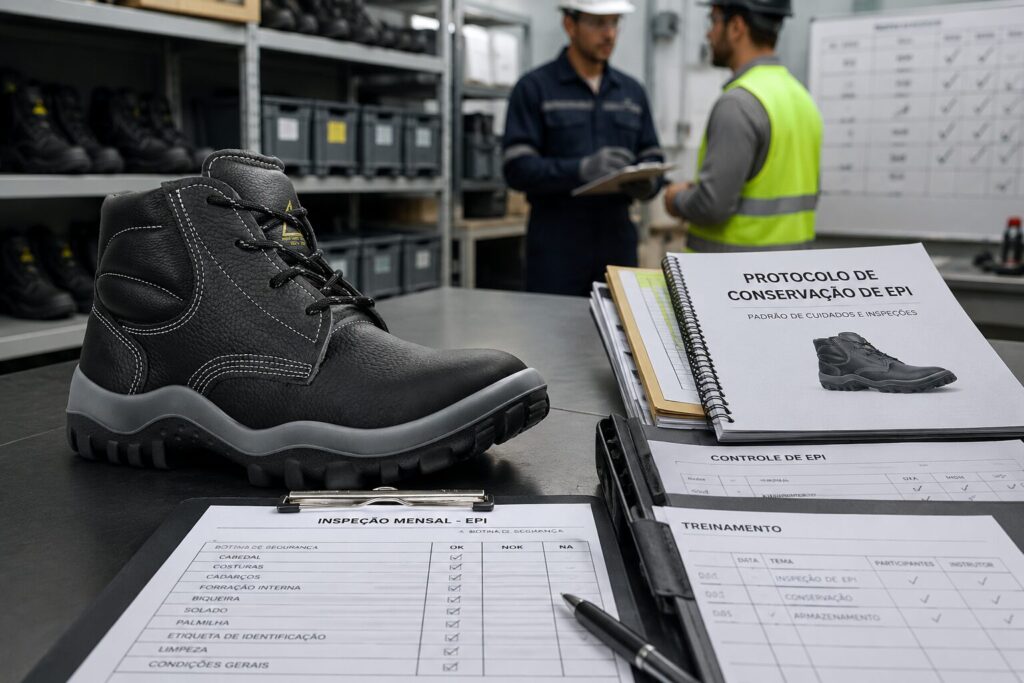
Next step: turn maintenance into a measurable routine
The initial pain point was clear: safety footwear that lasts less than it should, generates recurring costs, and, worse, exposes the worker to silent risks. Now you have the complete map to change this game within your operation.
Three principles to carry forward:
- Maintenance is risk management, not just savings. Every poorly maintained safety boot is a PPE failure waiting to happen.
- Each material requires a specific method. Leather, composite, polyurethane outsole, and insoles require distinct cleaning, drying, and storage procedures.
- Replacement is a technical decision, based on objective signs of wear, not on a fixed calendar or superficial appearance.
Practical application starts tomorrow. Set up a written maintenance protocol, train users in five minutes at the start of the shift, and create a monthly inspection sheet per pair.
In 90 days, you will have concrete data on actual service life, replacement frequency, and return on investment in PPE. This simple routine professionalizes the Occupational Safety department and eliminates decisions based on guesswork.
The next step is to align maintenance with the right product for your operation. If your front is heavy industry or civil construction, discover the Safetline safety boots line and see how the footwear's construction already provides the foundation for an extended service life.
Well-maintained footwear protects twice: the worker today and the budget tomorrow.
Frequently Asked Questions
What is the service life of safety footwear?
There is no fixed period defined by standard. Durability depends on the intensity of use, the work environment, and the risk agents to which the footwear is exposed. On average, replacement occurs between 6 and 12 months for daily full-time use. The decisive criterion is the state of maintenance: cracks in the upper, worn outsole, or exposed safety toe cap indicate immediate replacement.
Can safety footwear be washed in a washing machine?
No. The washing machine compromises the structure of the upper, deforms the insole, damages internal components, and can detach the outsole. Mechanical shock and water temperature also affect the integrity of leather and synthetic materials. Correct cleaning is done manually, with a damp cloth and mild soap, respecting the characteristics of each component.
How to dry wet safety footwear correctly?
Drying must occur in a ventilated place, in the shade, with the footwear open and the insole removed. Never use dryers, ovens, direct heat sources, or exposure to intense sun. These methods harden the leather, deform the outsole, and reduce grip. Paper towels or newspaper inside the footwear help absorb internal moisture during the process.
When should safety footwear be replaced even if it shows no apparent wear?
Replacement is indicated when there is a loss of outsole grip, presence of cracks, permanent deformation, water infiltration, or persistent discomfort reported by the worker. The Certificado de Aprovação guarantees protection under intact PPE conditions. After exposure to aggressive chemical products, severe impacts, or contact with high temperatures, replacement must be evaluated regardless of usage time.
What product should be used to clean the leather upper of safety footwear?
Use a cloth slightly dampened with water and mild soap. After cleaning, apply a specific leather moisturizer or neutral grease to preserve the material's flexibility. Avoid solvents, alcohol, kerosene, bleach, and abrasive products. These agents dry out the leather, compromise seams, and can invalidate the certification of the personal protective equipment.
How to store safety footwear when not in use?
Store in a dry, airy place protected from direct sunlight. Avoid damp environments, proximity to heat sources, or direct contact with the floor. Use silica gel sachets to control internal moisture and keep the insole removed during prolonged storage. Do not stack other objects on top of the footwear to preserve its original shape.
Is safety footwear maintenance mandatory by standard?
NR-06 establishes that the worker is responsible for storing and maintaining the provided PPE, while the employer must provide guidance regarding its use and cleaning. Proper maintenance is, therefore, a shared legal requirement. The Occupational Safety department needs to document training, provide clear instructions, and monitor the maintenance routine to ensure regulatory compliance.