

Safetline, a specialist in safety footwear for over 50 years, knows that PPE and CPE are fundamental acronyms in occupational safety. But do you know the difference between Personal Protective Equipment and Collective Protective Equipment? Understanding this difference is essential to fully protect the health and lives of workers.
In this article, we clearly explain what each one means, when to use each type of protection and why both are indispensable for a safe work environment. Check out the definitions, practical examples, and best practices recommended by Safetline to ensure the ideal protection for your team.
Personal Protective Equipment (PPE)
Personal Protective Equipment (PPE) is any device or accessory for personal use intended to protect the worker against risks to their safety and health during work. In other words, PPE is used by a single person at a time and offers protection only to the wearer. Helmets, safety glasses, hearing protectors, gloves, masks, safety harnesses, and safety footwear are among the most common PPE. For example, quality safety boots and safety boots (ankle), Safetline's specialty, protect the worker's feet against falling objects, punctures, and other hazards, ensuring comfort and safety.
By legal determination (Regulatory Standard No. 6 of the Ministry of Labor), every company is required to provide appropriate PPE for the risks of each activity, at no cost to the worker. PPE must be used whenever collective safety measures do not completely eliminate risks, while collective protections (CPEs) are in the implementation phase, or to meet emergency situations. This means that PPE is considered the last line of defense: it does not prevent the accident itself, but prevents or minimizes injuries if an incident occurs. For example, a safety helmet does not prevent an object from falling from scaffolding, but it can prevent a serious head injury to the employee.
It is worth noting that every PPE marketed in Brazil must have a Certificate of Approval (CA), issued by the Ministry of Labor, after evaluation and testing in accordance with applicable technical standards. Before a PPE is sold, it undergoes resistance, efficacy, and comfort tests. The CA has a validity period and must be renewed periodically. You can even check the status of a CA in the government's official CAEPI System. This care ensures that reliable PPE, such as Safetline's, delivers the promised protection.
Examples of the most commonly used PPE: helmets and balaclavas (head protection), earplugs and earmuffs (hearing protection), glasses and visors (eye and face protection), gloves and protective sleeves (hand and arm protection), respirators and filter masks (respiratory protection), special clothing such as vests and coveralls (body protection), and shoes, boots, and safety boots (ankle) (foot and leg protection). Each PPE is designed for a specific type of risk, so it is important to correctly identify the risks of each role to select the appropriate individual equipment.
Collective Protective Equipment (CPE)
Collective Protective Equipment (CPE) is a device, system, or safety measure installed in the work environment with the objective of protecting all workers simultaneously who are exposed to certain risks. Unlike PPE, which acts directly on the individual, CPE acts on the sources of danger or the environment, neutralizing or minimizing risks even before they reach people. In other words, CPEs prevent accidents and protect everyone on site, creating a safer environment for the collective.
As a simple example, fire extinguishers and fire suppression systems are often considered collective protection measures: they do not belong to a specific person and serve to control early-stage fires, protecting the entire team and the property. Other common examples of CPEs include: signage and safety tape (communicating hazards and delimiting risk areas), cones, chains, and physical barriers (temporarily isolating dangerous areas), ventilation and exhaust systems (eliminating airborne contaminants such as gases, dust, or vapors), guardrails and safety nets (preventing falls from heights), sirenes and emergency alarms (alerting everyone to dangerous situations), electrical lockouts and tagout mechanisms (LOTO) on machinery (preventing accidental restart during maintenance), and acrylic barriers on counters (retaining droplets, collectively protecting against contamination, as seen during the pandemic).
The great advantage of CPEs is that their effectiveness is independent of the worker's individual action. Once installed and maintained correctly, a CPE protects everyone, all the time, without requiring each person to take direct initiative to be protected. For this reason, safety standards always prioritize the adoption of CPEs: engineering and collective protection measures must be implemented first, making the environment inherently safer.
In fact, several specific Regulatory Standards, such as NR-10 (safety in electrical installations) or NR-12 (safety in machinery), require the implementation of appropriate CPEs (for example, de-energization, mechanical guards, sensors, etc.). The principle is clear: the work environment must not pose risks to the worker's safety, and it is up to the employer to reduce hazards at the source whenever possible.
It is important to highlight that CPEs also require proper management: inspection, signage, and training. It is of no use to install exhaust fans or protection systems if they are not maintained, or if workers do not know how to use them correctly (for example, respecting a barrier or activating a ventilation system). Thus, the company's safety culture must include awareness of the importance of CPEs, in addition to PPE. When everyone understands and values collective measures, not removing protections, and not bypassing safety devices, the environment becomes much more protected. In this regard, the role of CIPA (Internal Accident Prevention Commission) and SESMT is fundamental to identify risks that can be eliminated or controlled collectively and to promote continuous training.
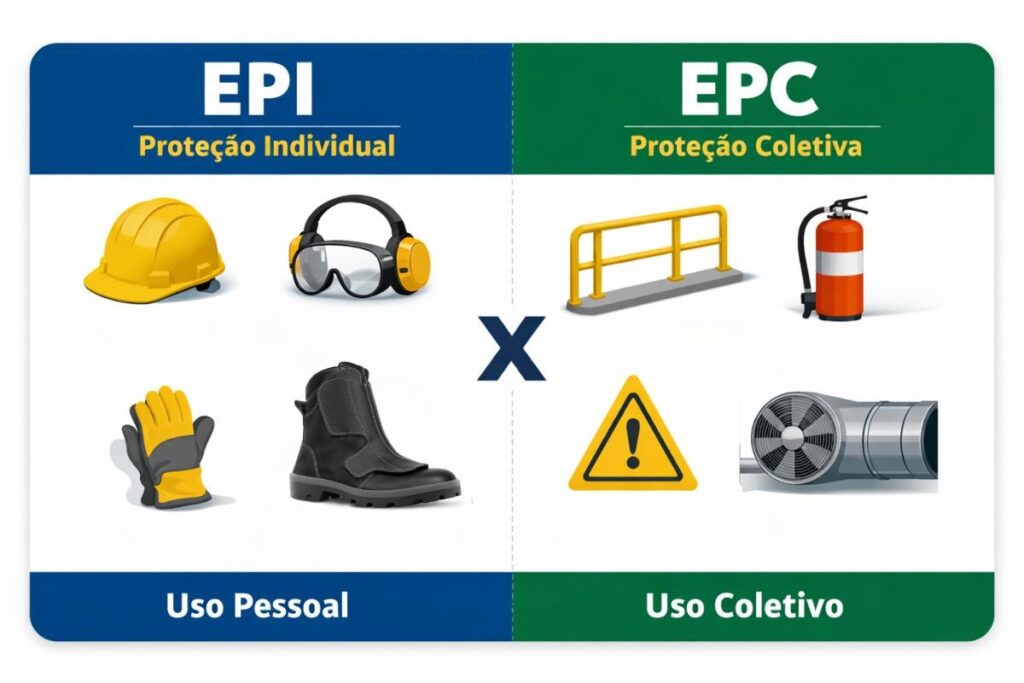
Differences Between PPE and CPE
The fundamental difference between PPE and CPE lies in the scope of protection: PPE individually protects each worker (one at a time), while CPE collectively protects everyone in the environment. This distinction in the acronym already indicates: Personal vs. Collective. But there are other important aspects that differentiate these two types of protection:
Scope of protection
PPE offers direct protection only to the person wearing the equipment. On the other hand, CPE protects all workers present, since it acts on the environment or the work process (for example, an exhaust fan improves air quality for the entire team).
Accident Prevention vs. Damage Reduction
CPE tends to prevent the accident, as it eliminates or isolates the hazard at the source (preventing the risk from materializing). PPE, in turn, does not prevent the accident from occurring, but prevents or mitigates damage to the worker if the accident happens. Thus, collective protection is always preferable, as it removes the risk instead of just protecting against it.
Dependence on the human factor
CPEs function independently of the employee's action or attitude; once installed, they are there protecting everyone automatically. On the other hand, PPE depends on correct use by the individual; if the worker forgets to put on safety glasses or uses the hearing protector improperly, the protection fails. Therefore, the effectiveness of PPE is linked to the awareness and discipline of each individual.
Implementation priority
In any occupational safety strategy, collective control measures (CPEs) must be adopted first to eliminate or reduce risks. PPE comes in as a complement to protect against hazards that could not be fully eliminated by collective measures or for emergency situations. This risk control hierarchy is recommended by standards and best practices (elimination/substitution of risk > collective protections > personal protections > administrative measures, etc.). In summary, PPE is the last barrier of protection and does not replace CPE, but rather complements safety.
Practical examples
Consider work at heights: a lifeline or fixed guardrail (CPE) is installed on the roof to prevent falls for all workers in that location. Even so, each employee must use a full-body safety harness (PPE) connected to the lifeline.
The lifeline acts collectively (no one falls because they are anchored), and the harness acts individually (holding the worker if they lose their balance). Another example: in a workshop with excessive noise, acoustic barriers or machine enclosures (CPE) can be installed to reduce environmental noise, but operators will also use hearing protectors (PPE) to protect themselves from residual sound.
These scenarios show that PPE and CPE go hand in hand; when risks are significant, collective and individual measures are usually applied simultaneously, increasing the level of protection.
Comparison
To make it easier, see below a comparison chart with the main differences between PPE and CPE:
| Criterion | PPE (Personal Protection) | CPE (Collective Protection) |
| Scope of protection | Protects only the user of the equipment. | Protects everyone in the work environment. |
| Mode of action | Acts on the individual, reducing injuries after an accident. | Acts at the source of the risk, preventing the accident from occurring. |
| Typical examples | Helmet, gloves, safety glasses, safety boots, safety harness, respiratory mask. | Fire extinguisher, local exhaust ventilation, guardrail, safety signage, protective barrier. |
| Dependence | Depends on correct use by the worker (human factor). | Independent of individual human action once installed. |
| Priority | Last control measure – use when there is insufficient collective protection. | First measure – implement whenever possible to eliminate or isolate the hazard. |
Therefore, it is clear that one type of equipment does not exclude the other. On the contrary, CPE and PPE are complementary in accident prevention. Responsible companies seek to eliminate risks with CPEs and, in parallel, provide appropriate PPE to protect employees from remaining hazards. Furthermore, the legislation requires the employer to adopt all necessary protective measures, both collective and individual. In other words, if a viable CPE exists for a certain situation, it must be implemented first; and even so, workers must receive and use the indicated PPE to be doubly protected.
Another point of difference is that the company is responsible for both: it is up to the employer to implement and maintain CPEs in the workplace and also to provide the appropriate PPE for each role, training employees on its correct use. For example, it is the company's duty to install machinery guarding (CPE) and provide safety gloves (PPE) when necessary, ensuring the physical integrity of its employees on all fronts. Failure to comply with these obligations can lead to legal penalties and, above all, increase the risk of accidents.
Importance of the Combined Use of CPE and PPE
Both PPE and CPE are extremely important for preventing accidents and occupational diseases. Together, they represent a company's commitment to the lives and health of its workers. Well-applied protective equipment functions as barriers that drastically reduce the likelihood of occurrences and the severity of potential injuries. In addition, investing in safety directly reflects benefits for the business: safer environments tend to be more productive, with fewer accident-related pauses, fewer leaves of absence, and higher team morale. Employees, knowing that the company cares about creating safe conditions and provides the appropriate equipment, work with greater peace of mind and confidence, which reduces stress and increases engagement.
On the other hand, neglecting proper protection, whether by not installing a necessary CPE or not providing quality PPE, exposes the team to risks and can lead to serious accidents, with human, legal, and financial consequences. A workplace accident can generate medical costs, compensation, loss of productivity, and damage to the company's reputation. Therefore, safety must be seen as an investment, not an expense. Every dollar spent on prevention, whether buying effective collective protection or good PPE for each employee, returns in the form of continuous work, preserved lives, and a positive organizational climate.
It is important to emphasize that simply providing the equipment is not enough. The company also needs to guide, train, and monitor the correct use of PPE and respect for CPEs on a daily basis. This continuous management ensures that workers are truly protected and that the safety culture becomes part of the routine. For example, there is no point in handing out earmuffs if employees do not use them correctly, or installing an exhaust system if it remains turned off to “save energy”. Occupational safety is a joint effort involving good equipment, appropriate procedures, and everyone's awareness.
Complete Protection with Safetline
PPE and CPE differ in the scope of protection, personal or collective, but both are essential pillars of occupational safety. One does not replace the other: the best accident prevention practices combine efficient collective measures and quality personal equipment. First, the risk in the environment is eliminated or controlled (CPE); then, each worker is protected against remaining risks (PPE). In this way, a maximum level of protection is achieved.
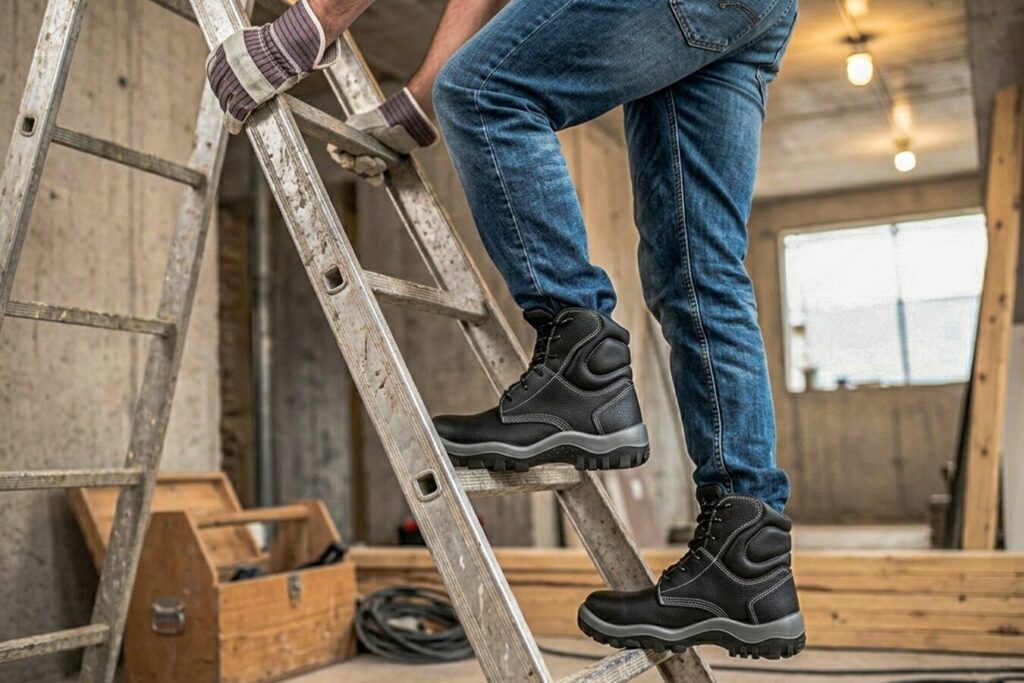
Safetline, as a manufacturer synonymous with quality and technology in safety footwear, reinforces the importance of applying all necessary safety measures. After implementing the appropriate CPEs in your establishment, it is essential to choose reliable PPE for personal protection, and Safetline can help with that. The company offers the most complete safety footwear line in Brazil, with various models of certified boots, safety boots (ankle), and shoes for the most diverse activities. These Safetline footwear models guarantee not only foot protection, but also superior comfort and durability, contributing to workers' adherence to PPE use.Stay on top of complete occupational safety!
Count on Safetline to guide your company in quality PPE, ensuring the personal protection of employees after collective measures. If you want to raise the level of safety in your company, contact Safetline or discover our safety footwear line. Protection, innovation, and trust are our commitments; together, we will keep every worker safe from head to toe.