

The Brazilian sugar-ethanol sector is a giant that drives the country with the strength of more than 800,000 workers. Uniting the intense routine of farming with the complexity of the industrial park, however, creates a unique challenge for Safety in the Sugar-Ethanol Sector management: how to ensure everyone's integrity, from harvesting to processing?
For those on the front line, the answer requires flexibility. It is necessary to master a true regulatory “puzzle” — integrating the requirements of NR31 (field), NR12 (machinery), NR15 (unhealthy activities), NR35 (height), and NR6 (PPE) — while translating complex statistics, such as those from the Annual Statistical Report of Occupational Accidents (AEAT) and the MPT Observatory, into practical daily actions.
Those who deal with Occupational Safety on the plant floor know this scenario well: the monthly report brings incidents that seem to come from different worlds. At the same time, you have cuts and punctures in the sugarcane field, slips in the mill, and burns near the boiler. It is a constant challenge, as each of these occurrences requires a specific standard, a different supplier, and, of course, training adjusted to each reality.
This article was created to organize this landscape. We will connect each risk to the governing standard and show why safety footwear is, in fact, a key piece in your prevention strategy – whether facing the irregular soil of sugarcane harvesting or the wet sucrose floor inside the industrial plant.
Understanding the challenges of Safety in the Sugar-Ethanol Sector: where the sugarcane field meets the plant
We are talking about a sector that moves more than 800,000 lives across the country, with a large part of production concentrated in São Paulo. The major differentiator here — and what makes safety management so challenging — is that the sugar-ethanol sector is not just rural or just industrial. It is both at the same time.
This mix of large-scale operations in the field with the frantic pace of the industrial plant creates a scenario where risks multiply. Understanding this duality is not just theory; it is the foundation for building a prevention culture that actually works in daily life.
Work environments and their particularities
To facilitate management, we can divide the operation into three main fronts:
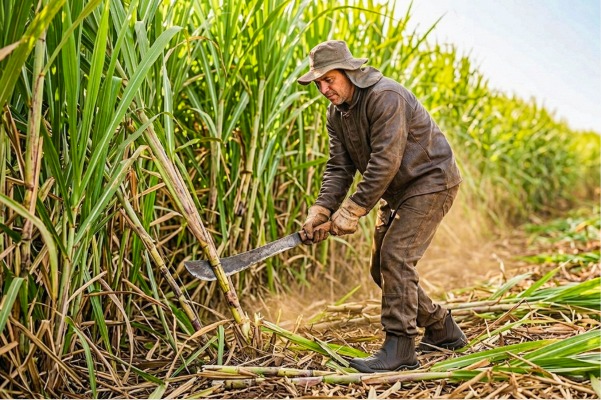
- In farming: Where planting, harvesting, and cutting occur (whether manual or mechanized). Here, the challenge is the open environment: irregular soil, exposure to venomous animals, and contact with agricultural pesticides.
- In the industry: A complex environment with mills, boilers, conveyor belts, and fermentation tanks. The risk profile changes here: the heat is intense, noise is constant, and the floor requires extra attention, as molasses and sucrose make it slippery.
- In internal traffic: The flow of machinery is heavy, with sugarcane trucks, multi-trailer trucks, and forklifts, which requires strict traffic control.
Main risks and their patterns

What do the data tell us? The Annual Statistical Report of Occupational Accidents (AEAT) and the MPT's Occupational Safety and Health Observatory are clear: some risk patterns repeat frequently in the sugar-ethanol sector. Understanding these “blind spots” is the first step to anticipating problems before they occur:
- Mechanical risks: cuts, crushing, and run-overs. Machinery and tools require constant vigilance — especially near mills, conveyor belts, and during harvester movement.
- Chemical risks: contact with herbicides, hot vinasse, and inhalation of vapors in the distillery represent an invisible danger that requires effective protective barriers.
- Thermal risks: it is a daily struggle against burns caused by molasses, boiler steam, and direct contact with furnace surfaces.
- Biological risks: in the sugarcane field, attention must be doubled regarding venomous animals – such as snakes, spiders, and scorpions – in addition to the risk of exposure to microorganisms in standing water areas.
- Puncture injuries: sugarcane stubble is a true silent “villain”. They cause plantar injuries, a specific risk that makes the use of puncture-resistant insoles an indispensable safety item.
Impact of seasonality and weather conditions
The harvest season (from April to November) is not just a period of high production; it is an endurance test. Intense heat, often above 35 °C, combined with humidity, does not just cause discomfort: it reduces attention, promotes dehydration and excessive fatigue, factors that open the door to mechanical accidents.
When the harvest season ends and the off-season arrives, the scenario flips. Rain joins molasses and sucrose on the factory floor, creating a highly slippery surface. The secret here is not just monitoring the weather, but anticipating how these changes in temperature and humidity alter the environment's behavior — and, consequently, the risk of falls and exhaustion.
Ergonomic and occupational health challenges
Even with technological advances, physical effort is still a constant. In the field, workers face repetitive movements, tool weight, and irregular soil. In the industry, the challenge is more subtle but equally exhausting: spending hours standing on hard floors, often under the continuous vibration of machinery.
This “silent wear and tear” — which generates lower back pain, tendinitis, and muscle fatigue — often goes unnoticed until it leads to medical leave. That is why, at this stage, the correct PPE stops being just a "mandatory item" and becomes a health tool: footwear with proper cushioning and an ergonomic design is what ensures that the employee finishes the shift as well as they started.
Navigating the standards: your safety map in the sugar-ethanol sector
The complexity of the operations we have seen so far requires a robust legal foundation. In the sugar-ethanol sector, safety is not governed by a single standard, but by a set of Regulatory Standards (NRs) that, together, ensure protection from the field to the powerhouse. The secret to an efficient prevention program is not memorizing laws, but understanding how they apply to the daily routine of the plant.
NR 31: the field's compass
NR 31 is your main reference for everything that happens outside the industry. From planting to harvesting, it details essential care: personnel transport, living areas, hydration, and the correct use of pesticides. If the activity is rural, NR 31 is your guide.
NR 12: safety on the production line
In the plant, NR 12 takes center stage. Mills, centrifugal conveyor belts, and harvesters are powerful machines that need "shielding" — whether through emergency stop systems, maintenance lockouts, or clear signage. The focus here is to ensure that the machine's power never becomes a risk to the operator.
NR 33 and NR 35: high-risk work
Whether cleaning silos, molasses tanks, and fermentation vats (confined spaces – NR 33) or performing maintenance on distillation towers and industrial roofs (work at heights – NR 35), these standards come into play when work goes up or "down", meaning rigor must be at its maximum.
The foundation of support: NR 6 and others
NR 6 acts as the 'birth certificate' of the PPE, ensuring that the supplied equipment has proven origin and technical efficacy. It is essential to guarantee the validity of this certification — learn How to Check PPE CA — for all purchased items. Added to this foundation are NR 10 (electricity), NR 15 (unhealthy conditions due to noise and heat), NR 20 (safety with fuels, such as ethanol), and NR 23 (fire protection).
The Strategic Role of PPE in Accident Prevention
Once the regulatory scenario is understood, we reach the point where theory meets the factory floor: Personal Protective Equipment (PPE). In the hierarchy of hazard controls, PPE is the final layer – the one that guarantees physical integrity when collective measures are not enough. In the sugar-ethanol sector, however, it stops being just a "mandatory item" and takes on a strategic role.
Smart selection: the risk dictates the equipment
Forget generic shopping lists. The choice of PPE must be a direct reflection of each role's risk matrix.
- In manual harvesting: The focus is on protection against cuts, stubble punctures, and impact resistance — an environment that requires safety boots with metatarsal protection and high-resistance outsoles.
- In harvester operation: The enemy is continuous noise and vibration; here, footwear ergonomics is fundamental to reducing fatigue and maintaining operator attention.
- In the distillery: With the presence of heat, vapors, and chemicals, clothing and footwear must not only protect but also ensure the employee's thermal and chemical stability.
Safety footwear: the point of contact with risk
The worker's foot is the most constant link between them and the risk. In the sugarcane field, they face irregular and puncturing soil; in the industrial plant, the challenge is slipping caused by the mixture of water, sucrose, and molasses. Therefore, the choice of safety footwear cannot be simplified.
Active management: PPE as a plant asset
No equipment, no matter how technological, delivers results alone. Efficacy depends on three pillars:
- Real training: The Daily Safety Talk (DDS) must go beyond "use your PPE"; it needs to explain why that specific technology is there.
- Continuous inspection: Equipment check-ups should be as natural as machine inspections.
- Replacement cycle: Understanding CA expiration and natural wear and tear in aggressive environments (such as vinasse) is what differentiates reactive safety management from strategic management.
Next step: transforming diagnosis into a protection program
The scenario we explored here has a clear name: the sugar-ethanol sector is a hybrid and challenging environment. The same employee often moves between the field plot, the mill, and the furnace yard. The first step toward high-level OSH management is to accept this complexity and stop treating farming and industry as separate worlds.
To structure a program that actually delivers results, three pillars must guide your strategy:
- Systemic vision: NRs do not operate in isolation. Your prevention program needs to weave NR31 (rural) with NR12 (industrial) and NR6 (PPE), creating a continuity plan that protects the worker in all environments.
- Respected hierarchy of controls: Eliminating the risk at the source is the ultimate goal, but where danger persists, PPE is the barrier that allows no failures. Ensure it is seen as the last and most important layer of defense.
- Sector-specific technical specification: Forget "universal footwear". The choice of PPE must be calibrated for the critical vectors of your sector: resistance to stubble puncture, grip on floors with sucrose and vinasse, protection against radiant heat, and ergonomic comfort for intense shifts.
The practical step for tomorrow is simple: cross-reference your operation's activities with the footwear currently on your employee's feet. Does it respond to daily challenges, or is it just a bureaucratic compliance item?
If you identified gaps in this cross-reference, know that Safety in the Sugar-Ethanol Sector is not bought from a catalog; it is built on technical details.
Frequently asked questions
What are the main NRs applicable to the sugar-ethanol sector?
The most relevant Regulatory Standards for Safety in the Sugar-Ethanol Sector are NR6 (PPE), NR12 (machinery and equipment such as mills and conveyor belts), NR15 (unhealthy conditions due to heat and noise), NR31 (safety and health in rural work, which covers sugarcane harvesting), and NR35 (work at heights, applied to silos, tanks, and industrial platforms). The integrated application of these standards is what structures a complete prevention program.
How many workers does the sugar-ethanol sector employ in Brazil?
According to data from the Ministry of Labor and Employment (MTE) and the Brazilian Sugarcane Industry Association (UNICA), the Brazilian sugar-ethanol sector employs more than 800,000 direct workers. The largest concentration is in the state of São Paulo, responsible for approximately 60% of national production. The sector combines rural and industrial activities, expanding the occupational exposure universe.
What are the main risks for those working in the plant and sugarcane field?
The risks are divided into five groups: Biological (venomous animals in the sugarcane field), chemical (agricultural pesticides and vinasse), physical (extreme heat, noise in the mills, and solar radiation), mechanical (machete, harvester, conveyor belts, and mills), and ergonomic (manual harvesting posture). This rural and industrial combination makes the sector one of the most complex in occupational safety management in Brazil.
Which safety boot is recommended for the sugar-ethanol sector?
In the agricultural environment, the safety boot needs to offer reinforced protection against typical field risks. Therefore, it must feature a metatarsal guard to prevent impacts and cuts, a puncture-resistant insole that prevents punctures caused by sugarcane stubble, a sucrose-resistant polyurethane outsole to withstand constant contact with plant residues, and a steel safety toe cap that guarantees mechanical protection against crushing.
In the industrial environment, however, the requirement changes: the safety boot must have a composite safety toe cap, which is lighter, non-conductive to electricity, and equally effective in mechanical protection. In addition, some plants have been incorporating the anti-torsion model into their industrial activities as a way to prevent sprains and increase safety against sharp objects. Thus, each environment demands specific characteristics, always aimed at protecting the worker against the most common risks of their activity.
Does NR31 alone cover the entire sugar-ethanol operation?
No. NR31 specifically addresses rural work, covering farming and harvesting. The industrial part of the plant, with mills, boilers, furnaces, and tanks, is mainly governed by NR12, NR15, and NR35. Therefore, safety programs in the sector must coordinate rural and industrial standards, without treating the operation as if it were exclusively agricultural.
How does the periodic replacement of PPE work in plants?
Replacement follows criteria of equipment lifespan, intensity of use, and exposure to aggressive agents. In environments with vinasse, furnace heat, and constant contact with sucrose, footwear wear is accelerated. The replacement program must be documented, with an individual record per worker, as required by NR6, and periodically reviewed by the SESMT.
Where can official accident statistics for the sector be found?
The main public sources are the Annual Statistical Report of Occupational Accidents (AEAT), published by the Ministry of Social Security, INSS data on Work Accident Communications (CAT), and the Occupational Safety and Health Observatory of the Public Prosecutor's Office for Labor (MPT). These databases allow segmentation by CNAE and identification of the true dimension of accidents in the sugar-ethanol sector.
Why is PPE considered the last layer of protection?
According to the hierarchy of hazard controls, priority is first given to eliminating the hazard, followed by substitution, engineering controls, and administrative measures. PPE comes in as the last barrier when previous steps do not completely eliminate exposure. In the sugar-ethanol sector, given the impossibility of eliminating many risks from harvesting and the industrial process, individual equipment gains strategic relevance.