

Safetline clarifies the differences between steel and composite safety toe caps, helping you choose the ideal option for each work environment. Safety toe caps are reinforcements in the front part of safety footwear that protect the toes against impacts and compressions. In sectors where there is a risk of falling objects, crushing, or impacts to the tip of the foot, the toe cap acts as a resistant “shield”.
According to technical standards (such as ABNT NBR ISO 20345), for footwear to be considered safety footwear, its toe cap must withstand impacts of up to 200 Joules and a compression load of up to 15 kN. This means that both steel and composite toe caps offer equivalent protection. Both meet the same safety requirements and will protect your toes in case of accidents. The difference lies in the materials and some important characteristics that we will see next.
Steel toe cap: characteristics and advantages
The steel toe cap is the most traditional form of protection in safety footwear. Generally made of high-strength carbon steel (such as SAE 1045) and treated with anti-corrosion paint, it has been present in the EPI market for decades. Check its main points:
Extreme mechanical resistance
The steel toe is approved for impact protection up to 200 J and compression load up to 15 KN. It is excellent for protecting against falling heavy or sharp materials, such as tools and metal sheets.
Durability
The steel toe cap is designed to maintain its original shape throughout the lifespan of the footwear, without deformation or loss of resistance, ensuring continuous protection for the user, ideal for industry and moving companies.
Accessible cost
Footwear with steel toe caps tends to be more economical. Steel has a lower production cost compared to special composite materials, making this option financially attractive for equipping large teams safely.
Greater weight
The point of attention is the weight. The steel toe cap adds mass to the footwear. Although it may seem small, the metal piece contributes to the footwear being heavier. On average, a steel toe cap weighs about 30–40% more than an equivalent composite one.
Conductivity
Being conductive, the steel toe cap cannot be used in activities with electrical risk. For these environments, the use of footwear with composite or polymer toe caps is recommended, which ensure protection without transmitting current.
It is worth noting that the toe cap protects the toes; to protect the sole of the foot against sharp objects (such as nails or wires on the ground), safety footwear needs an anti-perforation insole, which is another fundamental component of EPI.
Examples of use: The steel toe cap is widely used in civil construction, heavy industry, mining, and other sectors where the main risk is falling objects on the feet. In these scenarios, it offers proven safety and excellent cost-benefit. All Safetline safety footwear with steel toe caps have a valid Approval Certificate (CA), ensuring they meet protection standards.
Composite toe cap: characteristics and benefits
The composite toe cap (or composite material toe cap) is a more recent technology, developed to meet needs where there is a restriction on the use of metal. This type of toe cap is manufactured with high-performance non-metallic materials. It combines carbon fibers, glass fibers, and special polyester resins. Let's look at its differentials:
Lighter
The composite toe cap is significantly lighter than steel. Before being assembled into the footwear, it is about 35% lighter compared to steel. In use, this translates into more comfortable footwear for long shifts, reducing user leg fatigue.
Does not conduct electricity
As it has no metallic components, composite is an electrical insulating material. This allows footwear with composite toe caps to be safely used by electricians or in locations with electrical shock risk, without the danger of the toe cap conducting current. Furthermore, specific standards (such as NR-10) recommend EPI without metallic parts in these cases.
Maximum protection without activating metal detectors
The absence of metal also avoids inconveniences in areas with metal detectors, such as banks, airports, and security industries. Workers can pass through revolving doors and detection portals without triggering alarms, streamlining their routine.
No “guillotine effect”
All certified safety footwear undergoes rigorous testing according to ABNT NBR ISO 20345, which simulates heavy object drops and intense pressures. These tests prove that the toe cap protects against crushing and does not pose an additional risk to the worker. In summary, the “guillotine effect” is merely a mistaken belief: in reality, the toe cap — whether steel or composite — ensures continuous and safe protection, being one of the most reliable elements of safety footwear.
Slightly higher investment
Due to the use of high-tech composite materials, footwear with composite toe caps generally has a higher unit cost than steel models. However, the gain in lightness and versatility often compensates for this investment.
Examples of use: The composite toe cap stands out in activities that require mobility, comfort, and safety in environments where metal is not allowed. Being lightweight and non-conductive, it is the ideal choice for electricians and electrical maintenance technicians, in addition to meeting the needs of airport workers who undergo security inspections and professionals in electronic industries or in magnetic resonance areas, where metallic materials are prohibited. Another important benefit is the reduction of weight on the feet, valued by those who spend all day in motion. Considering these specific segments, Safetline offers several models equipped with composite toe caps, all rigorously tested and approved to ensure maximum protection and performance.
Comparison: summarized differences between steel and composite
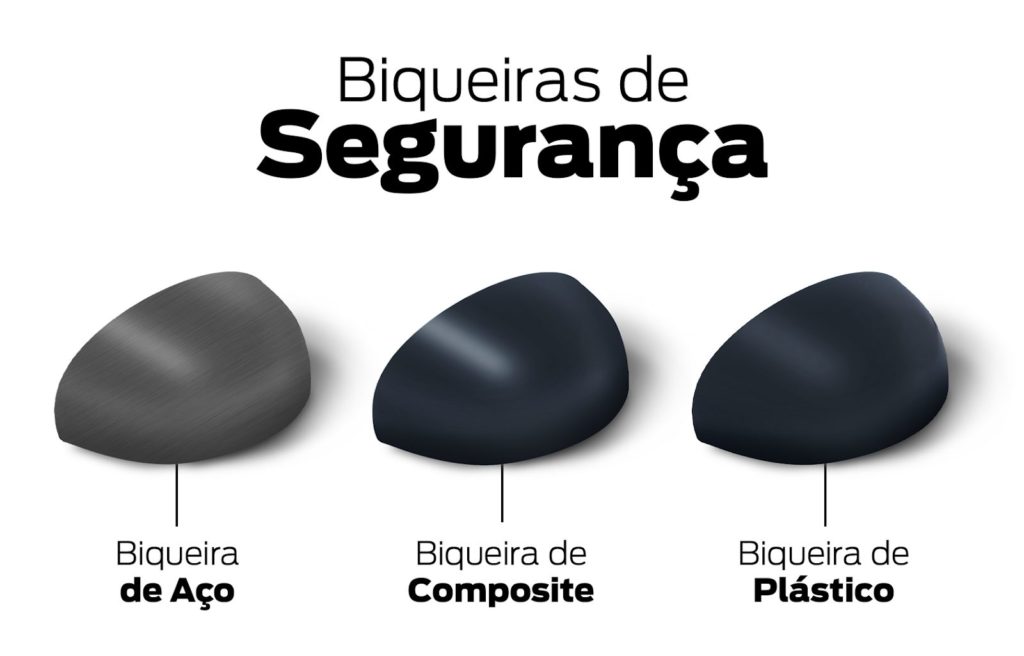
To facilitate the visualization of the differences, we have summarized the main aspects of each type of safety toe cap:
| Characteristic | Steel Toe Cap | Composite Toe Cap |
|---|---|---|
| Impact Resistance | 200 J | 200 J |
| Compression Resistance | 15 kN | 15 kN |
| Weight | approximately 84 grams | approximately 51 grams |
| Electrical Conductivity | Conducts electricity (non-insulating) | Does not conduct (electrical insulator) |
| Effect on Metal Detectors | Triggers detectors (metallic) | Undetectable (non-magnetic) |
| Footwear Cost | Generally more accessible | Generally higher |
As we have seen, both toe caps protect equivalently in what truly matters: impacts and compressions. The choice between one and the other will depend on your use context and the specific needs of your work.
Steel or composite: which to choose for your safety footwear?
The decision between footwear with a steel toe cap or a composite toe cap must take into account the environment and the professional activity. There is no universal answer. Each material has its practical advantages. To help, consider the following guidelines:
Work with electricity
If you work as an electrician, in panel maintenance, or any function with risk of shock, demand composite. The composite toe cap has no metallic components, ensuring the electrical insulation of the footwear. In this way, it meets electrical safety requirements (preventing accidents and complying with ABTN NBR ISO 16603:2017 for insulating footwear).
Security control and detectors
In places with metal detectors (aeroports, banks, electronics industries), composite also has an advantage. It avoids delays and inconveniences during inspections, as the footwear will pass freely through the control without triggering alarms.
Physical load and duration of use
If you spend many hours on your feet, walking long distances, or frequently climbing stairs, weight makes a difference. Composite, being lighter, contributes to less fatigue throughout the workday. Logistics teams, warehouse workers, assemblers, and others who are constantly moving tend to benefit from lighter footwear.
Traditional construction site or factory environments
If your work is in civil construction, heavy metallurgy, mining, or similar, and there are no special requirements (such as electricity), the steel toe cap remains an excellent choice. It offers robust and reliable protection at a lower cost, fully complying with standards. Many managers opt for steel in these situations due to its cost-benefit ratio.
Specific normative requirements
Always check the CA (Approval Certificate) of the footwear to see if it meets the requirements of your work. Both types of toe caps undergo rigorous testing. Therefore, it is fundamental that the chosen model has valid certification appropriate to your activity.
Thus, the best toe cap is the one that suits your occupational risk. Safetline manufactures safety footwear with both steel and composite toe caps, serving different sectors and user preferences. If you are still in doubt about which to choose, our technical team can help with specialized guidance.
Tailored safety with Safetline
Both steel and composite toe caps fulfill their role of protecting feet in case of accidents, each with its strengths. Safetline, with over 50 years in the market, does not compromise on quality and incorporates both technologies into its product line. The commitment is to offer you the best of both worlds: maximum safety and daily comfort.

Need help deciding? Explore the Safetline models available on the Products page or contact us to speak with our specialists. We are ready to help you find the ideal safety footwear for your needs. Protect your feet with experts in the field and take the next step with complete confidence.