
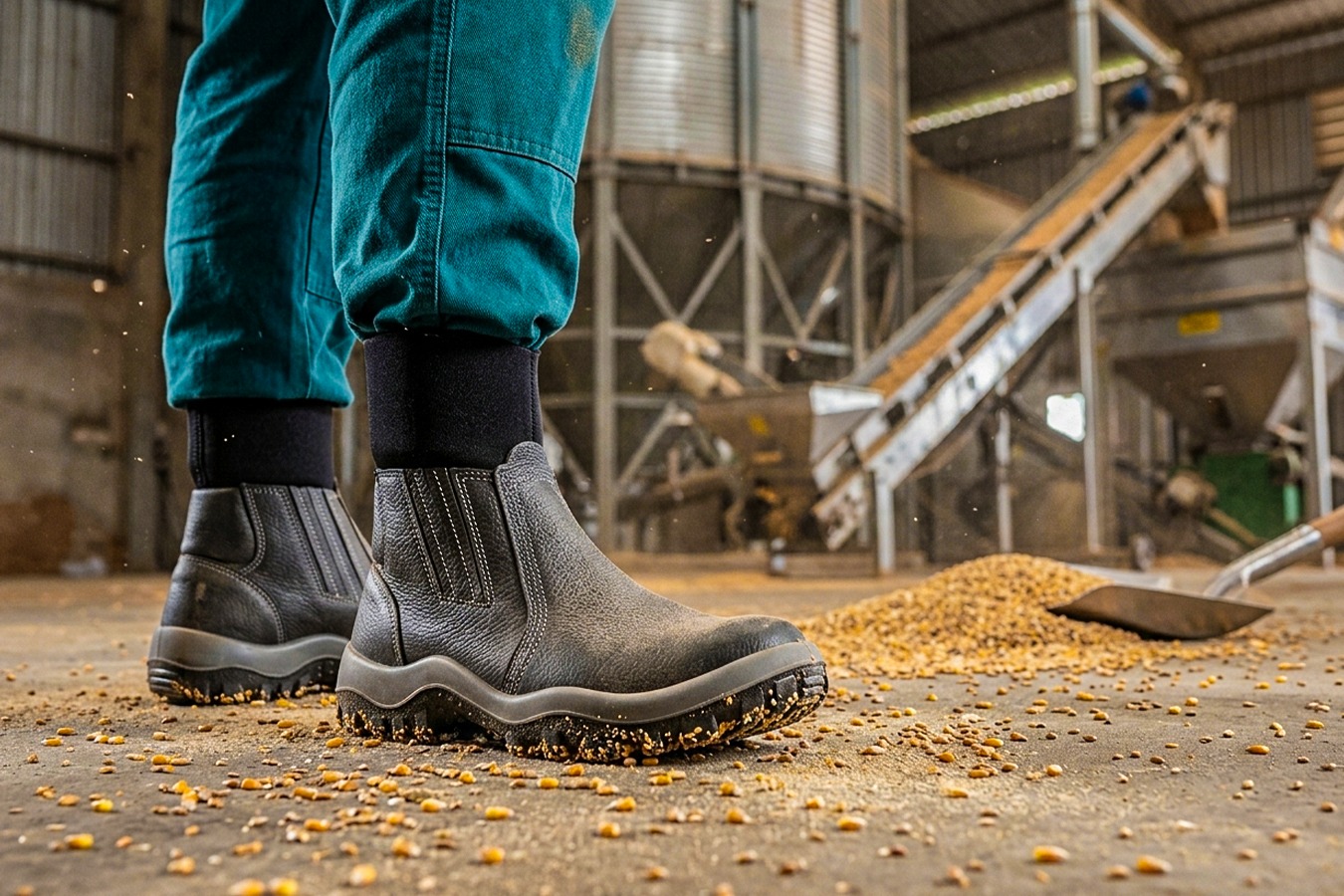
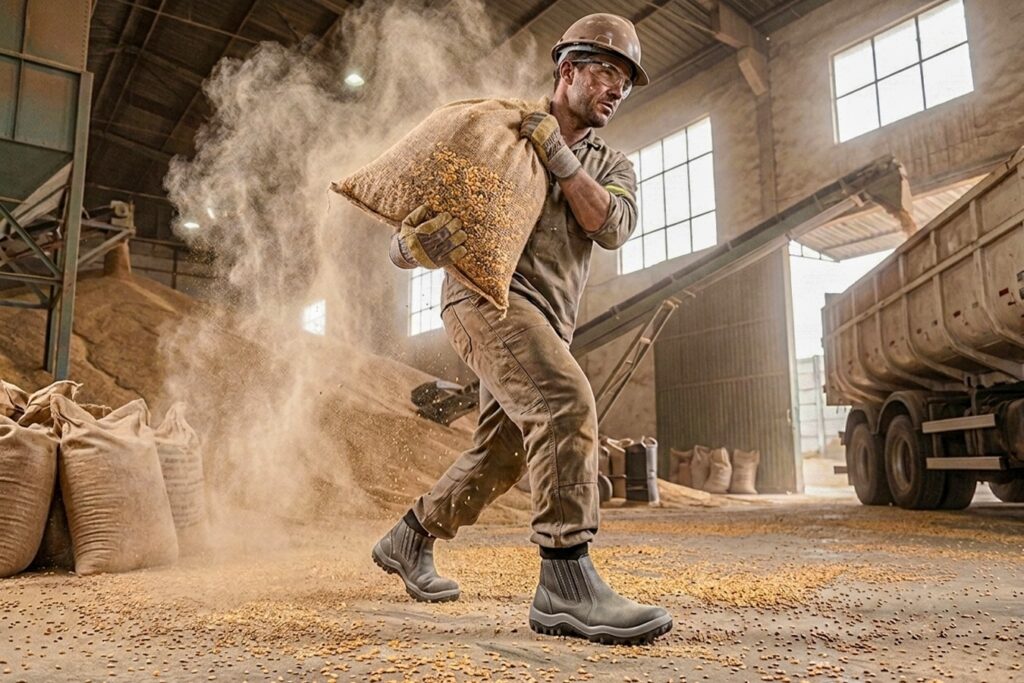
Safety boot for grain handling is the safety footwear designed for agricultural storage and processing environments, where the floor accumulates fine organic residues, suspended dust, and there is projection of residues and grains over the user's feet.
Understanding the activity and the risk involved leads us to two possible scenarios, with some differences and other similarities.
Both scenarios require a dual-density outsole with an anti-slip design, a composite or steel safety toe cap for protection against impacts and compression caused by heavy materials falling on the toes, and abrasion-resistant leather, contributing to the protection of the footwear in environments with the presence of particles and abrasive materials.
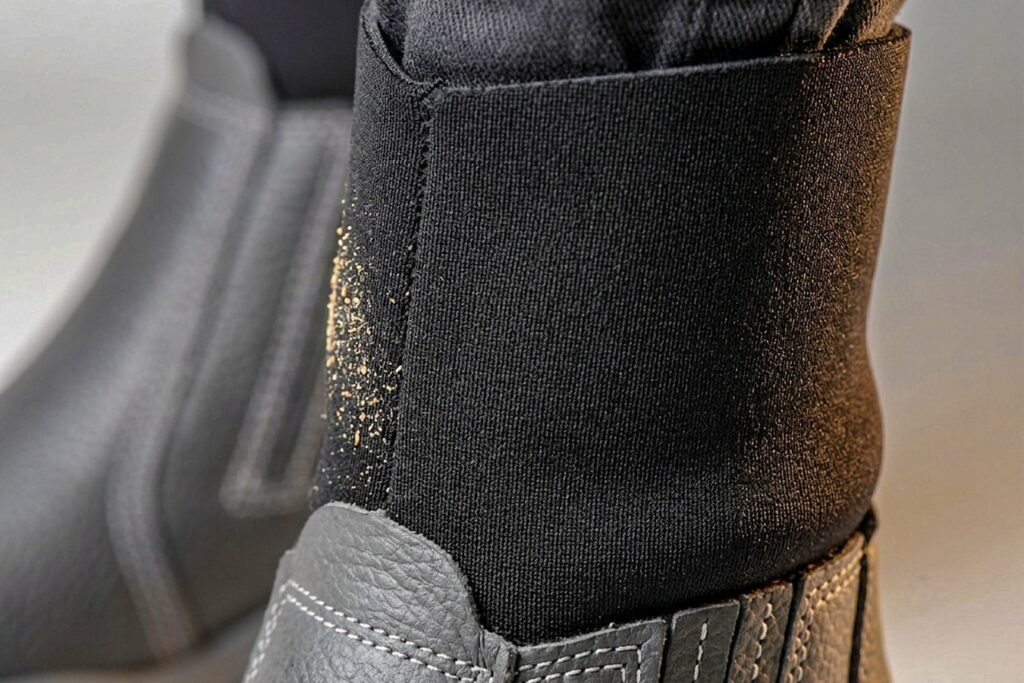
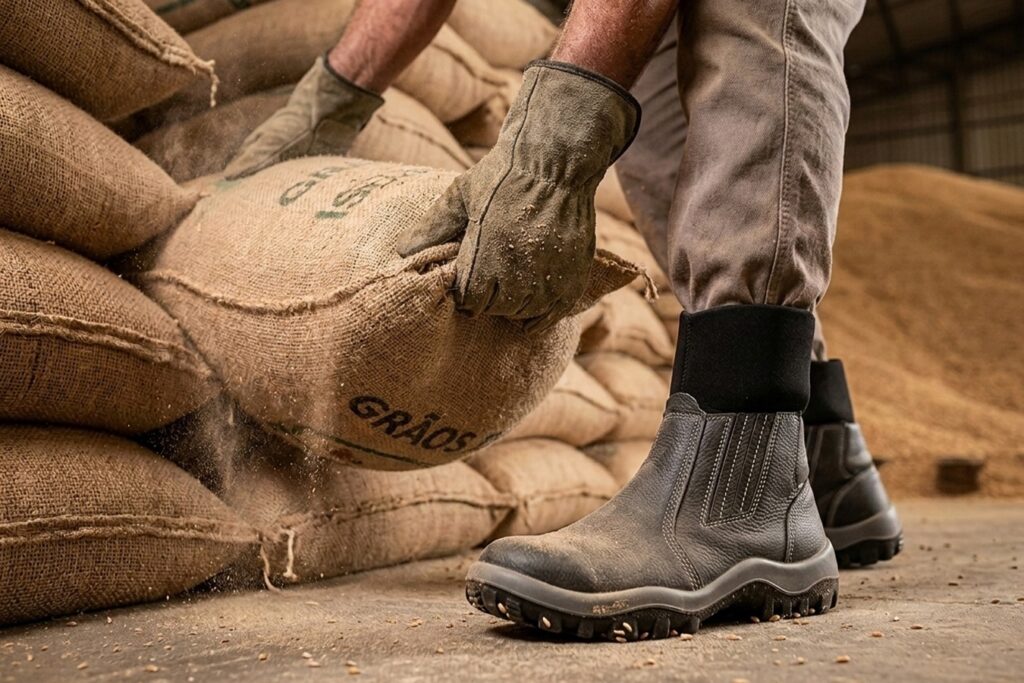
However, in circulation areas and open yards, the model must feature internal neoprene protection, which helps prevent residues and grains from entering the inside of the footwear. In closed areas with suspended dust, the use of antistatic footwear is recommended to reduce the risk of electrostatic charge accumulation and spark generation that could contribute to an accident.
In grain terminals and cooperatives, cheap footwear lasts less than three months. Dust accumulates on the poorly designed outsole and grip disappears right where the floor is slippery.
The cost of accelerated replacement weighs heavier on the budget than the initial purchase seems to indicate.
Next, you will connect each grain handling risk to the technical specification that reduces accidents and replacement costs.
What is a safety boot for grain handling?
The safety boot for grain handling is safety footwear designed for the agro-industrial storage and processing environment, where the floor accumulates fine organic residues, dust, and moisture.
It combines an anti-slip outsole, impact-resistant safety toe cap, and materials that withstand constant abrasion. It is not a generic adapted safety boot: it is an item specified for the concrete risks of silos, hoppers, grain terminals, and bagging lines.
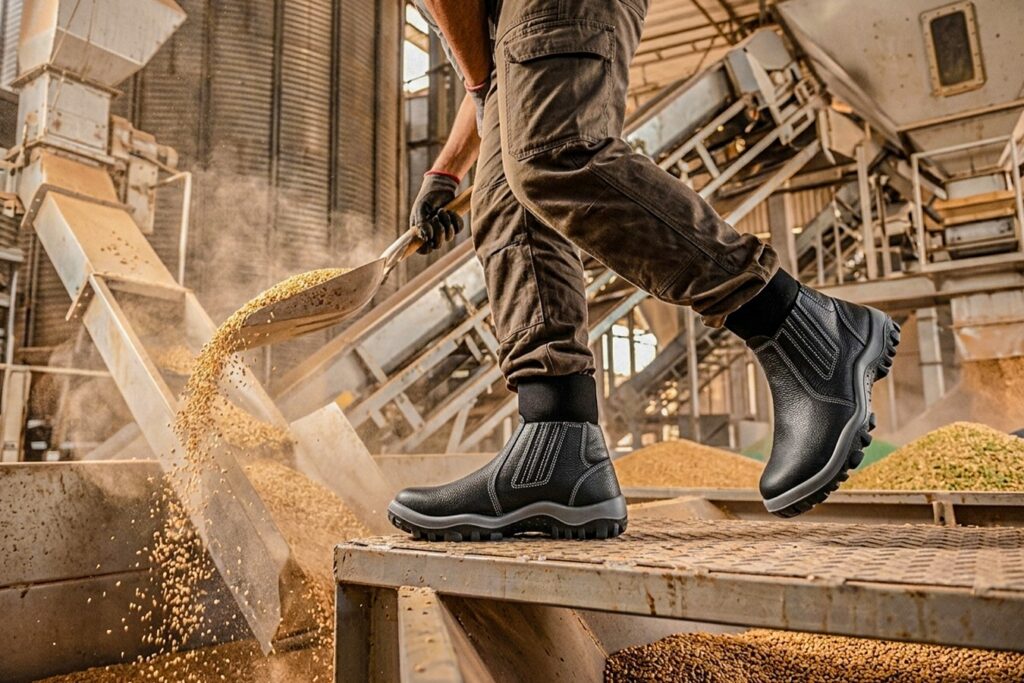
Definition and function in the agro-industrial environment
In cooperatives and processing industries, workers move between unloading yards, conveyor tunnels, silos, and bagging areas. Each point has a distinct risk profile.
Identifying the risk of each activity and using the appropriate footwear is the key to protecting the user, reducing labor risks, and ensuring operational efficiency.
Occupational risks in the grain sector: dust, slippery surfaces, and falling loads
The grain handling concentrates risks that rarely appear together in other sectors. The first is the slippery floor due to fine organic residue.
Broken grains, husks, and bran form a loose layer that drastically reduces friction, increasing the risk of same-level falls.
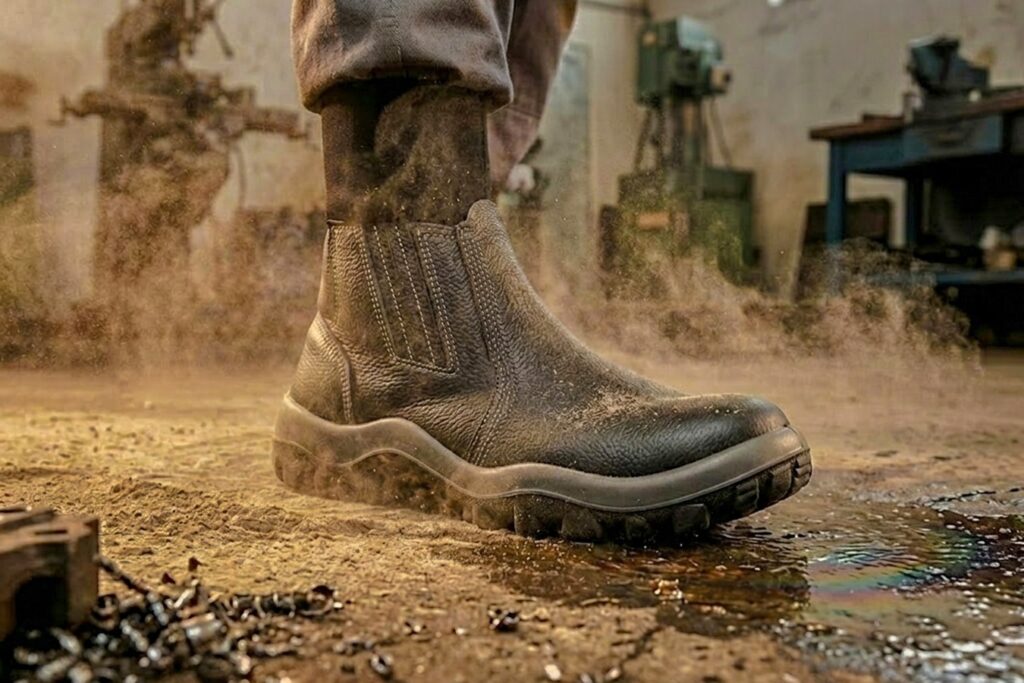
Second, suspended fine dust is a constant and often underestimated risk. The accumulation of grain particles such as corn, soy, wheat, or rice, when dispersed in the air in closed environments, creates a charged and highly explosive atmosphere. This condition becomes critical because a small ignition source—such as a static energy spark, mechanical friction, or even a defective light bulb—is enough to trigger a violent explosion.
Third is the falling of bags and objects. Bags weighing 25 to 50 kilograms, pallets, and equipment parts represent a direct impact on the instep and toes.
Fourth is the projection of grains through the opening of the workers' footwear. This detail, which may seem simple, brings serious risks to safety and health. When grains penetrate the footwear, they can cause discomfort, foot injuries, and even infections due to constant friction. In addition, the accumulation of grains inside the footwear compromises mobility, increases fatigue, and can cause falls or accidents during movement in loading and unloading areas.
Add to this an environment with temperature variations and moisture accumulation. The footwear material can suffer accelerated wear, lose mechanical resistance, and even favor the proliferation of fungi and bacteria, compromising foot health.
Why common footwear does not suit this scenario
A basic market model usually fails on four fronts in this environment.
In grain terminals, safety footwear faces specific challenges that compromise its effectiveness and make a design review urgent. Grip on the floor is quickly lost because the outsoles were not designed to expel grain residues that accumulate in contact with the ground, creating a slippery surface and increasing the risk of falls. Durability is also severely affected: abrasive dust and moisture attack the leather and seams at an accelerated rate, reducing the lifespan of the footwear and requiring frequent replacements.
Another critical point is impact protection, which is often insufficient or non-existent, leaving the worker exposed in situations of falling loads. In addition, the antistatic property, essential in dust-laden environments, has a very short validity in most brands. The poorly designed outsole accumulates debris that prevents energy dissipation, increasing the risk of sparks and explosions.
For the manager, the practical effect appears in the budget: replacement every two or three months, medical leave due to accidents, rework in purchasing, and the risk of a fatality.
The correct technical footwear reverses this logic. It costs more per pair, but delivers a superior lifespan, reduces replacement frequency, and maintains the legal compliance required by the operation.
In the next sections, each risk described here will be connected to the technical feature that neutralizes it.
Technical features that the grain handling safety boot must have
Specifying the right footwear starts by translating each risk of the grain environment into a technical attribute required in the purchase. It is not enough to ask for a “safety boot”: the manager needs to know exactly what to demand from the supplier.
Below are the four criteria that separate a model suitable for the sector from a generic safety boot.
Anti-slip outsole for floors with grain residue and dust
The floor of silos, hoppers, and dispatch areas is rarely clean. Loose grains, husks, and fine organic dust form a layer that reduces friction and turns every step into a fall risk.
The technical answer is the dual-density outsole with an anti-slip design. The softer layer absorbs impact, and the harder outer layer drains residue through the design channels and maintains grip even with grains underfoot.
Flat outsoles show low grip from the start, while low-density outsoles tend to show lower durability and greater wear over time, which can compromise their performance over time.
Safety toe cap for protection against falling bags and loads
The handling of loads up to 50 kg, pallets, and big bags places the worker's foot in a constant path of impact. The safety toe cap is the item that addresses this risk.
There are two approved options: steel safety toe cap and composite safety toe cap. Both meet the impact resistance test required by the standard. The composite does not conduct temperature nor trigger metal detectors, an advantage in operations with access control.
Moisture resistance and comfort for long shifts
Silos and hoppers concentrate moisture, and common leather absorbs, rots, and hardens. Water-resistant leather increases resistance to contact with water and extends the lifespan of the footwear.
Standing shifts of eight hours or more require comfort. An anatomical insole, good ventilation, and an upper that does not press reduce fatigue and medical leave due to discomfort at the end of the shift.
Durability and Validity of Antistatic Protection
Suspended dust in grain terminals does not only represent an explosion risk, but can also compromise the durability of safety footwear. Abrasive particles can wear down the leather and other footwear components over time, reducing its lifespan and increasing the need for replacement. Opting for footwear made with quality leather and abrasion-resistant materials contributes to greater strength and durability in environments with a high presence of particles.
However, we cannot forget the most important point: the validity of the antistatic property. In dust-laden locations, this feature is vital to prevent sparks that could trigger serious accidents. Footwear whose antistatic performance guarantee is only six months or less represents an unnecessary risk, as it leaves the worker vulnerable after a short period of use.
A quality footwear that has an antistatic protection guarantee for its entire lifespan generates fewer replacements, which means fewer purchases, fewer downtimes, and a predictable budget. Durability and antistatic protection guarantee, here, are not sales pitches: they are a direct reduction of operational costs and risks.
How to choose and adapt to the operation and NR6
Translating technical criteria into a purchasing decision requires checking legal compliance, distributing the model by function, and planning replacement.
A common mistake is to standardize a single footwear for the entire cooperative without noticing that the hopper operator, the warehouse checker, and the silo worker face different exposures.
Below is the practical path to specify and close the purchase with legal security.
Verification of the CA (Certificate of Approval)
Every safety footwear sold in Brazil needs a valid CA, issued by the Ministry of Labor and Employment. Without it, the PPE has no legal value and does not protect the company in inspections or labor lawsuits.
Before closing the order, check the CA number on the government website and verify its validity. Also check if the protections described in the certificate, such as: safety toe cap, anti-slip, and antistatic properties, correspond to what the operation requires.
Suitability for the type of function within the grain operation
The NR6 determines that the employer must provide the appropriate PPE for the activity's risk. This means mapping function by function.
Those who circulate in areas with dust explosion risks need footwear with antistatic properties. Those who operate in wet silos require water-resistant leather. Meanwhile, the forklift operator or bagging unloading worker depends on a robust safety toe cap against impact.
Maintenance to extend the lifespan of the footwear
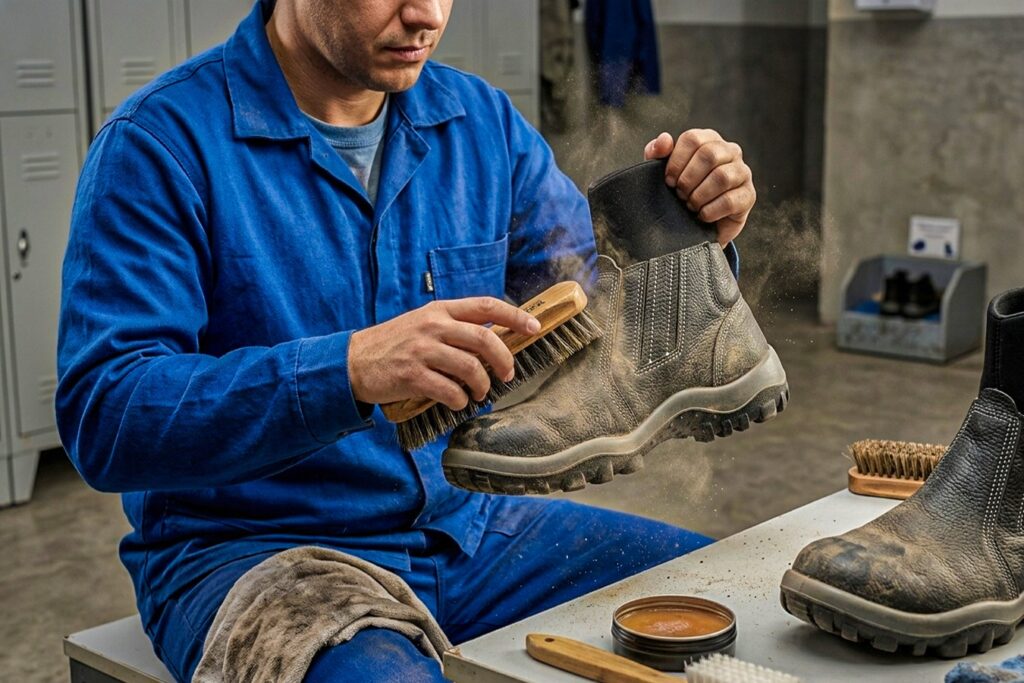
The fine dust of the grain environment can accelerate leather wear. Guide the team to clean the footwear at the end of the shift, removing accumulated residues and drying it away from direct heat sources.
Replacement must occur when the footwear loses its protective characteristics, such as in cases of torn leather, material deterioration, or when protection against water penetration is compromised. Delivery and replacement must be recorded in the PPE sheet, in accordance with the procedures applicable to NR-6.
How to quote and standardize PPE for the entire team
For a cooperative or industry, standardizing reduces inventory costs and simplifies control. Set up the quote with the team's complete sizing, the function of each group, and the technical attribute required by area.
Safetline serves this recurring purchase profile with footwear lines designed for the agro-industrial environment.
Models like the Safetline grain handling safety boot combine an anti-slip dual-density outsole and superior durability, a direct cost-benefit argument for those who suffer from accelerated replacement.
The first order that transforms your replacement
You started this text dealing with the slippery floor of the hopper, the dust that clogs the outsole, and bags falling without warning.
Now you know that none of these risks are solved with a generic safety boot: each requires a specific technical attribute, proven in the CA and suitable for the function.
What remains from this reading fits into three points:
- Grip first. Dual-density outsole with an anti-slip design keeps the foot firm even with loose grain and organic residue on the floor.
- Protection proportional to the risk. Composite or steel safety toe cap against falling heavy materials, resistance to fine dust abrasion, and, in silos with combustible dust risk, antistatic property.
- Durability is cost. A cheap model that lasts less than three months multiplies your replacement; the real cost of PPE is measured in lifespan, not per unit.
The next step is concrete. Map the functions of your operation (hopper, warehouse, silo), cross-reference each exposure with the technical criteria in this article, and set up the purchase specification before contacting any supplier.
If you want to transform this specification into footwear that withstands the grain processing routine, discover the Safetline safety boot for heavy-duty operations and evaluate the performance on your own line.
In grain handling, choosing the appropriate safety boot contributes to greater durability and lower replacement frequency, offering protection and resistance for the work routine.
Frequently asked questions
Which safety boot to use in grain handling?
The Safetline grain handling safety boot is the most suitable for grain handling and combines a dual-density outsole with an anti-slip design, a composite or steel safety toe cap, and an abrasion-resistant upper. These attributes address the real risks of the sector: slippery floors due to fine organic residue, dust that compromises grip, and falling bags. Generic models do not deliver this durability in an agro-industrial environment.
Why does the safety boot need to be anti-slip in silos and hoppers?
Because the floor of silos, hoppers, and unloading areas accumulates loose grain, fine dust, and moisture, a combination that drastically reduces friction. The anti-slip outsole maintains grip even with residue between the sole and the floor, preventing slips. A common outsole loses this property quickly, increasing the risk of falls during the shift.
Composite or steel safety toe cap for working with grains?
Both meet the impact protection required by the standard. The steel safety toe cap offers consolidated resistance and an affordable cost. The composite one is lighter, does not conduct temperature, and is indicated when there are metal detectors in the operation or electrical risk. The choice depends on the function and specific environment of each worker.
Does the safety boot for grain handling need to be antistatic?
Yes, when there is a dust explosion risk in silos and confined spaces. Suspended grain dust is combustible, and the antistatic property dissipates charges that could generate sparks. Check if the classified atmosphere of the operation requires this feature and confirm the specification with the supplier before standardizing the model.
What to check in the Certificate of Approval (CA) of the safety boot?
Check if the CA is valid, if it corresponds exactly to the delivered model, and if it covers the protective requirements of the function. The CA is the document that proves the compliance of the footwear with NR6 and enables the legal supply of the PPE. Without a valid CA, the equipment cannot be distributed to the worker.
Why do cheap safety boots last less in the grain environment?
Because the constant abrasion of dust, the moisture of silos, and contact with organic residue attack low-quality materials. Budget models usually lose grip and show upper wear in less than three months. Accelerated replacement increases the real cost per pair, making technical footwear more advantageous in the volume of a cooperative.
How to choose the right safety boot for each function in the cooperative?
Standardizing a single model for the entire operation is a mistake. The hopper operator, the warehouse checker, and the silo worker face different exposures to moisture, impact, and explosion risks. Map the risks by workstation, cross-reference these risks with the required technical attributes, and distribute the appropriate model to each function.
Is water-resistant leather safety boot worth it for grain storage?
Yes, in environments with recurring moisture, such as silos, hoppers, and washing areas. Water-resistant leather is more resistant to contact with water and maintains internal comfort during long shifts, reducing premature wear caused by moisture. Combined with a comfortable insole and dual-density outsole, it extends the lifespan of the footwear in the agro-industrial sector.
Why does the safety boot for grain handling need to have a neoprene sock?
The safety boot for grain handling needs to have a neoprene sock because this material works as a barrier that helps prevent grains from entering through the opening of the footwear—a common problem that causes discomfort, injuries, and even accidents due to loss of stability.