
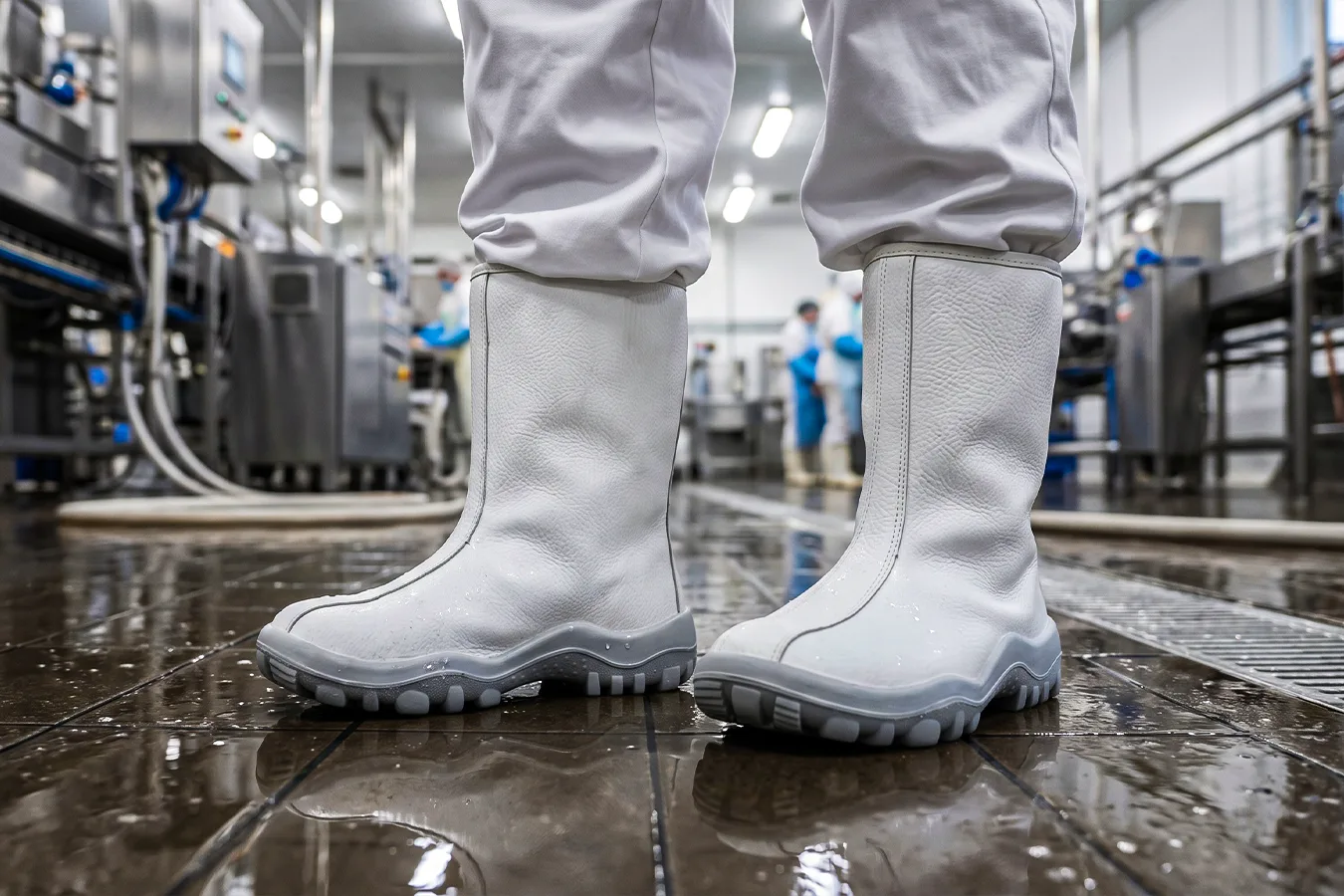
Footwear for the food industry is safety footwear developed to meet the demands of food production and processing environments. Its design prioritizes ease of cleaning, comfort, safety, and compliance with the sanitary requirements applicable to the sector. Depending on the activity and the risks involved, it may feature a slip-resistant outsole, an easy-to-clean upper, thermal protection, and/or a safety toe cap, always with a valid Certificado de Aprovação (CA).
Slips and falls on the same level are among the risks present in environments such as meatpacking and dairy plants. In these locations, safety depends on a combination of factors, including floor conditions, cleaning procedures, and the choice of footwear suited to the activity and the work environment.
The issue is that requirements change from the slaughterhouse to the cold chamber, and from baking to bottling. Specifying a single model for the entire plant usually proves costly due to premature replacements and incidents.
This guide leads the selection of safety footwear for the food industry, addressing the requirements of each area, the slip-resistance levels of the footwear, cleaning requirements, and criteria for volume purchasing.
What defines footwear for the food industry
Footwear for the food industry is a PPE designed for three conditions that rarely appear together in other sectors: floors subject to moisture and grease, frequent sanitization, and sanitary regulations that restrict materials and colors.
Therefore, the right model combines an upper resistant to sanitization processes, an outsole with an SRC slip-resistance level, and a construction with as few seams as possible, reducing points that could promote liquid infiltration or waste accumulation.
The choice must stem from the actual exposure of each area and the risks involved in the activity, not just the team's preference.
Risks present in food and beverage plants
Before specifying, it is worth mapping out what the footwear faces every day:
Presence of moisture in various process stages and cleaning procedures.
Animal and vegetable residues that can reduce the grip of outsoles not suited for the environment.
Accumulation of waste in seams, creases, and hard-to-clean spots, which can compromise hygiene.
Frequent sanitization processes that require uppers made of compatible and resistant materials.
Temperature variations between different production, storage, and refrigeration areas.
Hygiene, cleaning, and sanitization requirements
Food safety programs demand that footwear withstand frequent sanitization processes without compromising its performance and original characteristics. For this reason, synthetic materials and polymeric compounds used in manufacturing occupational footwear are widely employed in these environments due to their resistance to cleaning and sanitization processes.
The white color facilitates the visual identification of dirt and contributes to inspection and sanitization processes. For this reason, it is widely used in food industry environments.
What the CA indicates about allowed use
The Certificado de Aprovação describes the risks for which the model was tested, including outsole resistance and upper protection. Checking this document prevents purchasing a product unsuitable for the environment. Anyone wishing to go deeper can learn how to identify safety footwear before completing the size grid.

How to choose the right footwear for each area
Specifying a single model for the entire plant causes waste in one sector and lack of protection in another. The way forward is to map each zone and define the outsole, upper, and safety toe cap according to the predominant risk.
Wet processing and slaughter areas
Wet processing and slaughter areas involve frequent contact with water, blood, viscera, and other waste inherent to the production process, as well as the movement of carcasses, boxes, and various materials. For these conditions, it is recommended to use water-repellent safety boots with protection against moisture from water-use operations, an SRC outsole for slip resistance, and a safety toe cap when required by the job risk analysis. These features contribute to worker safety, comfort, and performance, while meeting the sanitization demands of the environment.
Cold chambers and freezing tunnels
In these areas, low temperatures can compromise the performance of conventional outsoles, making the selection of appropriate materials essential. It is recommended to use footwear with a TPU (thermoplastic polyurethane) outsole, a material that helps maintain flexibility and performance in refrigerated environments, along with a thermal and regulating lining that aids worker comfort throughout the shift. For this application, a mid-cut safety boot is a recommended option as it provides protection and comfort compatible with environmental conditions.
Bottling, packaging, and dry areas
In these areas, where exposure to moisture tends to be lower, lighter models can be used, such as occupational shoes or safety shoes. The choice should prioritize an outsole with slip resistance compatible with environmental risks, materials suitable for sanitization processes, and features that provide comfort during long periods of standing and moving. White color is frequently adopted because it facilitates the visual identification of dirt and contributes to hygiene controls.
Dispatch, docks, and external traffic areas
In these areas, the movement of pallets, goods, carts, and forklifts is common, along with constant circulation of people and equipment. For these conditions, using safety boots with a safety toe cap is recommended when required by the activity's risk analysis, alongside an SRC outsole that contributes to slip resistance. Models with a lace-up closure system can also provide a better fit to the feet during the workday, promoting comfort and stability while moving.
Maintenance and engine rooms
In these areas, professionals frequently move through different sectors of the plant and may be exposed to specific mechanical, electrical, and operational risks of each activity. For these conditions, using safety boots without metallic components is recommended, featuring an SRC outsole and specifications compatible with the role's risk analysis.

Specification, care, and replacement throughout the service life
Technical specification only yields results when PPE management accompanies the entire cycle: purchase, use, and replacement.
Specification criteria before purchasing
Survey by plant area, detailing the number of users and predominant risk.
Complete sizing grid, including extreme sizes, to avoid improvisation.
Verification of CA validity and delivery logs signed by employees.
Support sectors, such as reception and dispatch, can follow the same logic applied to safety footwear for logistics, featuring slip-resistant outsoles and comfort for long shifts.
Sanitization routine without compromising the material
Footwear sanitization should be carried out according to company-established procedures and manufacturer guidelines, using methods and products compatible with the materials composing the footwear.
It is also important to follow drying and storage recommendations, contributing to the preservation of the product's original characteristics and its performance throughout its service life.
Signs that footwear must be replaced
Footwear replacement must be considered when signs of wear are observed that could compromise its safety, performance, or hygiene. Key indicators include excessive wear of the outsole tread grooves, cracks or damage to the upper, loss of protective features, and any damage affecting the product's integrity.
In industrial environments, especially in the food sector, it is also essential to observe the presence of fungi, bacteria, or persistent dirt that cannot be removed during sanitization, as they may represent contamination risks.
Replacing footwear at the right time contributes to worker safety and hygiene. Furthermore, choosing footwear with resistant, durable, and easy-to-clean materials favors product preservation and its service life.

Where to start specification
The starting point for footwear specification is evaluating the real conditions of each environment, considering factors such as exposure to moisture, sanitization requirements, occupational risks, and applicable sanitary standards. The difference is that these factors vary depending on the area of operation, and environments like the slaughter area, cold chambers, and bakery areas demand distinct features from the same PPE.
Therefore, footwear selection must always align with working conditions and the risk analysis of each operation, ensuring adequate safety, comfort, and performance for the activity performed.
If you retain three key points from this guide, keep these:
Specify by plant zone, defining the outsole, upper, height, and safety toe cap according to the predominant risk of each area.
The starting point for footwear specification is evaluating the real conditions of each environment, considering factors such as exposure to moisture, sanitization requirements, occupational risks, and applicable sanitary standards. The difference is that these factors vary depending on the area of operation, and environments like the slaughter area, cold chambers, and bakery areas demand distinct features from the same PPE.
Therefore, footwear selection must always align with working conditions and the risk analysis of each operation, ensuring adequate safety, comfort, and performance for the activity performed.
Manage the full lifecycle: defined cleaning routine, monitored replacement indicators, and valid CA recorded with each delivery.
The next step fits into this week's agenda. Walk through the plant with a simple spreadsheet, recording floor types by area, cleaning agents used, and the number of users with footwear sizes.
This survey becomes the foundation of the sizing grid and prevents buying a single model that protects well in one sector and fails in another.
Right footwear in each area means sanitary control and team protection resolved in a single decision.
When mapping is complete, talk to Safetline's technical team to discover the white line and, if appropriate, build a complete footwear grid for your operation by plant area with the support of an authorized distributor.
Frequently Asked Questions
Which footwear should be used in the food industry?
Footwear should be specified according to the risks and conditions of each area. Generally, it is recommended to use models made from materials resistant to sanitization processes, preferably in white when required by company standards. In environments exposed to moisture, priority should be given to footwear with water-repellent protection or moisture protection for water-use operations, as well as an SRC-rated outsole for slip resistance.
In processing areas, slaughterhouses, and cold chambers, mid-cut safety boots with protective features compatible with the activity may be indicated. Every model must have a valid CA (Certificado de Aprovação) and a construction that minimizes seams and waste accumulation spots, favoring sanitization processes.
Why is food industry footwear usually white?
White is widely used in the food industry because it facilitates the visual identification of dirt during routine inspections and sanitization processes. Additionally, many companies adopt light colors for uniforms and equipment as part of their internal food hygiene and safety control procedures. For this reason, white footwear is a frequent choice in food production and handling areas.
What is the difference between PVC and microfiber footwear for meatpacking plants?
PVC is waterproof, easy to clean, and widely used in boots intended for environments with high moisture exposure and frequent cleaning processes. Microfiber, on the other hand, is a lightweight material, resistant to sanitization processes, and provides comfort for extended shifts.
Is footwear for cold chambers different from regular safety footwear?
Yes. Cold chamber environments and freezing tunnels require footwear developed to maintain performance at low temperatures. In these cases, it is recommended to use models with thermal and heat-regulating lining, such as Thinsulate, which contributes to worker comfort during the shift.
Another key differentiator is the TPU (thermoplastic polyurethane) outsole, a material that helps maintain flexibility and grip in cold environments. Additionally, footwear with water-repellent uppers helps protect against moisture from activities and the workplace environment.
How to sanitize food industry footwear?
Footwear sanitization must follow company-established procedures and manufacturer guidelines, using appropriate cleaning methods and products for each work environment and footwear material.
It is essential that chemical products used are compatible with the footwear materials, avoiding harsh substances that could cause damage, compromise structure, or reduce durability. Using inappropriate products, especially in high concentrations, can cause premature wear and severe damage to the footwear.
It is also important to observe the manufacturer's storage and maintenance recommendations, preserving the product's original characteristics and contributing to the maintenance of hygiene, safety, and performance conditions throughout its service life.
When should safety footwear be replaced in the food industry?
Replacement must be carried out whenever signs of wear or damage are identified that could compromise safety, performance, hygiene, or footwear integrity. Key indicators include excessive wear of outsole tread grooves, cracks or tears in the upper, and water penetration inside the footwear.
It is also necessary to consider replacement when the footwear loses its sanitary conditions, especially in cases where it presents persistent dirt or contamination that cannot be eliminated by proper sanitization procedures.
Maintaining a record of deliveries and replacements is also recommended, facilitating the tracking of the replacement cycle by role, sector, or activity.
Does any white footwear work for the food industry?
No. Color is only one of the selection criteria. The footwear must have a valid CA (Certificado de Aprovação), features compatible with job risks, materials resistant to sanitization processes, and a construction that minimizes seams and waste accumulation points. Furthermore, using an SRC-rated outsole for slip resistance is recommended, along with moisture protection from water-use operations when necessary.
White footwear lacking the right technical features may meet visual requirements, but not necessarily the safety, performance, and hygiene needs demanded by the work environment.