
In corporate procurement, reducing costs is an ongoing priority. However, when it comes to Personal Protective Equipment (PPE), analyzing only the initial purchase price can lead to decisions that significantly drive up expenses over time. Safety footwear durability is one of the most critical factors in determining return on investment and total cost of ownership.
Companies that evaluate only the purchase price frequently overlook recurring expenses associated with replacements, logistics, inventory, and supply chain management. Therefore, investing in durable safety footwear does not represent a higher cost, but rather an intelligent strategy for reducing operational costs.
It is precisely in this scenario that brands renowned for quality, such as Safetline, stand out—delivering solutions engineered to maximize safety footwear durability, protect employees, and generate real savings for businesses.
How Safety Footwear Durability Reduces Operational Costs
The relationship between safety footwear durability and cost savings can be measured objectively. The longer the service life of the PPE, the lower the replacement requirements and the smaller the annual purchase volume.
Low-Quality Footwear
- Lower initial investment.
- Average service life of approximately 3 months.
- Frequent need for replacement.
- Higher cumulative cost throughout the year.
- Increased administrative and logistical workload.
High-Durability Footwear
- Higher initial investment.
- Average service life of 9 months or more.
- Fewer replacements.
- Reduction in annual pair consumption.
- Lower total cost of ownership.
When analyzing the total operational cost, it becomes evident that safety footwear durability directly impacts the corporate budget.
Beyond savings on PPE procurement, companies that use more durable products reduce expenses related to freight, goods receipt, warehousing, invoice issuance, and emergency replacements.
The Mathematics of Cost-Benefit: Durability vs. Replacement
When safety footwear offers low durability, the company is forced to place multiple purchase orders throughout the year to ensure continuous PPE supply to employees.
In contrast, high-durability safety footwear—engineered with premium materials and wear-resistant technologies—remains in service far longer, drastically reducing replacement frequency.
The cost savings are not limited to the product itself, but also encompass the elimination of hidden costs associated with constant replacements.
Case Study: How Durable Safety Footwear Delivers Annual Cost Savings
To demonstrate how safety footwear durability directly affects bottom-line results, we analyzed the annual cost for an industrial plant with 650 employees.
The study compares a standard market model with a high-performance solution from Safetline.
Cost and Performance Indicators
| Indicator | Conventional Footwear | Safetline High Durability |
|---|---|---|
| Model | Leather safety boot, elastic closure, and steel toe cap | Leather safety boot, lace-up closure, and composite toe cap |
| Average Durability | 4 months (120 days) | 9 months (270 days) |
| Unit Price | R$ 69.50 | R$ 127.85 |
| Daily Cost per Worker | R$ 0.58 | R$ 0.47 |
| Annual Purchase Volume | 1,950 pairs | 867 pairs |
| Total Annual Cost | R$ 135,525.00 | R$ 110,803.33 |
The Myth of the Lowest Price
At first glance, the conventional option appears more advantageous due to its lower initial purchase price.
However, its low safety footwear durability demands the purchase of 1,950 pairs per year to equip the exact same workforce.
With Safetline engineering and technology, durability increases from 4 to 9 months, reducing procurement volume to just 867 pairs annually.
Key Results Achieved
- Direct financial savings of 22.31% on the annual footwear budget.
- Reduction of R$ 24,721.67 per year in total costs.
- Fewer procurement and replenishment workflows.
- Greater budget predictability.
- Enhanced inventory control.
The study clearly demonstrates that safety footwear durability is a decisive factor for organizations looking to cut costs without compromising worker protection.
Case Study 2: The Impact on Large Logistics Complexes
When analyzing large-scale operations, safety footwear durability becomes even more strategic.
One of the country's largest mining and infrastructure conglomerates, with over 350 delivery points distributed across Brazil, implemented Safetline footwear across its operations.
The results observed over a three-year period were substantial:
- First 12 months: average of 12,440 pairs per month.
- Months 13 to 24: average reduced to 6,525 pairs per month.
- Months 25 to 36: average stabilized at 6,172 pairs per month.
Practical Outcome
Following the standardization of higher-resistance models, there was an approximate 50% reduction in recurring footwear demand.
For organizations reliant on complex logistics operations, this reduction yields major gains across:
- Freight.
- Warehousing.
- Inventory control.
- Distribution.
- Supply chain management.
Once again, safety footwear durability proved to be a competitive differentiator with a direct impact on financial performance.
Safety Footwear Durability and Corporate Sustainability
The benefits of safety footwear durability extend well beyond financial savings.
Reducing replacement frequency directly supports ESG (Environmental, Social, and Governance) goals.
By consuming fewer pairs over the course of the year, organizations reduce:
- Industrial waste generation.
- Disposal of components such as outsoles and uppers.
- Raw material consumption.
- Emissions generated by logistics transportation.
- The operation's carbon footprint.
Investing in durable safety footwear is also an investment in sustainability.
The Hidden Costs of Low-Durability Safety Footwear
Beyond direct expenses, the use of low-quality PPE incurs silent financial losses.
Productivity Drops
Worn-out or uncomfortable footwear can cause fatigue, musculoskeletal discomfort, and decreased worker performance.
Increased Accident Risks
When the outsole loses traction or the footwear structure degrades, the risk of slips, trips, falls, and workplace accidents increases significantly.
More Replacements and More Administrative Burden
The lower the safety footwear durability, the higher the volume of purchase orders, shipping management, receiving, and tracking required throughout the year.
Indirect Financial Impacts
Medical leaves, emergency replacements, administrative rework, and legal liabilities can easily eclipse the nominal savings gained by purchasing solely based on lowest unit price.
When Quality Is Non-Negotiable
With more than 50 years in the market, Safetline has established itself as a benchmark in protection, innovation, and durability.
The company engineers solutions dedicated to maximizing safety footwear durability, leveraging high-grade raw materials, proprietary technology, and stringent quality control processes.
Materials such as 100% full-grain leather, heavy-duty components, and composite safety toe caps ensure extended service life, superior comfort, and heightened protection for workers.
Safetline Portfolio Highlights
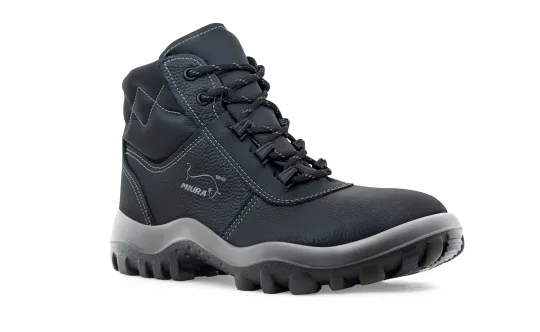
Miura Safetline Gran Luxo Black Safety Boot
Crafted from premium water-repellent full-grain leather, it offers high resistance to moisture, contributing to extended safety footwear durability.
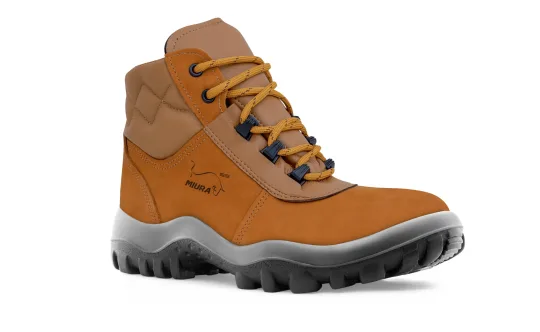
Miura Safetline Caramel Nubuck Safety Boot
Equipped with the Falcon Dual-Density (PU/PU) outsole, it delivers high abrasion resistance, exceptional slip resistance, and reduced wear over time.
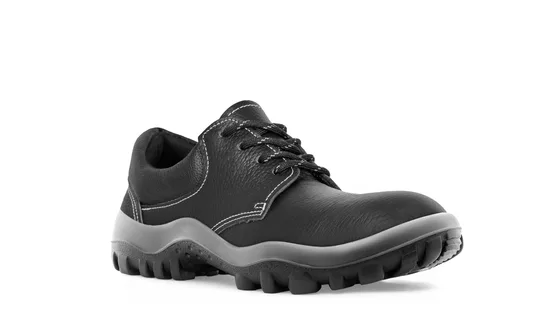
Safetline Lace-Up Safety Shoe
Features Full Impact technology and high-tenacity nylon reinforced stitching, mitigating failures at critical flex points and extending product service life.
Why Safety Footwear Durability Must Be a Core Procurement Criterion
PPE selection should never be based solely on unit price.
The data proves that safety footwear durability directly drives operational costs, productivity, worker safety, and sustainability metrics.
Companies that invest in durable safety footwear successfully reduce annual costs, lower replacement volumes, streamline logistics, and reinforce their ESG practices.
By choosing solutions built for maximum endurance, such as Safetline models, your organization transforms a recurring expense into a strategic investment with proven returns.
Do not compromise on worker safety or your business's financial health.
Contact Safetline specialists, request a quote, and discover how safety footwear durability can deliver cost savings, productivity, and protection across your entire operation.