

Identifying safety footwear is not just about whether it looks resistant. Correct PPE must have a Certificado de Aprovação (CA), technical markings, protection acronyms compatible with the activity's risk, and appropriate construction for the work environment.
For companies, safety technicians, buyers, and end-users, this verification prevents three common problems: incompatible PPE purchases, worker exposure to real risks, and liabilities due to inadequate supply.
In this guide, you will understand how to identify safety footwear by its CA, normative acronyms, toe cap type, sole, traceability, and signs of wear. At the end, you will have a practical checklist to validate the PPE before purchase, supply, or use.
How to quickly identify safety footwear?
To identify safety footwear, check if it has a valid CA, permanent markings on the product, protection acronyms compatible with the activity's risk, an appropriate toe cap, the correct sole, and traceability information such as manufacturer, lot, reference, and manufacturing date.
In practice, observe these points:
- CA number and possibility of consultation in the MTE system.
- Manufacturer's name or brand identification.
- Protection acronyms, such as SB, P, A, E, FO, SRC, HRO, WRU, WR, M, AN or CR.
- Compatibility between the model and occupational risk.
- Type of toe cap, insole, sole, upper, and closure.
- Instruction manual and maintenance recommendations.
- Physical condition of the PPE, especially the sole, seams, upper, and toe cap area.
If any of these items are missing, illegible, or incompatible with the activity, the footwear needs to be evaluated more critically before being purchased or delivered to the worker.
Why does correct safety footwear identification matter?
Safety footwear protects feet against risks that can cause absences, serious accidents, and loss of productivity. Among the main risks are:
- Impacts from falling objects on toes.
- Punctures from nails, wires, scrap, and sharp objects.
- Slips on wet, smooth, or oily floors.
- Contact with heat, cold, humidity, or chemical products.
- Electrical risks, when the worker operates in specific installations.
- Cuts, abrasions, and lateral impacts.
- Impacts on the metatarsal region.
The most common mistake is choosing footwear based solely on price or appearance. This decision can be costly. A model without the necessary protection can fail precisely at the critical moment.
On the other hand, oversized footwear for a simple activity can also lead to discomfort, low adherence to use, and unnecessary cost. The correct choice balances protection, comfort, durability, and legal compliance.
First step: identify the activity's risks
Before looking at the model, color, or price, evaluate the work environment. The footwear must address the actual risk of the job.
See practical examples:
| Environment or activity | Main risk | Protection to be evaluated |
| Civil construction | Impact, puncture, and slip | SB, P, SRC, resistant toe cap and robust sole |
| Logistics | Slip, light impact, and long shifts | SB, E, SRC, comfortable sole and good absorption |
| Refrigerated environments | Cold, humidity, and slippery floor | CI, WR or WRU, SRC and thermal lining |
| Metallurgy and welding | Contact heat, impact, and sparks | HI, HRO, SB, M and resistant sole |
| Electrical | Electric shock in dry environment | SI or OI. Insulating footwear according to application. |
| Chemical and petrochemical | Chemical agents, oils, and electrostatic risk | FO, A, WRU, appropriate sole and resistant upper |
| Agriculture and field | Humidity, cuts, impact, and uneven terrain | WRU, CR, P, SRC and appropriate shaft |
The analysis must be performed by a qualified professional, such as a safety technician or engineer. The buyer may know the acronyms, but the final definition must consider the PGR, actual exposure, and usage conditions.
Verify the PPE's Certificado de Aprovação (CA)
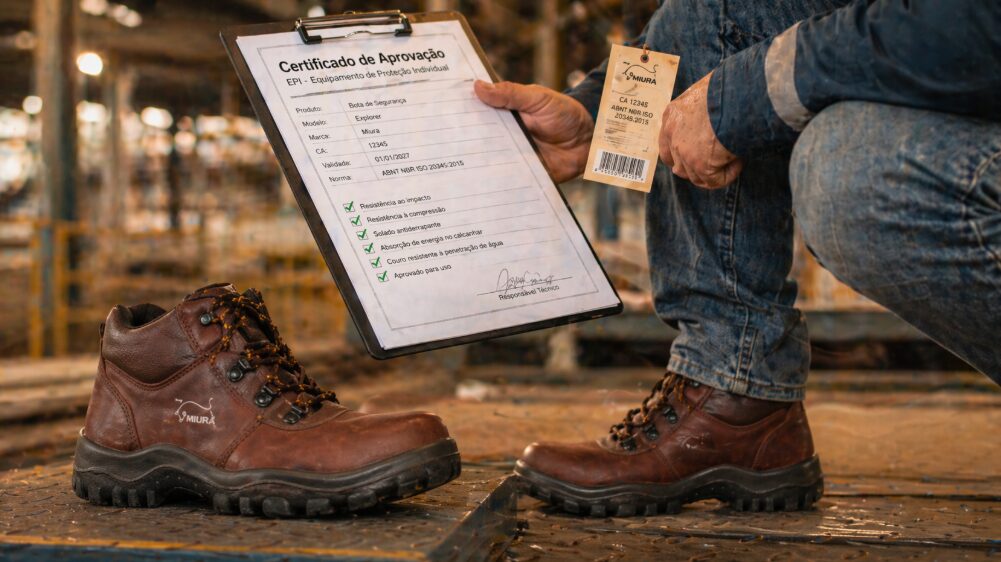
The CA is one of the main points to identify if the footwear can be treated as PPE. It proves that the equipment has undergone technical evaluation and meets applicable requirements.
When verifying the CA, observe:
- Certificado de Aprovação (CA) number.
- Manufacturer's name.
- Approved PPE type.
- Model description.
- Protections indicated in the certificate.
- Certificate validity.
- Usage restrictions, if any.
A common mistake is to only check if a CA number exists. This is not enough. The CA must correspond to the actual footwear model and the protection required for the activity.
For example, occupational footwear may have a CA but not be suitable for heavy objects falling on the toes. In this case, if the job requires a safety toe cap, the model must be safety footwear, not just occupational.
Does a valid CA mean the footwear never expires?
No. The validity of the CA and the lifespan of the footwear are different concepts.
The CA is the documentary validity for commercialization and technical proof of the PPE. The durability of the footwear, however, depends on use, maintenance, storage, environment type, work shift intensity, and the product's physical condition.
After acquisition, the company must observe the manufacturer's guidelines regarding storage, inspection, usage validity, and replacement.
Understand safety footwear acronyms
The acronyms engraved on the footwear indicate which protections the model offers. They help the buyer, safety technician, and user confirm if the PPE meets the foreseen risk.
| Acronym | What it indicates | When to observe |
| OB | Basic occupational footwear, without safety toe cap | Areas without risk of impact on toes |
| PB | Basic protective footwear | Intermediate impact risks |
| SB | Basic safety footwear, with toe cap resistant to 200 J impact | Environments with risk of falling objects on feet |
| SRA | Slip resistance on ceramic tile with detergent solution | Wet floors or with frequent cleaning |
| SRB | Slip resistance on steel floor with glycerin | Environments with grease, oil, or smooth surfaces |
| SRC | Combination of SRA and SRB tests | Environments with higher slip risk |
| P | Puncture-resistant insole | Construction, maintenance, scrap, metallurgy, and areas with sharp objects |
| A | Antistatic property | Electronics, petrochemical, logistics, and areas with electrostatic risk |
| E | Heel energy absorption | Long shifts and activities with much movement |
| FO | Fuel oil resistant sole | Workshops, industry, maintenance, and oily environments |
| HRO | Contact heat resistant sole | Welding, steelmaking, metallurgy, and heated areas |
| CI | Cold insulation | Cold chambers and refrigerated environments |
| HI | Heat insulation | High-temperature environments |
| WRU | Upper resistant to water penetration and absorption | Humidity, splashes, and outdoor areas |
| WR | Fully water-resistant footwear | Environments with constant presence of water |
| M | Metatarsal protection | Mining, steelmaking, heavy logistics, and construction |
| AN | Ankle protection | Locations with risk of lateral impact or instability |
| CR | Cut resistance | Activities with blades, machetes, sheets, or glass |
These acronyms should not be seen as secondary technical details. They are the language of PPE. Footwear with SB protects against toe impact, but this does not automatically mean it has a puncture-resistant insole, heat resistance, or metatarsal protection.
Difference between occupational, protective, and safety footwear
Many people use the terms as if they were interchangeable, but they indicate different levels of protection.
Occupational footwear
It is indicated for light risks. It does not have a safety toe cap against heavy impact. It can be used in administrative areas, light services, or environments where there is no risk of objects falling on the toes.
Protective footwear
It has intermediate protection. The toe cap resists less impact than that of safety footwear (100J). It is less common in some segments, as many companies prefer to directly specify safety footwear when there is a relevant risk.
Safety footwear
It is the model indicated for more severe risks. It has a safety toe cap with 200 J impact and compression resistance, and can also receive additional protections according to the activity.
The most important difference is simple: if there is a real risk of heavy objects falling on the toes, the company must evaluate safety footwear with an appropriate toe cap.
Examine product markings and traceability
Reliable safety footwear must allow for technical identification. Look for markings such as:
- CA number.
- Manufacturer.
- Model reference.
- Manufacturing date or lot.
- Protection acronyms.
- Permanent identification on the sole, label, or area indicated by the manufacturer.
These markings help in audits, internal inspections, recurring purchases, field reports, and failure investigations. They also prevent confusion between similar models with different protections.
At Safetline, traceability is treated as a technical differentiator. The objective is to allow the product to be identified, analyzed, and linked to its manufacturing history. This increases buyer confidence and facilitates technical support when the company needs to prove compliance.
Evaluate the toe cap: steel, composite, or PVC
The toe cap is one of the most important parts of footwear when there is a risk of impact on the toes.
Steel toe cap
It is traditional, robust, and indicated for industrial environments with mechanical risk. It offers high resistance to impact and compression but adds more weight to the footwear.
Composite toe cap
It is a modern and lighter alternative. As it is manufactured with non-metallic material, it can be indicated for environments where lightness, comfort, and the absence of metallic components are important.
PVC toe cap
It is used in models that do not need to protect against heavy falling objects. It can be useful in specific contexts but does not replace a safety toe cap when the risk requires severe impact protection.
The correct choice depends on the environment. There is no single best toe cap for all cases. There is an appropriate toe cap for the right risk.
Check the puncture-resistant insole
If the worker operates in areas with nails, wires, scrap, chips, glass, or sharp objects on the ground, a puncture-resistant insole is essential.
The most common options are:
- Steel insole: traditional, resistant, and widely used in industrial areas.
- Aramid insole: lightweight, flexible, and with high puncture resistance.
The protective insole must be listed in the model's characteristics and corresponding acronyms. Do not assume that all safety footwear has puncture protection. The acronym P needs to be verified.
Observe the sole: grip, material, and environment
The sole is the foundation of safety footwear performance. It influences grip, stability, comfort, impact absorption, abrasion resistance, and durability.
PU/PU sole
It is a versatile option for general use. The lower density layer aids comfort and impact absorption. The denser outer layer contributes to resistance and durability.
PU/TPU sole
It is indicated when the operation requires higher performance in grip, wear resistance, and stability on challenging surfaces.
Nitrile rubber sole
It is indicated for more aggressive environments, especially when there is contact heat, oils, fuels, intense abrasion, or exposure to extreme conditions.
When identifying the footwear, look for information about the sole material and its acronyms. In areas with slippery floors, SRC is usually an important requirement. In high-temperature environments, HRO and HI should be evaluated. In workshops and maintenance, FO can make a difference.
Check the upper and water resistance
The upper is the top part of the footwear. It can be made of leather, microfiber, or other technical materials.
Dry, humid, chemical, outdoor, or frequently sanitized environments require different uppers. Therefore, observe:
- Material resistance.
- Breathability.
- Type of finish.
- Ease of cleaning.
- Resistance to water penetration and absorption.
- Presence of acronyms like WRU or WR.
Water-repellent leathers and technical microfibers can be decisive in refrigerated environments, the food industry, humid areas, industrial cleaning, and outdoor logistics.
Choose the appropriate closure type
The closure also helps identify if the footwear matches the user's routine.
Elastic
Indicated for practicality, quick donning, and activities with lower risk of twisting. It is widely used in light industrial areas, logistics, and operations requiring speed.
Lace-up
Allows for a more precise fit to the foot's shape. It can be better for activities with intense movement, uneven terrain, and the need for firmness and support.
Velcro
Facilitates donning and can be interesting for environments requiring practicality or specific adaptations.
The closure alone does not define the level of protection, but it influences safety, comfort, and adherence to use.
Do not ignore comfort and sizing
Technically correct but uncomfortable footwear tends to lead to low adherence. The worker may loosen, adapt, remove insoles, or avoid correct use.
To identify if the footwear is suitable for the user, evaluate:
- Correct sizing.
- Adequate toe space.
- Firm fit on the instep.
- Absence of pressure points.
- Comfortable internal insole.
- Lining without excessive friction.
- Good impact absorption.
- Stability when walking.
Measurement should consider the larger foot, length, width, and time of day. Generally, the end of the day is more suitable for measuring, as feet tend to be more swollen.
In the case of Safetline footwear, the technical guidance is to use the user's usual sizing, as with dress or sports shoes. The idea of always buying a larger size should not be applied without criteria, because excessive looseness also creates risk.
How to identify footwear unsuitable for use
Even good footwear needs to be replaced when it loses its protective characteristics.
Pay attention to signs such as:
- Sole detaching, cracked, or excessively worn.
- Upper torn, cut, or deformed.
- Toe cap exposed or dented by impact.
- Deformed internal insole.
- Loss of grip.
- Broken seams.
- Water ingress in a model that should resist humidity.
- Persistent bad odor, fungi, or excessive internal humidity.
- Illegible CA marking.
- Product without traceability or without an instruction manual.
Also observe signs of hydrolysis in improperly stored PU soles, such as crumbling, cracking, or disintegration. Correct storage reduces this risk.
Checklist for identifying safety footwear before purchase
Use this checklist for technical purchases, approvals, and PPE renewals:
- Has the activity risk been mapped?
- Does the model have a CA?
- Does the CA correspond to the manufacturer and the actual model?
- Do the protection acronyms meet the risk?
- Does the product have permanent markings?
- Is the toe cap suitable for the impact risk?
- Is there a puncture-resistant insole when there is ground risk?
- Does the sole meet the floor and environment requirements?
- Does the upper withstand humidity, chemicals, or abrasion when necessary?
- Has the sizing been correctly validated?
- Has the worker tested the fit and comfort?
- Does the instruction manual accompany the product?
- Have the storage conditions been respected?
- Does the supplier offer technical support?
- Has the cost been evaluated by the lifecycle, not just the purchase price?
This checklist reduces specification errors and helps purchase PPE that truly protects.
Why choose Safetline footwear?
Choosing the right safety footwear requires confidence in the manufacturer. Safetline has been operating in the sector for over 50 years and develops footwear focused on protection, comfort, durability, and traceability.
Among the brand's differentials are:
- Production with advanced industrial technologies.
- Direct injection of soles on Desma machines.
- Programmed stitching with Durkopp Adler machines.
- 3D development and prototyping.
- Own Pelcrust tannery for greater raw material control.
- Quality control at different stages of production.
- Lines for different risks, such as high temperature, humidity, cold, metatarsal, puncture, and slip.
- Products with technical identification and traceability.
For companies, this means more predictability in purchasing, greater security in audits, and better support in choosing the appropriate PPE.
Conclusion: correct identification means better purchasing and greater protection
Identifying safety footwear is a technical decision. CA, acronyms, toe cap, sole, upper, traceability, and comfort need to be evaluated together.
The best footwear is not simply the cheapest or the most robust. It is the one that delivers the right protection for the right risk, with sufficient comfort for continuous use and compliance for the company.
If your team needs to choose, approve, or replace safety footwear, count on Safetline to find the most suitable model for the activity. Speak with our team and receive technical guidance to purchase more securely, reduce specification errors, and better protect each worker.
Frequently asked questions about how to identify safety footwear
How to know if safety footwear is approved?
Check the CA number, consult the certificate in the official MTE system, and verify if the manufacturer, model, and described protections correspond to the purchased product.
Where is the CA located on safety footwear?
The CA can appear on an internal label, engraved on the sole, side, or another area defined by the manufacturer. The important thing is that the identification is legible and corresponds to the model.
Does all safety footwear have a toe cap?
Safety footwear, in the SB classification, has a toe cap resistant to 200 J impact. Occupational footwear, however, does not have a safety toe cap, as it is aimed at light risks.
What is the difference between OB and SB?
OB indicates basic occupational footwear, used in environments without significant risk of objects falling on the toes. SB indicates basic safety footwear, with impact protection toe cap.
What does SRC mean in safety footwear?
SRC indicates slip resistance in two types of tests: ceramic tile with detergent solution and steel floor with glycerin. It is an important acronym for humid, oily, or slippery environments.
What does P mean in safety footwear?
The acronym P indicates puncture resistance. It is important in construction, maintenance, metallurgy, and locations where there are nails, wires, glass, or sharp objects on the ground.
Does an expired CA prevent the use of footwear?
For acquisition, the CA must be valid. After acquisition, the company must observe the conditions of use, storage, maintenance, and validity informed by the manufacturer. Always evaluate with the occupational safety department.
When to replace safety footwear?
Replace when there is excessive wear, damaged sole, torn upper, compromised toe cap, loss of grip, deformation, poor fit, or any sign that protection has been reduced.
How to identify if the footwear is suitable for an electrician?
Look for SI or OI on the PPE. Verify if the model is indicated for electrical risk, if it does not have components incompatible with the application, and if the CA describes the correct protection. For electrical activities, the choice must be technically validated.
Should comfort also be evaluated?
Yes. Comfort influences the correct use of PPE. Uncomfortable footwear can lead to pain, fatigue, low adherence, and risk of accidents. Safety and comfort should go hand in hand.