
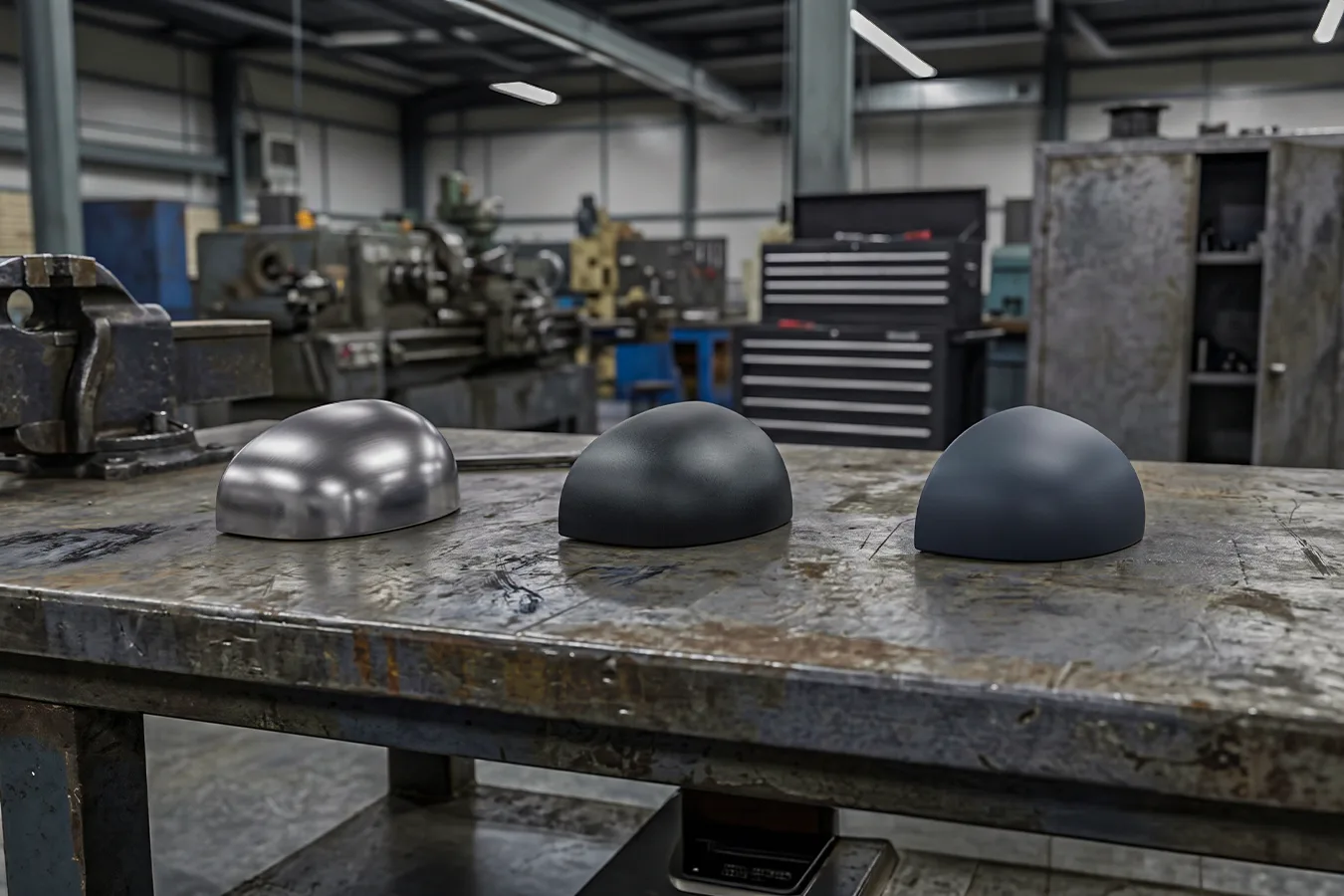
The safety toe cap is the structural reinforcement in the front region of professional footwear, responsible for protecting the toes against impacts and compressions. According to ABNT NBR ISO 20345, this component must withstand impacts of up to 200 Joules and compression loads of up to 15 kN.
Manufactured in steel or composite, each material meets the same protection requirement, varying in weight, thermal conductivity, and metallic detectability. Both undergo the same impact testing, but behave differently depending on the usage environment. What works well in a meatpacking plant may not be ideal at an airport or a heavy production line.
Incorrect selection results in returns, low team adoption, and regulatory non-compliance. This material matches each type of safety toe cap to its usage scenario, to specify the right footwear for each sector.
In addition to safety options, there is also the polypropylene shaping toe cap, used in occupational footwear that does not require protection against impact or compression. Its function is to give shape and structure to the front region of the footwear, ensuring aesthetics and comfort, without meeting safety standard requirements.
It is suitable for sectors where there is no risk of falling objects or crushing, but where durable, good-looking footwear is still desired.
What is a safety toe cap and what are the available types
The safety toe cap is the rigid reinforcement positioned at the front of the footwear, over the toes. Its function is to absorb impacts from falling objects and resist compression loads.
According to ABNT NBR ISO 20345, to be classified as safety footwear, the safety toe cap must withstand an impact of 200 Joules and compression of 15 kN. Steel and composite meet this requirement equivalently.
Crushing protection is the same in both materials. What truly sets them apart are weight, thermal conductivity, metallic detection, and cost. These factors guide specification by sector.
Safetline offers safety boots with certified safety toe caps in steel and composite, all with valid CA and compliance with ABNT NBR ISO 20345. This serves everything from heavy industry and civil construction to meatpacking plants, electricians, and areas with metal detection.
In addition to safety options, there is also the polypropylene shaping toe cap, used in professional footwear that does not require protection against impact or compression. Its function is solely to give shape and structure to the front of the footwear, ensuring aesthetics and comfort. It is recommended for sectors without risk of falling objects or crushing, but which still demand durable and well-finished footwear.
Steel safety toe cap
Manufactured in high-strength carbon steel, it is the most traditional solution in the PPE market. It offers high mechanical resistance and a low acquisition cost, making it attractive for equipping large teams. As a point of attention, it presents greater weight and conducts electricity and temperature, transmitting cold or heat to the user's toes.
Composite safety toe cap
Produced with fiberglass, carbon fibers, and resins, it is significantly lighter than steel. Because it contains no metal, it is indicated for electrical activities, does not trigger metal detectors, and acts as a thermal insulator, making it ideal for electricians or for environments with access control and low temperatures, such as meatpacking plants.
Polypropylene toe cap
Made of polypropylene (plastic), it is also non-metallic and lightweight. It offers thermal and electrical insulation, with the lowest cost among available options after steel and composite. Its main function is to give shape and structure to the front of the footwear, being indicated for environments without risk of falling objects or crushing, but which still demand resistance and adequate finish.

Comparison between steel, composite, and polypropylene
When we talk about steel and composite, both materials meet the same impact (200 J) and compression (15 kN) requirements. The difference appears in secondary properties, and that is precisely where the manager defines which one to specify. Weight, thermal conductivity, metallic detection, and cost are the factors that guide the choice between steel and composite for each sector.
When there is no risk of falling objects or crushing, the polypropylene shaping toe cap becomes a good option. Lightweight, non-metallic, and low-cost, it guarantees shape and structure to the footwear, offering thermal and electrical insulation, but without meeting the impact and compression requirements of the safety standard.
The table summarizes the criteria that weigh most heavily in corporate purchasing decisions.
| Type of Toe Cap | Impact/Compression Resistance | Weight | Thermal/Electrical Conductivity | Metallic Detectability |
|---|---|---|---|---|
| Carbon Steel | 200J / 15kN | Heavier | Conducts cold, heat, and electricity | Detectable |
| Composite | 200J / 15kN | Lightweight | Thermal and electrical insulation | Non-Detectable |
| Polypropylene | Does not meet safety standard | Very lightweight | Thermal and electrical insulation | Non-Detectable |
Weight and comfort during the workday
Steel is approximately 64% heavier than composite and almost eight times heavier than polypropylene. This difference in mass, which may seem small in absolute numbers, becomes significant in work shifts of eight hours or more, since the added weight increases fatigue and reduces adherence to continuous footwear use.
Composite emerges as a lighter and more comfortable alternative, without losing safety certification, while polypropylene, extremely lightweight, is indicated only for professional footwear without requirements for impact or compression protection.
Conductivity and thermal behavior
Steel conducts electrical current and is therefore completely counter-indicated for activities with electrical hazards. In these environments, only non-metallic and insulating materials are used, such as composite or polypropylene. The choice between them depends on the risk present in the operation:
Risk of impact and crushing: the correct choice is composite, which meets the safety standard (resistance to 200 J impact and 15 kN compression).
No impact risk: polypropylene becomes a viable alternative, offering lightness, electrical insulation, and lower cost, but without safety certification for impact.
On the thermal aspect, each material behaves differently:
Steel: conducts temperature and transmits cold or heat directly to the feet, which can cause discomfort in extreme environments.
Composite: acts as a thermal insulator, ensuring greater comfort in cold rooms or places with high temperature variation.
Polypropylene: being plastic, it also offers thermal insulation, but is recommended only for professional footwear in sectors without risk of falling objects.
Demystifying the guillotine effect
The idea that a safety toe cap can "cut" the user's toes is a myth. Every certified safety toe cap undergoes strict normative tests that reject any type of deformation representing a risk to the worker's physical integrity.

How to choose the right safety toe cap by sector type and occupational risk
Correct specification starts from the predominant risk of the activity. The safety toe cap material changes as the environment demands lightness, electrical insulation, or freedom from metal.
Civil construction and heavy industry
In these sectors, the core risk is falling heavy and sharp materials. The steel safety toe cap delivers proven resistance with the lowest unit cost, making it easier to equip large teams. Since the environment is already harsh on footwear, the durability of steel offsets the additional weight.
The most suitable recommendation is the composite safety toe cap. This material combines lightness with high strength, fully meeting normative requirements for impact (200 J) and compression (15 kN). Furthermore, being non-metallic, it offers electrical insulation, which increases safety in activities with risk of contact with electricity.
Another relevant point is comfort: during long shifts and prolonged standing periods, composite reduces fatigue compared to steel, making it a strategic choice for sectors demanding robust protection without compromising worker well-being.
Electrical maintenance and power operations
For electricians and professionals working under NR-10, the toe cap cannot contain metal, since steel conducts electrical current and compromises safety.
In this context, the composite safety toe cap is the most suitable recommendation: besides being non-metallic and insulating, it maintains the protection required by standard, with impact resistance of 200 J and compression of 15 kN. It is essential, however, to specify models with a valid CA for electrical insulating footwear, guaranteeing legal compliance and operational safety.
As an alternative, in situations without risk of falling objects or crushing, the polypropylene toe cap can also be used. It is lightweight, non-metallic, and insulating, offering comfort and low cost, but it does not meet normative requirements for impact and compression, being suitable only for professional footwear in controlled environments.
Airports, banks, and areas with detection
Where there are metal detection gantries, composite or polypropylene pass through without triggering alarms, speeding up inspection routines.
Logistics and long shifts on your feet
Workers who remain on the move all day benefit from the lightness of composite, which reduces fatigue without compromising protection.
In corporate procurement, cross-reference sector risk with the material and confirm the CA of each model before finalizing the order.

What to define before placing the order
All safety toe caps resist the same 200 Joules of impact and 15 kN of compression when we talk about safety — that is, steel and composite. The question is not which one is stronger, but how they behave regarding secondary properties and which risk predominates in the operation.
On the other hand, the polypropylene toe cap is not for safety: it serves only for shaping, without meeting normative requirements for impact and compression.
Incorrect specification means returns, low team adoption, and PPE that protects less than it should in the right scenario. Before placing the order, keep three points in mind:
Resistance is equal, context is not: steel and composite pass the same normative impact and compression test (200 J and 15 kN). Polymer is not for safety, serving only for shaping without meeting normative requirements. What changes between them are factors like weight, thermal conductivity, and metal detection.
The sector dictates the material: meatpacking plants, electricians, and airports require non-metallic, meaning composite. Heavy industry and civil construction accept steel for the best unit cost. Light operations, without risk of falling objects or crushing, can use polypropylene as a shaping option.
A valid CA is non-negotiable: without a valid Certificate of Approval, the specification does not hold up in audits nor protect the company from liability.
The next step is objective: list the predominant risks for each role on your team and cross-reference with the table in this article. This turns purchasing into a documented technical decision, not guesswork.
This is where Safetline makes the difference. Safetline's safety boot line covers all three toe cap materials — steel, composite, and polypropylene — all with valid CA.
This allows you to equip different sectors of the same company with a single supplier: steel for heavy industry and civil construction, guaranteeing the best unit cost; composite for meatpacking plants, electricians, metal detection areas, as well as mining and railway segments, offering comfort and protection for long shifts; and polypropylene for light operations, without risk of falling objects or crushing, serving only as a shaping option and representing the lowest cost.
In addition to the portfolio, the technical team supports the alignment between occupational risk and material, which reduces returns and ensures audit compliance.
After mapping your sectors, explore the Safetline safety boot line with certified toe caps and align your specification with experts who understand every environment. The right safety toe cap is the one that matches the real risk of the activity where it will be used.
Frequently Asked Questions
Is a composite safety toe cap as strong as steel?
Yes. Both composite and steel safety toe caps pass the same ABNT NBR ISO 20345 tests, resisting 200 Joules of impact and 15 kN of compression. The difference lies in secondary properties such as weight, thermal conductivity, and metal presence, not in impact protection. Both guarantee the same safety for the toes.
Does a composite safety toe cap pass through metal detectors?
Yes. The composite safety toe cap is manufactured with non-metallic materials, such as carbon fibers, fiberglass, and resins. Therefore, it does not trigger metal detectors at airports, banks, and controlled security areas. This makes composite the recommended choice for workers who go through routine inspections or detection gantries.
Which safety toe cap is recommended for working with electricity?
For activities involving electrical hazards, specify a composite or polypropylene toe cap. Containing no metallic components, these materials do not conduct current, meeting NR-10 requirements for footwear free of metallic parts. Steel safety toe caps, being conductive, must not be used by electricians or in environments with risk of electrical shock.
Which safety toe cap is best for meatpacking plants?
The composite safety toe cap is the most recommended for meatpacking plants. Unlike steel, which conducts cold and transmits low temperatures to the foot, composite acts as a thermal insulator. This reduces discomfort during long shifts in cold rooms and refrigerated environments while maintaining the same impact and compression resistance required by standard.
How do I know if the shoe's toe cap meets the standard?
Check the footwear's Certificate of Approval (CA), issued by the Ministry of Labor. Every certified safety footwear undergoes tests that prove toe cap resistance according to ABNT NBR ISO 20345. You can confirm product validity and data when you check the PPE CA before finalizing corporate purchases.