

Safety footwear for mining is the personal protective equipment designed to protect workers' feet against the specific hazards of underground galleries and open-pit operations. It combines a composite safety toe cap, slip-resistant dual-density outsole, puncture-resistant insole, and anti-torsion bar, meeting ABNT NBR ISO 20345 and the requirements of NR-22, which regulates safety in mining activities.
In mines, rock impacts, constant moisture, slippery floors, and unstable terrain quickly reduce the lifespan of generic footwear.
Before your next purchase, it is worth answering a practical question: can the chosen model keep up with the pace of the operation, or will it need to be replaced in the very first months?
This guide crosses each NR-22 requirement with the corresponding technical specification, from the outsole to metatarsal protection.
What is safety footwear for mining?
Safety footwear for mining is Personal Protective Equipment designed to simultaneously withstand rock impacts, constant abrasion, gallery moisture, unstable terrain, and chemical agents.
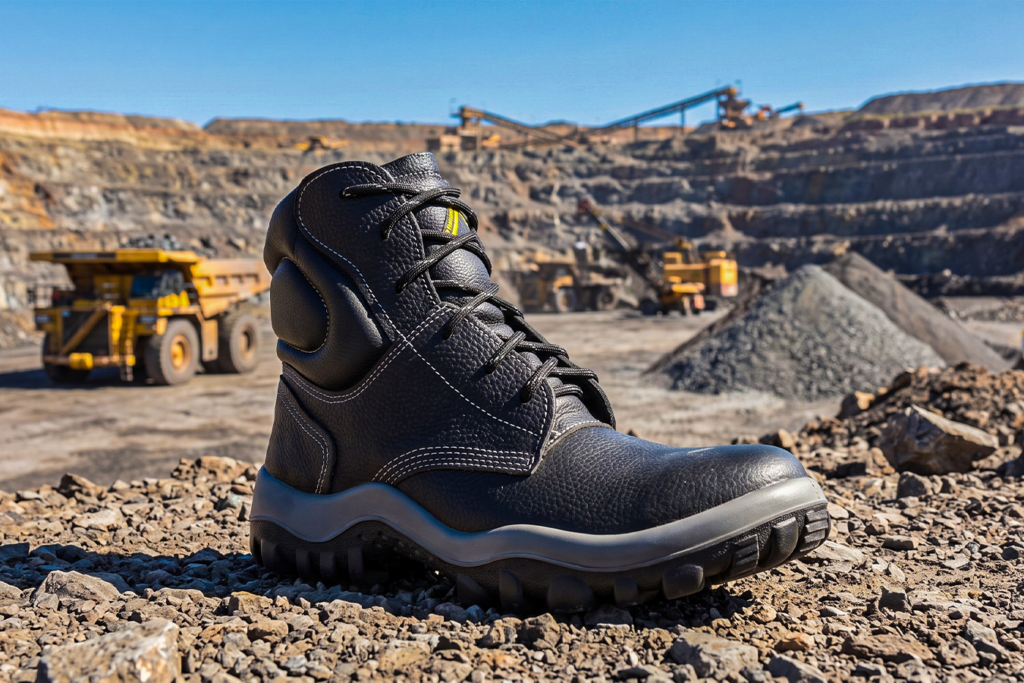
It combines features that common occupational footwear does not have: water-resistant leather, reinforced safety toe cap, puncture-resistant insole, slip-resistant dual-density outsole, and a high shaft to protect and “estabilizar” the ankle.
It is specified according to NR-22 and certified by a valid Certificado de Aprovação.
Definition and function within the mining environment
The core function of this footwear is to maintain the physical integrity of the worker in one of the most aggressive environments in the economy. In an open-pit mining front or inside an underground gallery, the foot is exposed to variables that add up throughout the entire shift.
It is not just about protecting against a single hazard. The footwear must have resistance to moisture, impact, puncture, slipping, and wear at the same time, and a weak point in any of these fronts already compromises the whole assembly.
Large mining companies face exactly this combination on a daily basis: long shifts, water-saturated floors, and solid rock in direct contact with the outsole.
Difference between common occupational footwear and mining footwear
Generic occupational footwear is sized for controlled environments, such as dry and level factory floors. It addresses predictable, low-variance hazards.
Mining footwear starts from another premise. It is built to absorb above-average impact energy, withstand gravel and rock abrasion, and maintain grip even with mud and water on the sole.
The difference lies in the materials and engineering:
- Outsole: dual-density compound with a deep tread pattern, approved for use on slippery and uneven floors.
- Safety toe cap: protective against falling object impacts.
- Puncture-resistant insole: a barrier against nails, rods, and sharp fragments on the ground.
- Upper: with reinforced seams to resist abrasion and contact with hydrocarbons, and water-resistant treatment to resist moisture.
Treating the two as equivalent leads to premature footwear failure and exposes the worker to unnecessary risk.
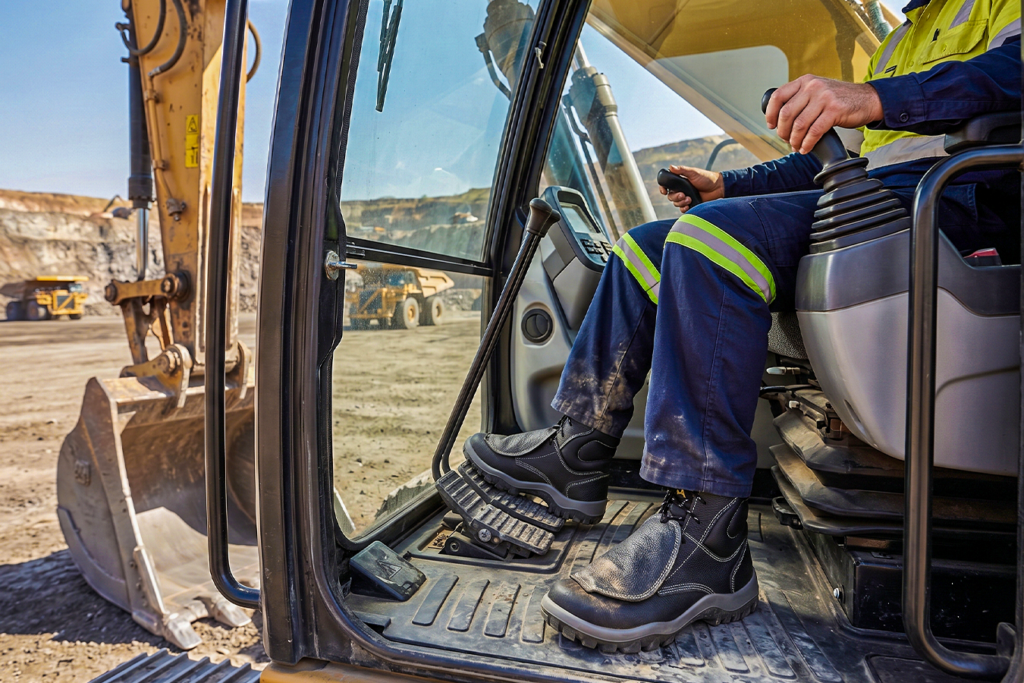
Why does the mine environment require specific footwear?
The mine environment concentrates hazards that rarely appear together in other sectors. Constant moisture in galleries degrades poorly selected uppers. Uneven terrain strains the ankle and promotes sprains.
Rock abrasion wears down the outsole much faster than on common industrial floors. Added to this is the eventual presence of electrical and chemical hazards, depending on the operation.
For this reason, correctly specifying the footwear ceases to be an operational detail and becomes a technical decision of compliance and cost. An undersized model fails earlier than expected, increases replacements, and transfers liabilities to the company.
For the OHS manager, understanding what characterizes this footwear is the first step before recording the NR-22 specifications and the specific functions of each work front, topics detailed in the next sections.
Occupational hazards in mining that define the footwear
The choice of footwear begins with the operation's hazard mapping, not with the cost line of the spreadsheet. Each environmental threat requires a specific technical response in the footwear, and ignoring one of them exposes the worker and the company.
In practice, the manager needs to cross-reference the operation's hazard inventory with the product's construction characteristics. It is this cross-referencing that separates proper PPE from generic industrial footwear pushed onto all sectors.
Mechanical hazards: impact, puncture, and crushing
Falling rocks and handling heavy parts generate direct impact on the feet. The answer is the composite safety toe cap, capable of withstanding the 200 J test required by the standard.
The gallery and pit floor is covered with sharp debris: nails, metal rods, and sharp fragments. This is where the puncture-resistant insole comes in.
In areas with mobile equipment and cargo transport, objects falling onto the instep is a real hazard. Metatarsal protection covers this exposed region and ensures protection.
Terrain hazards: loose gravel, mud, uneven surfaces
Mining means unstable floors; loose gravel, steep ramps, and mud require grip that a common outsole does not deliver.
The slip-resistant dual-density outsole maintains traction on slippery surfaces and absorbs the impact of prolonged walking. Meanwhile, the anti-torsion bar stabilizes the foot on uneven terrain, reducing the risk of ankle sprains.
Water-resistant leather and reinforced upper seams are fundamental elements to increase the resistance of footwear used in mining. Water-resistant leather receives a special treatment that prevents water and moisture penetration, keeping feet dry and extending the footwear's durability in harsh environments.
Reinforced seams, on the other hand, ensure greater structural robustness, withstanding intense stress and preventing tears or premature failures. The combination of these two features ensures protection, comfort, and reliability for the worker, even in extreme conditions of the mining segment.
The high shaft present in anti-torsion models or boots has the main function of offering greater stability to the ankle, significantly reducing the risk of sprains during sudden movements. In addition, its reinforced structure ensures lateral protection against impacts, bumps, or contact with objects, creating a safety barrier that preserves the joint in situations of physical exertion or exposure to challenging environments.
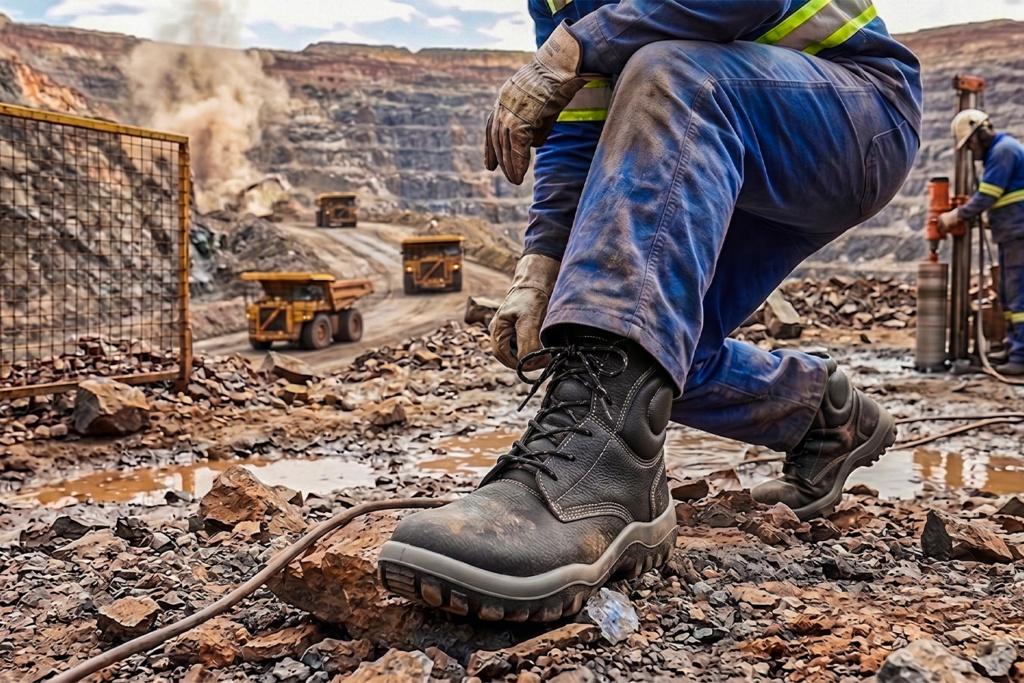
Thermal, chemical, and constant moisture hazards
Underground galleries deal with permanent moisture, and the open-pit mine exposes the outsole to machine oils and fuels. Hydrocarbon resistance prevents footwear degradation during this contact.
Operations near kilns and heated materials, such as in refractory plants, require thermal resistance from the footwear.
Electrical hazards in areas with energized equipment
Energized belts, panels, and catenaries require attention. Depending on the role, the footwear needs dielectric properties, defined by the actual exposure of each employee.
Large mining companies deal with all these hazards simultaneously, which makes role-based specification an operational necessity, not a preference.
Contact with explosives and antistatic PPE
In mining operations, contact with explosives requires strict safety protocols, as any electrostatic discharge can represent an ignition hazard. Therefore, the use of antistatic footwear is essential to protect workers and reduce the likelihood of accidents.
NR-22 and safety footwear in mining
NR-22 is the regulatory standard that addresses occupational health and safety in mining. It covers everything from gallery ventilation to individual worker protection, and this is where footwear enters the manager's analysis.
Unlike generic standards, NR-22 recognizes that the mine environment imposes combined hazards. This changes the specification logic: a certified footwear is not enough; it must respond to the actual conditions of the operation.
What NR-22 determines about foot protection
The standard requires the company to provide appropriate PPE for the hazards identified in the workplace, at no cost to the worker. For the feet, this means cross-referencing the mine's hazard inventory with footwear that addresses impact, puncture, and agents present in the activity.
The responsibility for defining the correct PPE lies with the operation's Risk Management Program. Large mining companies structure this definition by role and by work front.
Relationship between NR-22 and NR-6 in PPE delivery
NR-22 points out the need for PPE, but NR-6 details the rules for supply, use, and storage. The two standards work together.
In practice, NR-6 mandates the delivery record, the requirement of use, and the replacement of footwear whenever damaged. The manager must document each stage of this cycle.
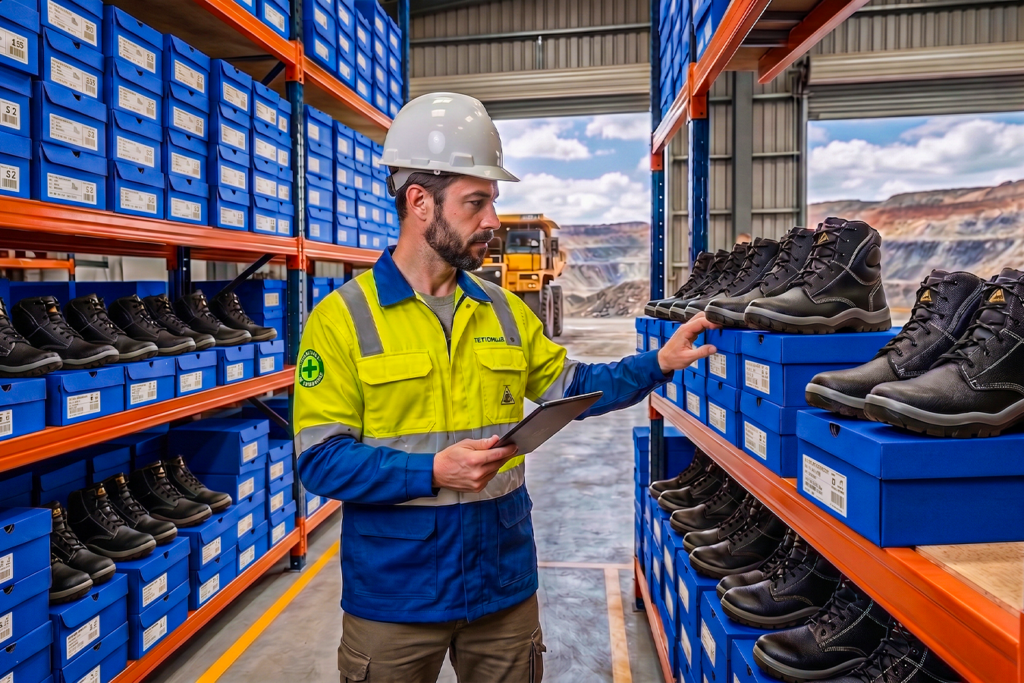
Employer and safety manager responsibility
The company is legally responsible for the adequacy of the PPE. Providing footwear that does not address the mapped hazard constitutes non-compliance and generates labor and social security liabilities.
It is up to the safety manager to validate whether the chosen model covers all the hazards of the front, train the team, and monitor usage. The mistaken choice of a single item can compromise the entire protection chain.
The role of the CA in legal compliance
No footwear can be delivered as PPE without a valid Certificado de Aprovação, issued by the Ministry of Labor. The CA proves that the product has undergone testing in accordance with ABNT NBR ISO 20345.
When specifying, check the CA number, validity, and correspondence with the role's hazard. Suppliers like Safetline keep this documentation available for the manager's consultation.
Essential technical specifications of mining footwear
After mapping the hazards and cross-referencing the operation with NR-22, the manager reaches the part that defines the purchase: the specification sheet. Here, each attribute of the footwear must respond to a real environmental threat.
The table below summarizes what to check before approving any supplier.
| Component | Technical function | Application in the mine |
| Safety toe cap | Absorbs impact and compression | Falling rocks, heavy equipment |
| Puncture-resistant insole | Barrier against sharp objects | Scrap metal, wire, sharp gravel |
| Dual-density outsole | Cushions and resists abrasion | Unstable terrain, rocky floor |
| Resistant upper | Withstands moisture and friction | Wet gallery, open-pit mine |
| Anti-torsion bar | Stabilizes the foot | Uneven terrain, ramps |
Safety toe cap: composite and steel, when to use each
The steel safety toe cap delivers proven impact resistance and predictable cost. On the other hand, the composite safety toe cap offers equivalent protection without conducting current or temperature, and weighs less.
On fronts with electrical hazards or in mines with metal detectors, composite is usually the technical choice. Where the predominant factor is pure impact, steel remains fully adequate.
Puncture-resistant insole and outsole protection
The puncture-resistant insole prevents sharp objects from penetrating the outsole to the foot.
Textile models cover the entire plantar surface, while metallic ones protect a defined area. On mine floors, covered with scrap metal and sharp gravel, this layer is not optional.
Dual-density construction and upper resistance
The dual-density outsole combines an inner layer that cushions with an outer layer that resists abrasion. This extends the lifespan in aggressive terrain.
The upper, in turn, must withstand constant moisture without losing integrity, which translates to fewer replacements.
Antistatic and dielectric properties
Environments with explosives or ignition hazards require the use of antistatic footwear, capable of dissipating energy charges in a controlled and safe manner.
Meanwhile, fronts with electrical contact hazards require dielectric properties, verifiable in the product's CA. Electrical hazards and ignition hazards are different and require specific PPE. Insulating footwear protects against electrical shocks by preventing current conduction, while antistatic footwear dissipates electrical charges in a controlled manner to prevent sparks that could detonate explosives or flammables.
Swapping one for the other is extremely dangerous: using insulating footwear in an environment with explosives increases the risk of ignition, and using antistatic footwear in an electrical hazard area exposes the worker to shock. Each PPE was developed for a specific type of threat, and incorrect use can be fatal.
Outsole with grip for uneven terrain
Grip defines safety on slippery floors, typical of wet galleries. Added to it is the anti-torsion bar, which stabilizes the foot on ramps and unstable soil, reducing sprains. Large mining operations deal with exactly this type of combined terrain.
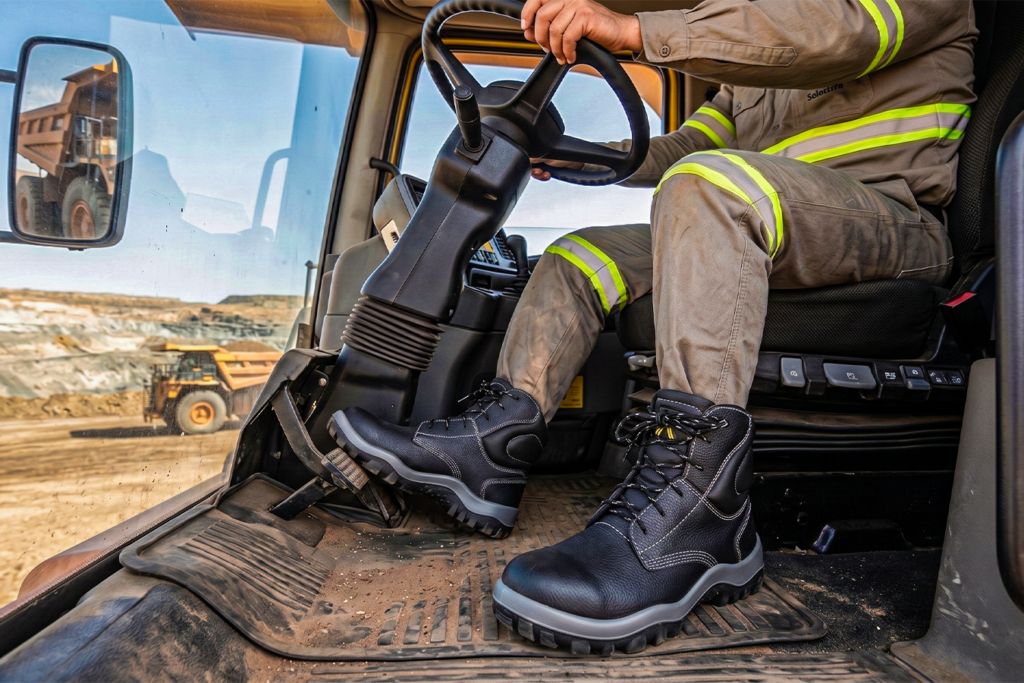
Durability and performance in severe conditions
Specifying the footwear is only part of the decision. What seals the deal is understanding how that product behaves over the months, under daily impact, mud, and rock abrasion.
In mining, footwear that fails early does not just generate replacements. It causes shift downtime, procurement rework, and worker exposure in the interval until replacement.
Why durability reduces cost per use in the long run
The experienced manager does not look at the sticker price, but rather at the cost per use.
The calculation is simple: divide the value of the pair by the number of months it actually protects in the field. Footwear that lasts twice as long, even with a higher initial investment, delivers a lower cost per month.
There is also the invisible cost: each premature replacement consumes warehouse hours, generates orders, transport, and CA verification. In an operation with hundreds of workers, the difference in lifespan becomes the annual budget.
This is the TCO (total cost of ownership) argument that large mining companies use when approving PPE suppliers.
Resistance to abrasion and contact with mine abrasives
Loose gravel, sharp rock, and uneven floors attack the outsole and the upper with every step. The most common failure point is the stitching and the safety toe cap flex area.
Check the abrasion resistance index declared by the ABNT NBR ISO 20345 standard and request a sample for field testing before contracting.
Footwear behavior in constant moisture and mud
Underground galleries maintain permanent moisture. Water and mud detach poorly bonded outsoles and degrade the internal material.
A dual-density outsole injected directly into the upper resists detachment better than glued systems. It is the difference between a pair that withstands the rainy season and one that splits at the sole in the first month.
Signs of wear that require replacement
Train the team to identify the replacement point:
- Worn-out outsole grooves, with loss of slip-resistant grip.
- Exposed or deformed safety toe cap after impact.
- Detachment between outsole and upper, even if partial.
- Punctured or bent puncture-resistant insole.
Recording these signs in periodic inspections prevents compromised footwear from remaining in use. This protects the worker and supports the traceability required by audits.
How to choose the right safety footwear for each role in the mine
Standardizing a single model for the entire mine is the most common procurement mistake in the sector. A drill rig operator in a gallery does not face the same environment as a laboratory technician or an off-road truck driver.
Before looking at the catalog, the manager needs to map the workstation. Each role has its own hazard profile, and the footwear must respond to this specific profile.
Mapping roles and hazards by workstation
Start with the list of roles identified in the operation's PGR. For each position, identify the dominant hazards: impact, puncture, moisture, chemical agent, or electrical hazard.
Think of the worker at the mining front, who deals with falling rocks and uneven floors: for them, the priority is a reinforced safety toe cap, metatarsal protection, and an anti-torsion bar.
On the other hand, those who work near energized networks in maintenance need dielectric footwear, without metallic components. Within the same company, therefore, very different specification sheets coexist.
Open-pit or underground: differences in the choice
In open-pit mining, the challenge is gravel abrasion, sun exposure, dust, and long walking distances. The focus falls on a resistant outsole, a shaft that protects the ankle, and comfort for long shifts.
In underground mining, constant gallery moisture, slippery floors, and confined spaces change the priority.
Here, the water-resistant leather of the upper, slip-resistant dual-density outsole resistant to hydrocarbons and with a drainage system carry weight. Each environment calls for its own specification sheet.
Fit, comfort, and compliance with use by the team
Footwear that is not worn correctly loses its protective function. Blisters, tightness on the instep, and excessive weight lead the worker to loosen the laces or change the model on their own.
Involve the team in the process. Test sizing, size ranges, and comfort during a real shift before closing the bulk order. High compliance reduces accidents and avoids waste of purchased and unused PPE.
Specification criteria for bulk purchasing (CNPJ)
For corporate procurement, formalize the technical requirement in the bidding document or purchase order. Document a valid CA, applicable ABNT NBR ISO 20345 standard, cross-referencing with NR-22, and the supplier's durability history.
Large mining companies work with role-segmented specifications precisely for this reason. The Safetline safety boot for roles with electrical hazards is an example of a specific model within this technical purchasing logic.
Specifying the right footwear for mining protects the team and the budget
In mining, choosing footwear goes far beyond a line on the purchasing spreadsheet. This choice affects the physical integrity of the team, compliance with NR-22, and the replacement cost that the operation carries all year round.
Undersized footwear usually gives out at the worst time: under rock impact in a gallery, on waterlogged floors, or on unstable pit terrain. When this happens, the result is labor liabilities, shift downtime, and, above all, risk to the person.
Specifying well, therefore, serves the safety of the team and the budget in the same decision.
The 3 principles for making the purchase decision
- Mapping before the catalog. The specification is born from the operation's hazard inventory, cross-referenced with the role and the environment. Never from the lowest unit value.
- Standard as a floor, not a ceiling. A valid CA and compliance with ABNT NBR ISO 20345 are minimum requirements. NR-22 requires reading the combined hazards of each workstation.
- Cost per lifespan, not per pair. Footwear with a dual-density outsole, puncture-resistant insole, and anti-torsion bar costs more upfront and less over the months, because it resists where generic products give out.
Next practical step for the manager
Build the specification sheet by role before contacting any supplier. List, for each position, the required safety toe cap, outsole type, hydrocarbon resistance, shaft height, and metatarsal protection when applicable.
With this document in hand, the conversation with the supplier stops being about price and becomes about technical alignment. This is how operations like Vale, Kinross, and RHI Magnesita handle high-turnover PPE procurement.
How Safetline supports technical specification
Safetline has been manufacturing safety footwear for decades for medium and large-scale industrial environments, with lines applicable to underground and open-pit mining.
It is worth starting by understanding how to identify safety footwear that truly meets your operation, with traceable CA and construction compatible with the mapped hazard.
The right footwear pays off on three fronts: fewer replacements, more protection for the team, and an operation aligned with NR-22.

From reading to the specification sheet: what to do now
Throughout this material, the goal was to answer a practical question: which footwear to use in mining without falling into the generic model that large manufacturers push onto every sector. The decision begins with the hazard inventory, respects NR-22 requirements, and is defined by the total cost of replacement, not the sticker price.
Three principles summarize the core points:
- Specification comes from the hazard, not the catalog. Gallery, pit, and laboratory require different construction responses. Standardizing a single model is the most expensive mistake in the sector.
- Standard and certification are non-negotiable. Without a valid CA and compliance with ABNT NBR ISO 20345, the footwear does not protect the worker or the company in an audit.
- Durability is economy. Water-resistant leather, a dual-density outsole, and an anti-torsion bar that last twice as long reduce replacements, shift downtime, and operator exposure.
The next step is concrete and fits into your next purchasing meeting: take your operation's hazard inventory by role and read the technical specification table in this article. Where the current footwear does not respond to a mapped threat, you already know what to negotiate with the supplier.
More than a recurring expense, the right footwear is the item that keeps the team in the field and the operation in compliance with NR-22.
To transform this cross-referencing into a tailored specification sheet and a fleet quote, speak with a Safetline specialist in heavy industry footwear.
Frequently asked questions
Which safety footwear to use in mining?
For mining, the recommended footwear is one with water-resistant leather, a reinforced safety toe cap (composite or steel), puncture-resistant insole, slip-resistant dual-density outsole, and hydrocarbon resistance. On unstable terrain and in galleries, prioritize a high shaft (anti-torsion safety boot or boots) with an anti-torsion bar and, when there is a risk of objects falling onto the instep, metatarsal protection. The exact choice depends on the role and the hazard inventory of each position in the operation.
What does NR-22 require regarding safety footwear?
NR-22 addresses occupational health and safety in mining and requires the free provision of Personal Protective Equipment appropriate to the hazard. All footwear must have a valid CA (Certificado de Aprovação) and meet ABNT NBR ISO 20345 standards. The standard recognizes that the mine imposes combined hazards, so the specification must address impact, puncture, slipping, and moisture at the same time.
What is the difference between a steel safety toe cap and a composite safety toe cap?
Both protect against impact and compression within the limits of the standard. The steel safety toe cap has a lower cost and high resistance. The composite one is lighter, does not conduct temperature or electricity, and does not trigger metal detectors. In mining with electrical hazards or fronts with long walking shifts, composite reduces fatigue and adds insulation. The decision is based on the role's hazard profile.
Why use a dual-density outsole in mining?
The dual-density outsole combines two layers: an inner one that absorbs impact and cushions the step, and an outer one that is more resistant to abrasion and slipping. On waterlogged gallery floors, loose gravel, and pit mud, this construction maintains grip and durability for longer. It is one of the features that most influence the footwear's lifespan in harsh environments.
Why use water-resistant leather in mining?
The use of water-resistant leather in mining is essential because the work environment frequently involves contact with water, mud, moisture, and chemical agents. This type of leather receives a special treatment that makes it resistant to liquid penetration, without losing the material's breathability.
Note: To offer more comfort during long shifts in mining, Safetline developed the waterproof sock, which, combined with the use of its footwear, ensures greater protection against moisture and keeps feet dry. This solution adds not only well-being to the worker but also contributes to the preservation of health and performance, since protected and comfortable feet reduce fatigue and increase safety throughout the day.
What is the purpose of the anti-torsion bar in footwear?
The anti-torsion bar is a rigid structure integrated into the outsole that increases the lateral stability of the foot. On uneven mine terrain, with loose stones and slopes, it reduces the risk of ankle sprains and improves support on inclined surfaces. Combined with a high shaft, it offers additional ankle containment during long travels through galleries or pits.
Is more expensive footwear worth it if it lasts longer?
Yes, when evaluating the total cost. Footwear that lasts twice as long reduces replacement frequency, procurement time, and shift downtime for replacement. It also decreases worker exposure in the interval until replacement. The experienced manager calculates the cost per month of use, not just the unit value of the purchase.
Does safety footwear for mining need to be puncture-resistant?
Yes. The puncture-resistant insole protects the sole against sharp and puncturing objects common in the environment, such as rock fragments, scrap metal, and drilling debris. It is an essential feature on mining fronts and in galleries, where the floor is rarely clean. Check if the model meets the puncture test required by ABNT NBR ISO 20345 and has a valid CA.
How to increase the lifespan of footwear in mining?
Conservation begins with the daily routine. Clean mud and abrasive dust after the shift, dry the footwear in the shade without a direct heat source, and perform a visual inspection of the outsole, safety toe cap, and seams. Environments with constant moisture require complete drying between uses to preserve internal components. Even the best-specified pair loses protection prematurely when daily care is lacking.