

Safety footwear for the railway sector is personal protective equipment specified for permanent ways, an environment marked by the impact of ballast and sleepers, uneven terrain, equipment vibration, moisture, and exposure in electrified sections.
For the right choice, it is necessary to combine a resistant safety toe cap, slip-resistant and anti-torsion outsole, and dielectric properties, always within the requirements of NR6, NR10, and the valid CA issued by the MTE.
The Brazilian railway network totals more than 30,000 kilometers, expanding through new concessions. Each kilometer requires a professional walking on loose ballast, uneven sleepers, and energized sections.
Unfortunately, many managers still view PPE as an inevitable cost rather than a strategic investment. This mindset leads to choosing cheaper but inadequate products that wear out quickly and do not offer the necessary protection. The result is a cycle of recurring expenses and an increase in the number of accidents.
This guide connects each risk of the permanent way to the corresponding technical requirement, so you can specify with criteria.
Occupational hazards in the railway sector and what they require from footwear
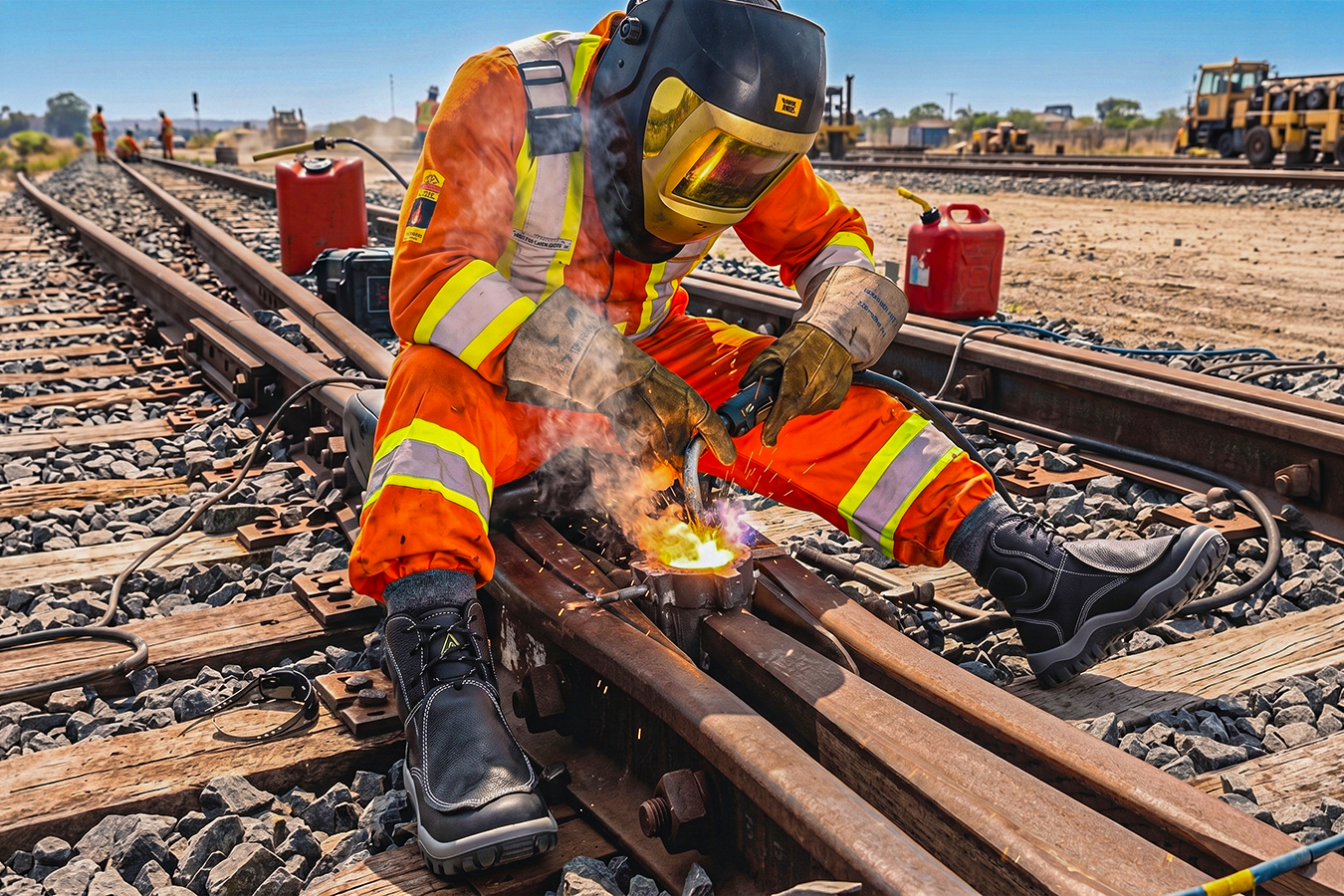
The railway environment concentrates risks that low-quality safety footwear was not designed to face.
The permanent way, the yard, and the maintenance workshop impose combined conditions: unstable terrain, impact from heavy components, presence of electricity, and long shifts walking in the field.
Each of these variables requires a specific technical property of the footwear. Ignoring this relationship between risk and requirement is the first step to choosing the wrong product.
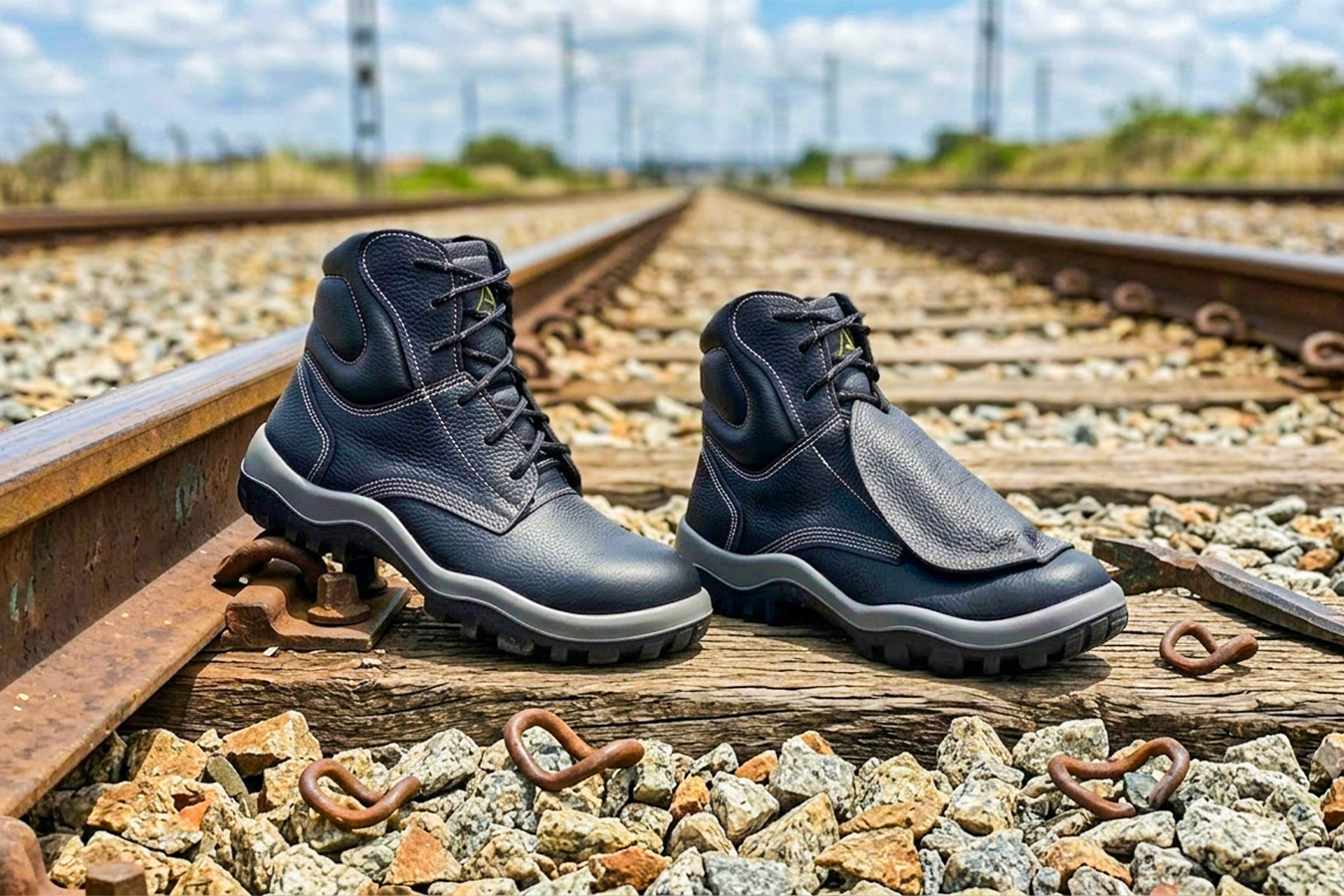
Permanent way environments: ballast, sleepers, and uneven ground
Walking on ballast is the daily challenge of the track worker. The surface is loose, angular, and unstable, which strains the ankles and increases the risk of sprains with every step.
This, combined with the unevenness between sleepers and the constant irregularity of the terrain, makes the scenario even more challenging. An outsole without adequate grip and lateral stability turns any movement into a fall hazard.
Here, two objective requirements come into play: an outsole with good traction on loose surfaces and an anti-torsion bar to stabilize the foot on uneven ground. Comfort during long shifts also ceases to be a luxury and becomes a technical requirement: dual-density outsoles reduce fatigue for those who walk kilometers of track per shift.
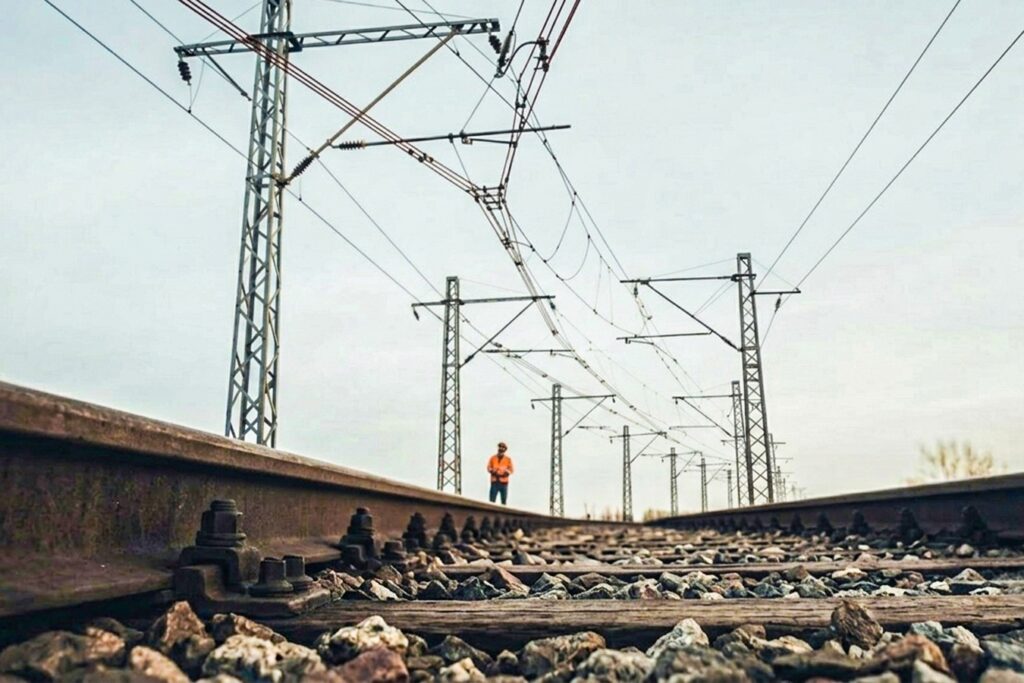
Electrical hazards and the overhead power line issue
In electrified sections, the catenary operates at high voltages, and proximity to the overhead power lines requires extra attention. The footwear must respond to this scenario.
For activities under the influence of electricity, the requirement is insulating footwear, capable of isolating the worker from ground-fault circuits.
Impact, crushing, and puncture in the handling of rails and components
Rails, joint bars, fasteners, and heavy tools are part of the maintenance routine. The drop of any of these items on the foot can cause a serious injury.
The safety toe cap, made of composite material, is the minimum requirement against impact and crushing. Meanwhile, the puncture-resistant insole addresses the risk of stepping on nails, rods, or metallic fragments scattered across the yard and the work front.
| Operational Risk | Technical Footwear Requirement |
| Ballast ground and uneven terrain | High-traction outsole + anti-torsion bar |
| Overhead power lines | Insulating outsole |
| Falling rails and components | Composite safety toe cap |
| Puncture by objects on the ground | Puncture-resistant insole |
| Long shifts in the field | Ortholite® comfort insole |
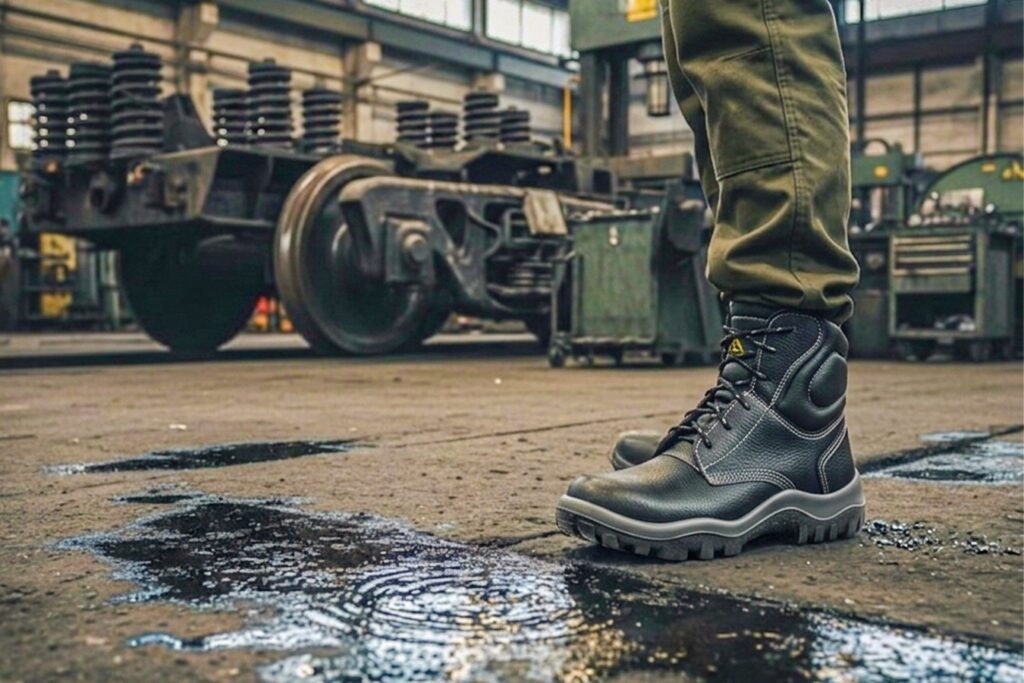
Exposure to oils, greases, and slipping in maintenance workshops
The rolling stock workshop presents a different risk profile than the track. Floors contaminated by oils, greases, and hydrocarbons drastically reduce grip and multiply the risk of slipping.
The requirement here is an oil and hydrocarbon-resistant outsole, which maintains traction even in contact with petroleum derivatives. A standard outsole degrades in this environment and loses its grip capacity much sooner than expected.
Each work front has its own set of risks, and the correct specification begins with this mapping by role, instead of treating footwear as a single catalog item.
Technical criteria for specifying the right railway footwear
After mapping the risks, the next step is to translate each of them into a verifiable technical requirement. Specifying without this breakdown leads to two bad outcomes: insufficient protection or unnecessary cost with attributes that the role does not require.
Below is a guide by attribute, with the advantages and disadvantages that the manager needs to weigh before closing the purchase.
Safety toe cap protection: composition and impact resistance
The safety toe cap protects against impact and compression, constant risks in handling sleepers, rails, and heavy tools. The reference standard requires impact resistance of 200 joules.
The choice falls on the composite safety toe cap, which is lighter, does not conduct heat, does not conduct electricity, and does not trigger metal detectors, representing a real advantage in electrified sections and during long shifts.
For permanent way crews who walk kilometers per shift, composite reduces fatigue without compromising protection.
Puncture-resistant outsole and grip on uneven terrain
Loose ballast and the uneven surface of sleepers require two distinct properties. The puncture-resistant insole protects against objects penetrating from below. The outsole's grip prevents slips on wet, oily, or unstable ground.
The outsole must be resistant to hydrocarbons, since grease and oil are common in yards and workshops. This is where dual-density construction comes in: a stiffer outer layer ensures traction on ballast, while the softer inner layer absorbs impact and vibration throughout the shift.
It is worth checking how to read the technical specification in the product's reference numbering, something we detail further in how to identify safety footwear.
Electrical insulation according to risk
In activities near energized networks, dielectric footwear is mandatory when there is electrical hazard, and its specification must be aligned with NR10 and the valid CA of the PPE.
Shaft, fit, and ankle protection on unstable terrain
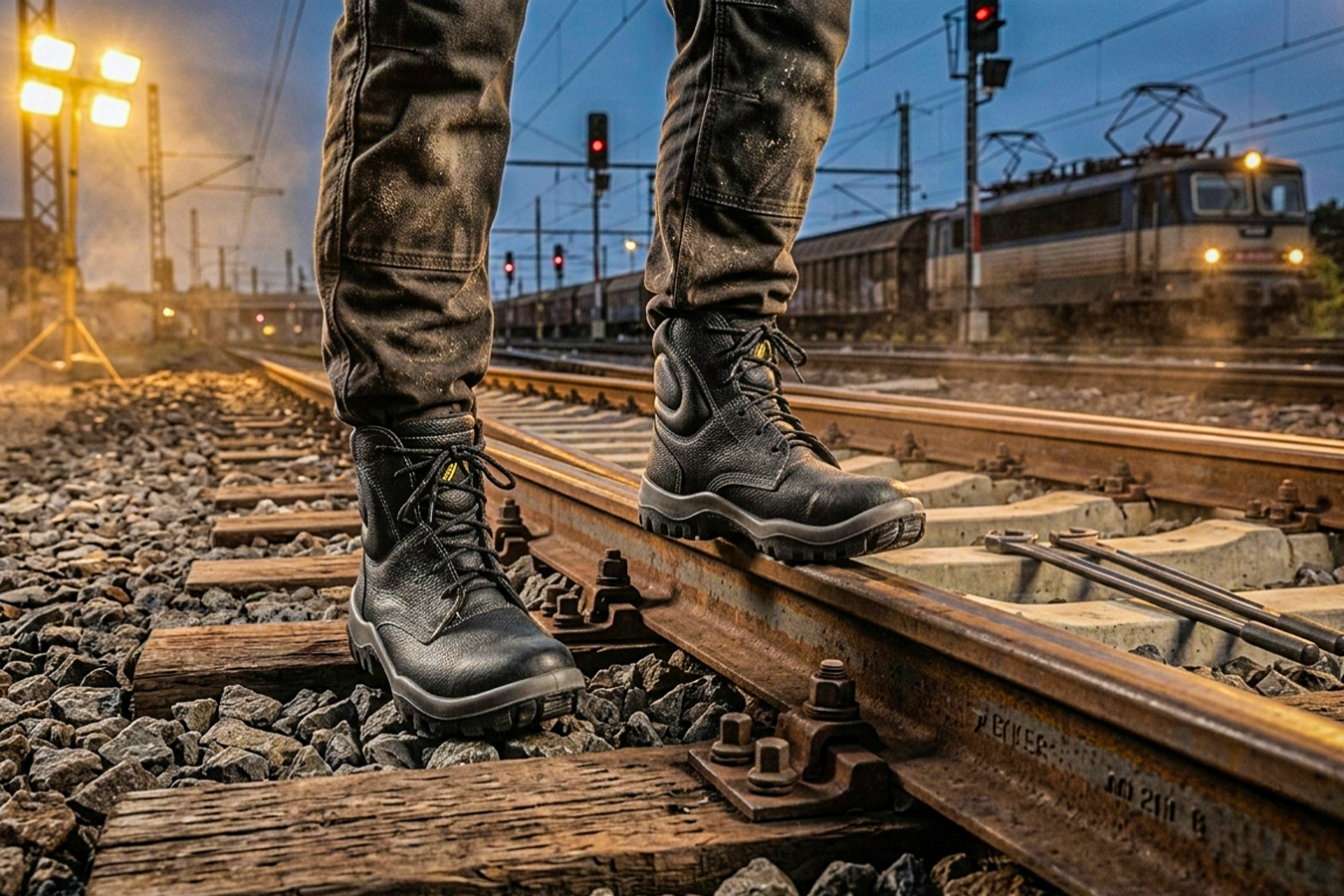
Stepping on ballast and sleepers requires footwear that offers stability and ankle support. A higher shaft, a reinforced thermoformed counter, an outsole with an anti-torsion bar and sidewalls, in addition to eyelets and a good lace fit, are features that help reduce excessive foot movement and increase safety on uneven terrain. For these conditions, the Safetline anti-torsion safety boot combines these elements to provide greater stability and support for the worker on railways.
Durability as a total cost criterion, not just comfort
Frequent replacement in the field has a high logistical cost: crew downtime, travel, and inventory. Footwear that lasts longer reduces the total cost per employee, even with a higher unit value. Durability, in this sector, is a financial decision.
How to structure the choice by role within the railway operation
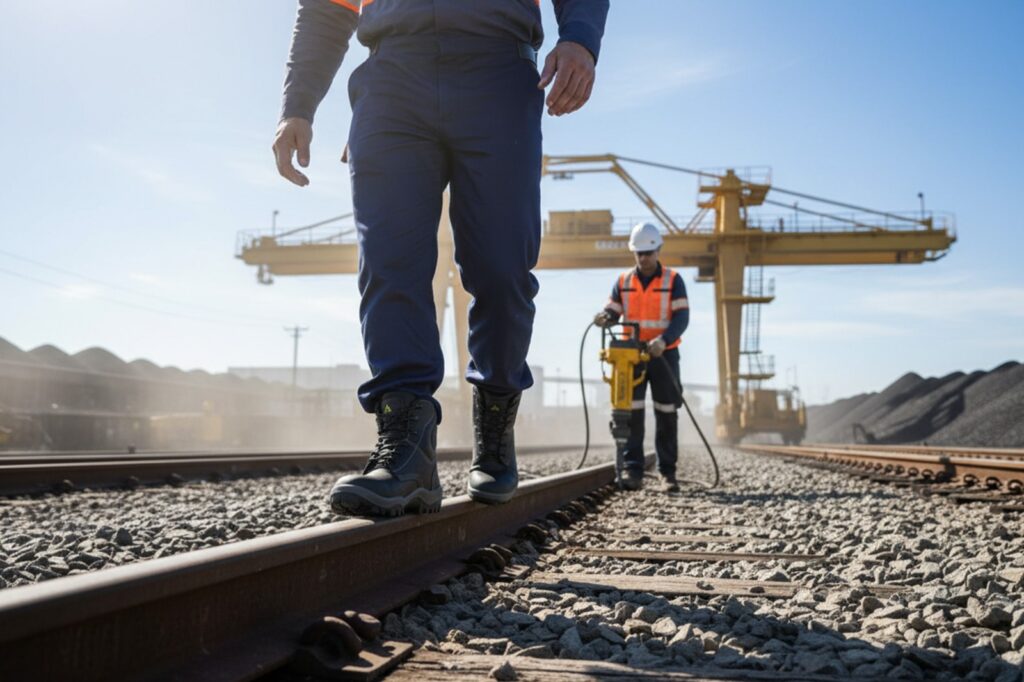
Specifying a single model for the entire operation is usually expensive. The exposure of those working on the permanent way is not the same as those operating in the yard or workshop.
If you standardize to the lowest common denominator, you leave part of the crew unprotected; if you standardize to the highest, you end up paying for attributes that most will never use.
The technical path is to group by role and cross-reference each profile with the requirements defined in the previous section.
Permanent way crew vs. workshop crew vs. maneuvering yard
Each work front has its own risk signature. The table below summarizes the minimum breakdown by profile.
| Profile | Dominant Risks | Priority Requirements |
| Permanent way | Ballast, sleepers, uneven terrain, long walks | Dual-density outsole, anti-torsion bar, impact-resistant safety toe cap |
| Maintenance workshop | Falling components, hydrocarbons, smooth floor | Reinforced safety toe cap, oil-resistant outsole, grip on wet floors |
| Maneuvering yard | Equipment movement, noise, long distances | Shift comfort, slip-resistant outsole, good heel impact absorption |
Where there is an electrified section, the dielectric requirement and alignment with NR10, discussed below, are added to this framework.
Mixed environments: when a single model is not enough
Many employees transition between fronts throughout the shift. A maintenance technician might start in the workshop and finish on the track. In these cases, specify for the most severe scenario that the role faces, not the average.
Footwear with a dual-density outsole and anti-torsion bar covers both ballast terrain and the workshop floor well, which reduces the variety of models in stock without sacrificing protection.
CA verification and compliance with NR6
No specification holds up without a valid Certificado de Aprovação (CA). The CA is the document that proves the testing of the model before the Ministry of Labor and that it meets what inspection requires.
Footwear without a current CA has no legal value as PPE, even if the construction seems adequate.
Check the number, validity, and whether the declared attribute (safety toe cap, dielectric, antistatic) corresponds to the role's risk. Record the supply and training, as provided for in NR6.
Maintenance and service life in intensive railway use
The railway environment wears out footwear quickly. Ballast, moisture, and oil continuously attack the outsole and the upper. Establish an inspection routine for the outsole, stitching, and safety toe cap integrity, as well as an objective disposal criterion.
Investing in safety footwear as PPE built for this intensity reduces replacement frequency and field exchange logistics, a significant gain in large-scale operations.
Railway specification: transforming risks into technical requirements
You started this guide with an uncomfortable realization: low-quality footwear was not made for the permanent way. Loose ballast, uneven sleepers, equipment vibration, energized catenary, and kilometers walked per shift.
None of these risks forgive lazy standardization. It is worth retaining three ideas from this content. The first is that each risk becomes a requirement.
Every threat in the railway environment has a corresponding technical attribute—safety toe cap, dual-density outsole, anti-torsion bar, dielectric property—and specifying without this map is gambling on chance.
Add to this the fact that it is the role that defines the model: permanent way, yard, and workshop require distinct profiles, and a single footwear model for the entire operation protects poorly or costs too much.
Finally, do not lose sight of the fact that durability is also economy. In the field, each replacement means logistics, downtime, and liability, and footwear that lasts longer reduces the total cost, not just the unit cost.
In practice, the move belongs to this week: build the risk matrix by role of your operation and cross-reference this matrix with the valid CA of each model before opening any quote.
From there, the dialogue with the supplier moves to another level. You stop asking for “safety boots” and start demanding verifiable attributes for each work front. This is how the dual-density outsole and anti-torsion bar technologies of Safetline industrial safety boots stop being catalog differentiators and become a technical response to your risk.
Contact the sales team and transform your risk matrix into a purchasing specification. After all, specifying the right railway footwear protects those on the track, and that is the reason behind every technical requirement in this guide.
Frequently Asked Questions
Which safety footwear is recommended for work on the permanent railway way?
For the permanent way, the footwear needs to combine a higher shaft for ankle fit and protection, a slip-resistant and hydrocarbon-resistant outsole, a composite safety toe cap, an anti-torsion bar, and a dual-density outsole. This combination addresses the uneven terrain of ballast and sleepers, the impact of heavy components, and long walks in the field. Models like the Safetline anti-torsion safety boot are ideal for this purpose, offering the necessary support to ensure worker stability on railways. Work in electrified sections also requires dielectric properties in accordance with NR10.
What is the difference between a composite safety toe cap and a steel toe cap in the railway environment?
Choosing a composite safety toe cap in the railway environment is strategic because it combines features that directly address the risks of this sector. Unlike a steel toe cap, composite does not conduct electricity, offering greater safety in electrified sections near the catenary. In addition, it is lighter, which reduces fatigue during long shifts on uneven terrain, without losing the mechanical resistance required to withstand impacts equivalent to those of metal.
Another relevant point is thermal comfort: composite does not transmit cold or heat, ensuring stability even in extreme weather conditions. It also does not corrode, maintaining performance in contact with moisture, oil, or chemicals common in railway operations. In addition, it does not trigger metal detectors, which can facilitate access to controlled areas. In summary, the composite safety toe cap combines electrical safety, durability, and comfort, making it a more suitable choice for the railway environment than traditional metal options.
Which regulatory standards apply to railway safety footwear?
The basis is NR6, which deals with PPE and requires a valid Certificado de Aprovação (CA) issued by the MTE. In electrified sections, NR10 determines adequate electrical protection for exposure to electrical hazards. NR12 may apply to workshop activities and machine maintenance. Every specified model must have a CA compatible with the role's risk.
What is a dual-density outsole and why does it matter in the railway sector?
A dual-density outsole combines two layers of polyurethane: a softer inner layer, which absorbs impact and reduces fatigue, and a more resistant outer layer, focused on grip and durability. In the railway environment, this means more stability on ballast and sleepers and more comfort during long walking shifts, without sacrificing the outsole's resistance to wear.
How to choose the right footwear for each role in the railway operation?
The technical path is to seek model unification, ensuring that each employee receives the correct PPE without the risk of inadequate specification. This strategy reduces the variety of SKUs in stock, simplifies logistics, and ensures that the footwear meets the requirements of all risk groups, linking each specification to the corresponding CA.
Why is footwear durability so relevant in the railway sector?
Because railway operations are distributed in the field, and replacement involves long-distance logistics and employee downtime. Footwear that wears out early raises the total cost beyond the unit value: it adds freight, replacement time, and the risk of using compromised PPE. Specifying durability reduces the life cycle cost, not just the purchase cost.
Does standard safety footwear work for railway work?
It is not recommended. Low-quality footwear was not designed for the combined conditions of the permanent way: unstable ballast terrain, impact from heavy components, electrical exposure in electrified sections, and long walks. It lacks attributes such as a higher shaft, anti-torsion bar, dual-density outsole, and, when applicable, dielectric protection. The correct specification starts with risk mapping by role.